I didn’t go into SIGN expecting something completely new.
If anything, it felt familiar from the start — like one of those ideas that quietly sits between things we’ve already seen, just arranged in a slightly different way.
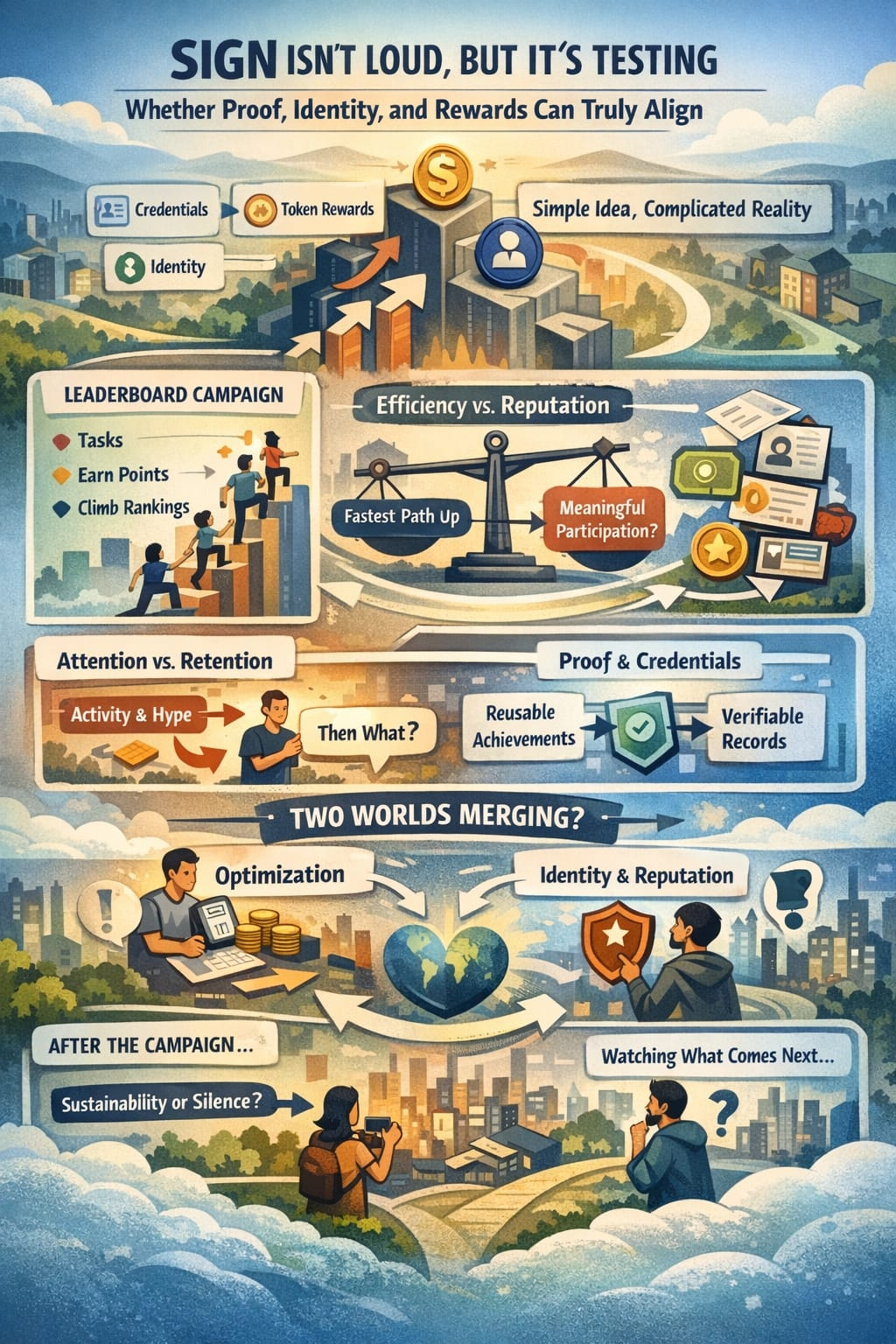
The more time I spent with it, the more it felt like SIGN isn’t trying to reinvent anything outright.
It’s taking pieces that already exist in crypto — credentials, identity, token distribution — and trying to connect them in a way that actually works in practice.
And that’s usually where things get hard.
The core idea sounds simple when you say it out loud.
Instead of every app or campaign deciding eligibility in its own messy way, SIGN tries to structure it.
Proof becomes something reusable. Something that doesn’t disappear after one interaction.
If you’ve done something, contributed somewhere, or qualified for something — that information can exist as a verifiable record instead of just a temporary checkbox.
Clean idea.
Complicated reality.
Because we’ve already seen both sides of this before.
Token distribution almost always turns into people optimizing for rewards.
Credential systems almost always struggle because normal users don’t really care about them.
SIGN is trying to merge those two worlds.
And that’s where it gets interesting.
The current leaderboard campaign makes that tension very visible.
On the surface, it looks familiar — complete tasks, earn points, climb rankings, get rewarded.
Same loop. Same behavior.
People show up, figure out the fastest path upward, and do exactly what’s required. Nothing more.
But SIGN is trying to layer something else on top of that.
It’s not just about actions — it’s about tying those actions to identity, to some form of reputation.
In theory, that should make participation more meaningful.
In practice… I’m not sure how much it actually changes behavior.
Because most people don’t think in terms of “reputation systems” when they’re interacting with crypto products.
They think in terms of efficiency.
What’s the easiest path?
What’s the minimum effort?
That’s always the real test.
If participation is too easy, it gets farmed.
If it’s too strict, people lose interest and move on.
Finding the balance sounds simple.
It almost never is.
And then there’s the bigger question that always lingers in the background — what happens after all of this ends?
Campaigns are good at creating attention.
They bring energy, activity, noise.
But attention isn’t the same as retention.
Once incentives slow down, things usually get quiet.
That’s when you find out what actually matters.
For SIGN, that moment will probably say more than anything happening right now.
Because the real idea here isn’t the leaderboard.
It’s whether this system becomes something other projects actually use.
Whether developers build around it.
Whether these credentials and proofs become something that exists beyond a single reward cycle.
I’ve seen strong ideas fade simply because they never left their own ecosystem.
At the same time, I can’t ignore the pattern.
Identity.
Reputation.
Proof of participation.
These ideas don’t disappear. They just keep coming back — slowly evolving, never quite exploding, but never fading either.
SIGN feels like part of that quiet trend.
Not loud.
Not trying too hard to be revolutionary.
Just… building around something that could matter, if it actually sticks.
Right now, I’m not leaning strongly in any direction.
I’m just watching.
Watching how people interact with it.
Watching how the system handles real behavior.
Watching if developers show up.
Watching what happens when rewards stop
doing all the work.
#SignDigitalSovereignInfra @SignOfficial $SIGN