
I learned this lesson watching a DeFi protocol in 2021 that dropped 70 percent over three weeks, then stabilized for a few days with declining volume before collapsing another 50 percent. At the time, I thought the stabilization meant the selling had exhausted and a base was forming. What I missed was that declining volume during stabilization often means participants are losing interest entirely rather than building conviction, and when interest dies, liquidity disappears, and the next move lower happens on even thinner participation. That memory is why ROBO's setup today concerns me more than yesterday's panic selling.
As of March 19, ROBO is trading at 0.02534 USDT, down 4.23 percent in the last 24 hours, moving in a range between 0.02522 and 0.02790. The price action looks calmer than the past few days. What does not look calm is how quiet the market has become. ROBO printed 704.65 million tokens traded in 24 hours, translating to roughly 18.75 million USDT. That is down from yesterday's 1.22 billion tokens and significantly lower than the surge we saw during the collapse. When volume drops by nearly half while price stabilizes, it usually means participants who wanted to exit already exited, but participants who might accumulate have not shown up yet. The market is stuck in no-man's land, waiting for something to tip it in one direction or the other, and right now there is no catalyst visible.
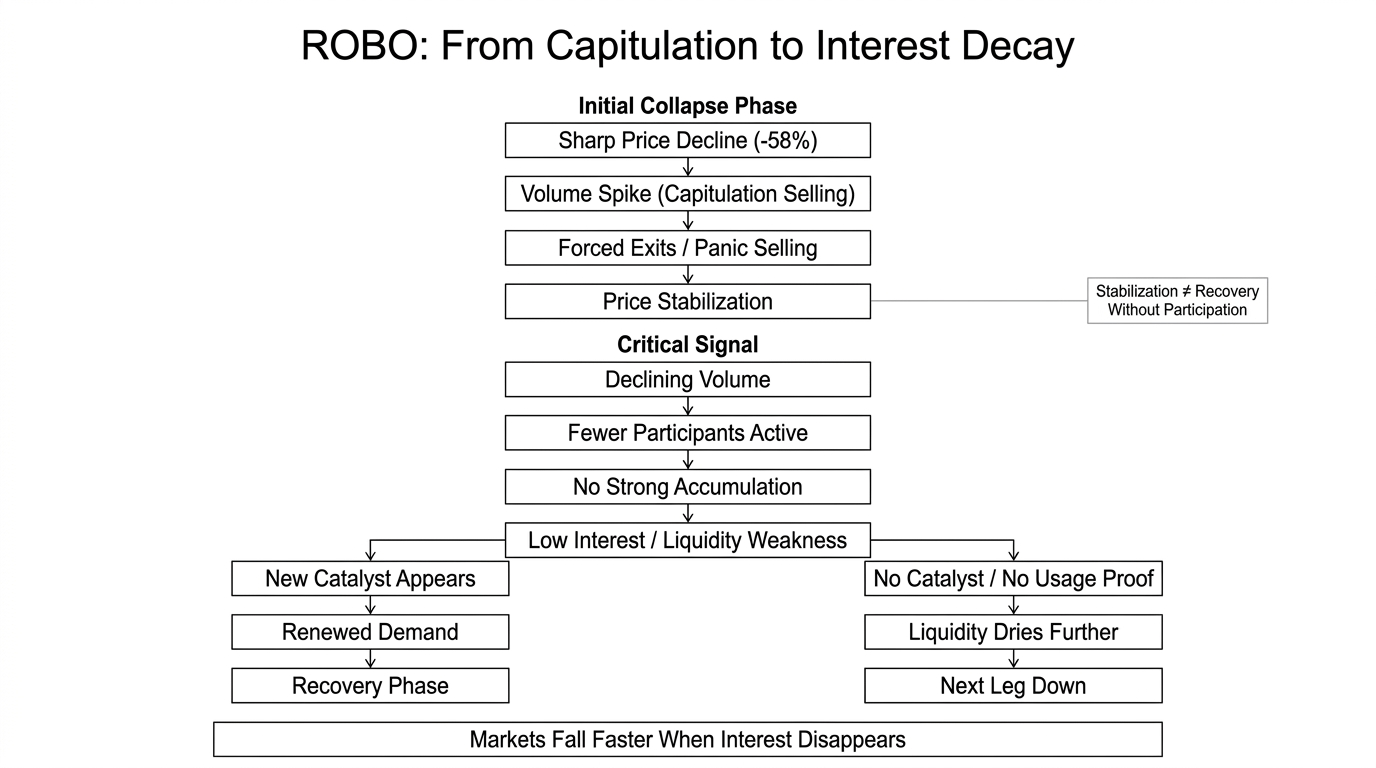
The technical picture is still deeply oversold but not recovering. The RSI at 25.16562 remains near oversold levels, which typically precedes bounces, but bounces during capitulation often fail unless something fundamental changes. The MACD is negative at minus 0.00016, still trending lower, which suggests momentum has not shifted even though selling pressure has decreased. The EMA 20 at 0.02979 is now acting as resistance, and ROBO would need to reclaim that level convincingly before the technical setup improves. Right now, the token is trading 58 percent below its all time high of 0.06071 from March 2, stuck in a range with declining interest, and the chart is not giving any signals that recovery is imminent.
Here is what I keep circling back to. Fabric Foundation is building coordination infrastructure for cross-organizational robot deployment. The whitepaper describes a world where autonomous robots from different operators work together across company boundaries, settling payments through ROBO, enforcing accountability through validator economics, and coordinating through public ledgers. That model makes sense architecturally. The problem is that cross-organizational robot coordination is still rare enough that building infrastructure for it might be premature. Most robot deployments today are single-operator systems where coordination happens internally. A warehouse running its own fleet does not need Fabric Protocol. A hospital deploying rehabilitation robots within its own facilities does not need operator bonds or challenge-based verification. The coordination problem Fabric Foundation is solving only becomes urgent when robots operate across multiple organizations with different incentives, and that deployment model is not common yet.
I think this is the core issue. Fabric Foundation built infrastructure for a market structure that will eventually exist but does not exist at meaningful scale today. That timing mismatch is what kills most infrastructure projects. You can be right about the future and still fail if you are too early, because markets do not reward being early. They reward being right at the right time. The robot economy that Fabric Foundation describes, where machines coordinate autonomously across organizational boundaries, is probably coming. But it might be coming in 2027 or 2028, not 2026. If that is true, then ROBO launched into a market that is not ready for it yet, and the token will trade at infrastructure-without-usage valuations until the market catches up to the vision, which could take years.
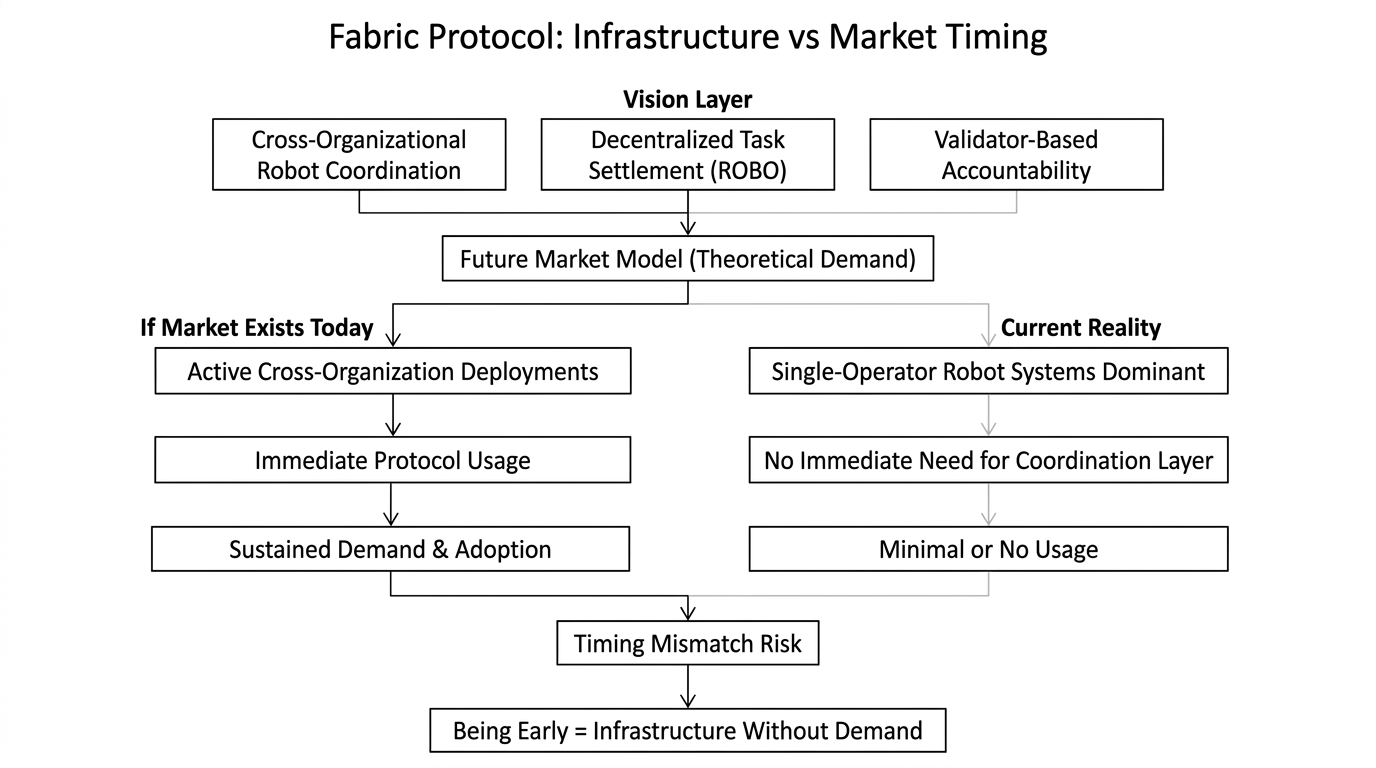
The silence from Fabric Foundation during this collapse reinforces my concern that they are building for a future market rather than solving a present problem. If cross-organizational robot coordination was happening now at scale, and if Fabric Protocol was capturing meaningful share of that coordination, the team would publish metrics showing robot registrations, task settlements, validator participation, and x402 USDC transaction volume. The fact that they have stayed silent throughout a 58 percent collapse suggests those metrics either do not exist yet or are too weak to support the current valuation. Either explanation means the market is correct to reprice ROBO lower until proof arrives.
The other problem is competitive positioning. Even if cross-organizational robot coordination becomes common in the future, why would operators choose Fabric Protocol over alternatives that might emerge from larger, better-funded players? Tesla is building Optimus with full vertical integration. Boston Dynamics has deep enterprise relationships. Figure AI has backing from major tech companies. If any of those players decide coordination infrastructure is important, they can build it as part of their robotics offering, and they start with distribution, trust, and capital that Fabric Foundation does not have. The open-source, decentralized model Fabric Protocol represents is philosophically appealing, but philosophical appeal does not always win markets. Sometimes centralized solutions with worse economics but better execution capture the market because they ship faster and integrate easier.
What would change my mind is if Fabric Foundation publishes operational data showing that cross-organizational robot coordination is happening now, not in some hypothetical future. Robot operators from different companies using Fabric Protocol to coordinate tasks. Validators actively checking claims and earning fees. Sub-economies forming around different use cases and testing different economic models. X402 processing real USDC payments for autonomous robot services. If that data exists and shows growth, then the infrastructure thesis validates and this collapse was capitulation before recovery. But if the silence continues, if the team stays focused on building for the future while ignoring present price action, or if they eventually publish metrics showing minimal usage, then ROBO is probably heading lower until it finds a valuation that reflects infrastructure built for a market that does not exist yet.
The allocation structure makes this timing problem worse. Fabric allocated 78 percent of ROBO supply to vesting schedules, with unlocks starting in late 2026. If the cross-organizational robot coordination market does not materialize before those unlocks start adding supply, the token will face structural pressure from vesting while demand remains theoretical. Right now, the 22 percent circulating supply includes early buyers, airdrop recipients, and public sale participants with no lockup. If those participants have mostly exited already, which declining volume suggests, then the remaining holders are either true believers with long time horizons or people stuck because liquidity dried up. Neither group creates the kind of market activity that attracts new participants.
For now, I am watching ROBO as a case study in infrastructure timing risk. The project might be solving the right problem, but they might be solving it three years too early. The token stabilized today after a brutal collapse, but declining volume during stabilization tells me interest is dying rather than conviction building. Markets do not wait for infrastructure to prove itself. They reprice based on expectations, and right now expectations are that Fabric Foundation built for a future that has not arrived yet. Track whether the team publishes data showing present-day usage rather than future-focused vision. Track whether the cross-organizational robot coordination market starts to materialize faster than expected. And track whether ROBO can hold current levels or whether the next leg down starts once participants realize the market Fabric Foundation is targeting might not exist at scale for years. Being early is the same as being wrong when you run out of time to prove it.
#ROBO $ROBO @Fabric Foundation
