


The more I stare at Midnight's NIGHT and DUST setup, the less I see it as a clever fix for fee volatility.
I see it as a design that quietly recentralizes power under the banner of sustainability.
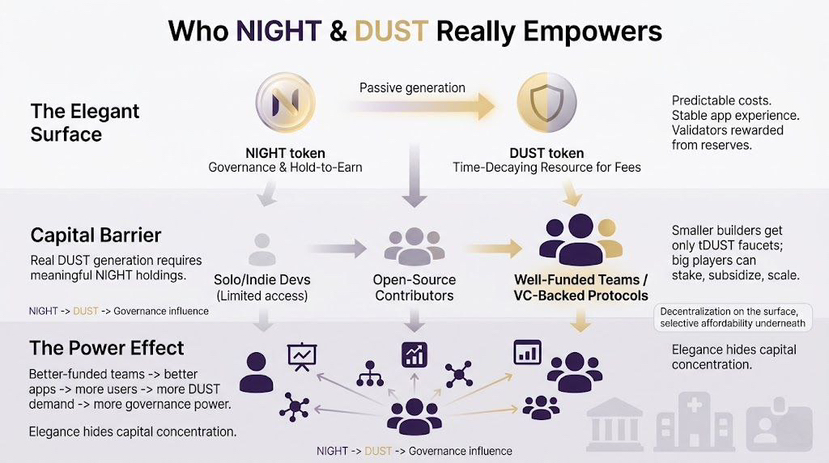
On the surface, it's brilliant. NIGHT as the transparent, hold-to-earn governance token. DUST as the shielded, time-decaying resource that regenerates passively from your NIGHT balance — no need to buy fees at market peaks, no constant burning, predictable costs for apps. Developers get stability. Users get smoother interactions. Validators get rewarded from reserves instead of squeezing users. In a sea of inflationary messes and gas wars, this looks like maturity.
But here's where my skepticism hardens.
The cost doesn't vanish — it migrates. And it migrates upstream to whoever can afford to hold meaningful NIGHT in the first place.
Small builders experimenting on devnet? Fine, tDUST faucets cover you. But the moment you want real apps, real volume, real shielded logic that matters — you need real DUST generation. Which means real NIGHT exposure. Not tiny bags for speculation. Actual locked capital that regenerates enough to subsidize execution without users noticing fees.
Who absorbs that? Not the indie dev scraping by. Not the open-source contributor testing ideas. Usually the well-funded team, the VC-backed protocol, the enterprise pilot with deep pockets. They can stake or hold large NIGHT positions, generate DUST passively, delegate or subsidize user flows, and build at scale. The solo builder staring at the same elegant model sees something else: another capital barrier before their app can even breathe.
That's not a bug. It's baked in.
And it compounds. Better-funded teams build better apps because they can afford the "battery" that powers private execution. Better apps draw users and liquidity. More users mean more DUST demand indirectly tied to NIGHT holdings. Larger holders gain more influence over governance tweaks — emission curves, delegation rules, reserve management — that shape how expensive (or exclusive) the system feels downstream.
Suddenly the "sustainable fees" narrative starts looking less like user empowerment and more like a filter that quietly favors capital concentration. Decentralization on the surface. Selective affordability underneath.
I keep thinking about regulated sectors Midnight eyes — finance, healthcare, identity. Those worlds already tilt toward big players who can afford compliance teams, audits, and capital reserves. If Midnight's model quietly amplifies that tilt by making meaningful participation capital-gated, does it really disrupt anything? Or does it just wrap the same power structures in zero-knowledge proofs?
The tech is serious. The intent feels genuine. But elegance in token design doesn't guarantee equity in who gets to use it. Sometimes it just hides the gatekeepers behind a cleaner UX.
That's the friction I can't shake. A model built to last might still end up reinforcing who already has the means to last.
What hits harder for you — does the NIGHT/DUST split feel like true infrastructure for privacy apps, or another elegant way to make sure the big stay big? Drop your take.
#night @MidnightNetwork $NIGHT
#BinanceSquareFamily #BinanceSquare #Market_Update #TrendingTopic $COS