

I'll be upfront. New crypto projects rarely trigger any real reaction from me these days. Not satisfaction, not curiosity. Just a kind of neutral pause. It's not because development has slowed down. In fact, it almost seems like too much. New tokens are popping up all the time, new systems get unveiled regularly, and each storyline attempts to assert itself as the main factor determining the future. Machine learning gets framed that way. Modular systems too. Real-world assets, privacy same pattern.
Everything is treated like a certainty until time proves otherwise. After going through multiple cycles, you start to recognize the rhythm. The messaging feels familiar, the urgency repeats, and even the ideas begin to blur together under new branding. Influencers rotate their focus almost predictably, timelines fill with confidence, and for a brief moment it all feels convincing again.
Then it fades out. Not because the ideas were entirely wrong, but because most of them never truly aligned with how people behave in practice. That's the mindset I have when looking at Midnight Network. Not excitement. Not rejection either. Just hesitation.
Because the core premise? It actually makes sense. More than a lot of what’s circulating right now. Blockchains were originally built around transparency, and at first that felt like a breakthrough. Everything open, everything verifiable, nothing hidden. It positioned itself as the opposite of traditional systems, which is exactly why people bought into it.
But over time, that same transparency starts to feel different. When every transaction you've made can be traced indefinitely. When wallets stop feeling anonymous and start resembling identities. When behavioral patterns are analyzed. When permissionless starts to feel more like constant visibility.
That’s not really freedom. It's exposure in a different form. And realistically, most people won't build serious financial activity on top of something that exposes them like that.
So privacy isn't optional. It's something missing. Midnight approaches that gap through a zero-knowledge model, where verification doesn’t require revealing the underlying data. And out of all the technical directions in crypto, this is one of the few that still feels grounded.
Not in a hype-driven way. In a functional sense. The idea itself is pretty simple if you look at the high-level view. However, the consequences of this idea might be more profound. Being able to confirm transactions, identities, or adherence to rules without revealing the actual data could be the factor that changes blockchains from just a speculative thing to a practical one.
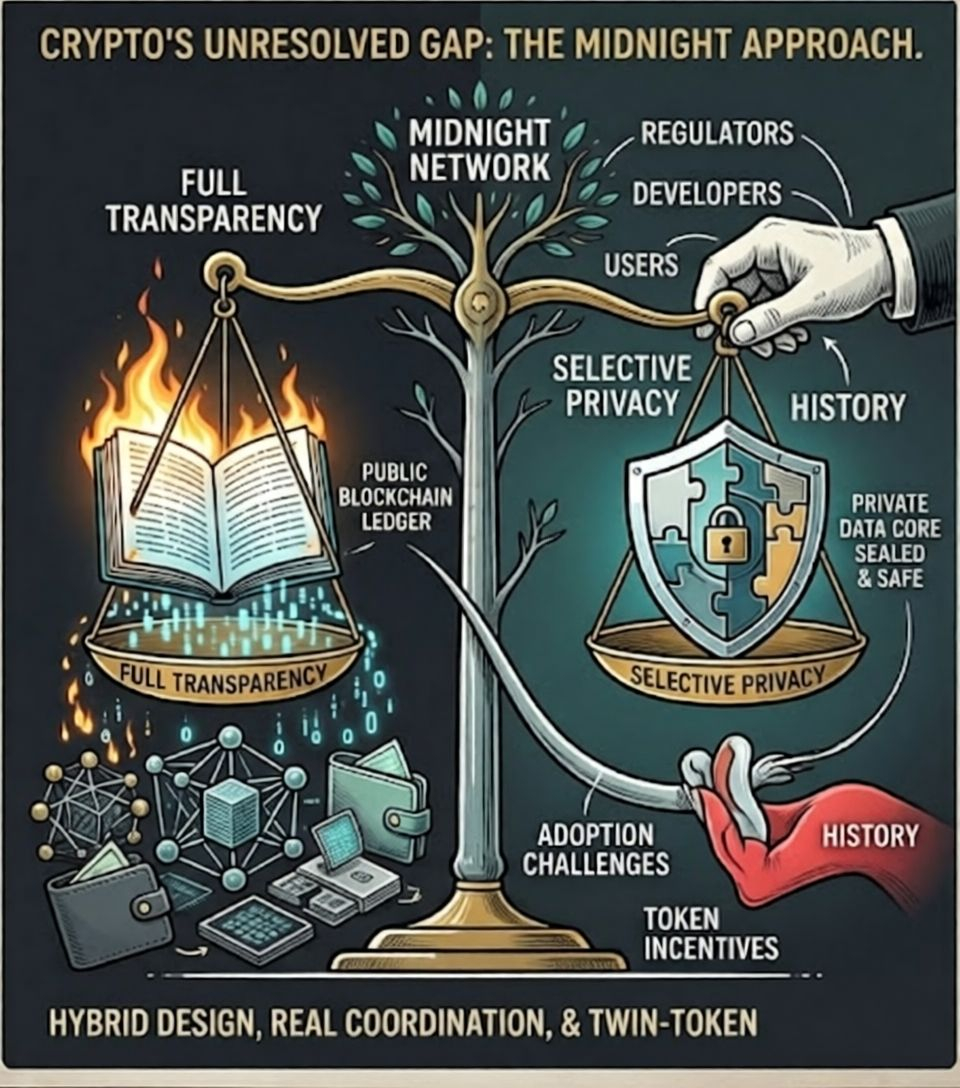
But this is also where doubt starts to come in. Because the space has seen important ideas before. Plenty of them.
Ideas that were structurally sound but never translated into real adoption. Sometimes they were too complex, sometimes too early, and sometimes they simply didn’t match how people actually use technology.
Midnight positions itself somewhere in between not complete anonymity, not full transparency. Selective privacy. Controlled disclosure. And to be fair, that direction makes sense. But that middle ground is usually where things get complicated.
Because now it's not just a technical problem. It turns into a real coordination challenge. On the one hand, Controllers are very cautious when it comes to privacy, on the other hand, users don't really understand it, and developers still need to create applications that people actually want to use.
Keeping everything so well combined is not an easy task at all. And crypto hasn’t handled fragile balance points very well historically.
Then there's the structure around it the tokens, the mechanics, how value flows through the system. When I see Twin-token designs, I instinctively slow down. Not because they're flawed by default, but because they often rely on everything else working smoothly.
And that rarely happens. What usually emerges are systems that look clean on paper but feel awkward in real usage. Users get confused, liquidity spreads thin, and incentives don't behave the way they were expected to.
Maybe Midnight avoids those issues. Maybe it does not. At present, it is still unknown. The question that keeps coming up in my mind is simple: who is the real owner of this? Infrastructure in crypto has a strange limitation. It's necessary, but invisible.
People don't wake up thinking about zero-knowledge systems. They just want tools that work fast, simple, and intuitive. So for Midnight to matter, it can't just exist as infrastructure. It has to integrate into applications that people actually interact with.
And that's usually the harder challenge. That's where most projects slow down. There's also the broader context it’s emerging from. There’s history behind it, ecosystems that have promised a lot but delivered more slowly than expected. That doesn’t guarantee failure, but it does shape perception.
Because timing matters more than people like to admit in crypto. You can be directionally correct and still miss the moment missed entirely. at the same time, it really doesn't feel right to dismiss it totally.
After all, if you strip everything back the core concern that Midnight is working on doesn't go away If anything, it becomes more obvious the longer you stay in the space. It’s not exciting in a hype sense. It’s more persistent than that.
Like an unresolved gap. And if crypto is ever going to move beyond repeating cycles of speculation, this is the kind of problem it eventually has to address. But eventually is always uncertain here.
Because understanding a solution and actually delivering something usable are two very different things. And that gap is where most projects end up fading.
So where does that leave Midnight? Somewhere in between. Not driven by hype, not proven either.
Not something to ignore, but not something to fully trust yet. It seems like a type of infrastructure that might become very significant if it succeeds, and on the other hand, might come to a complete and quiet end if it fails.
Perhaps that is the most realistic approach to the matter. No definite finality. No imposing persuasion. Only a balanced viewpoint derived from experience and a recognition of how frequently this area over-promises and under-delivers.
It might become quite significant or just cease to exist without any fuss - these are still open questions.
At the moment, I have a passive stance towards it without making any hurry to determine its fate.