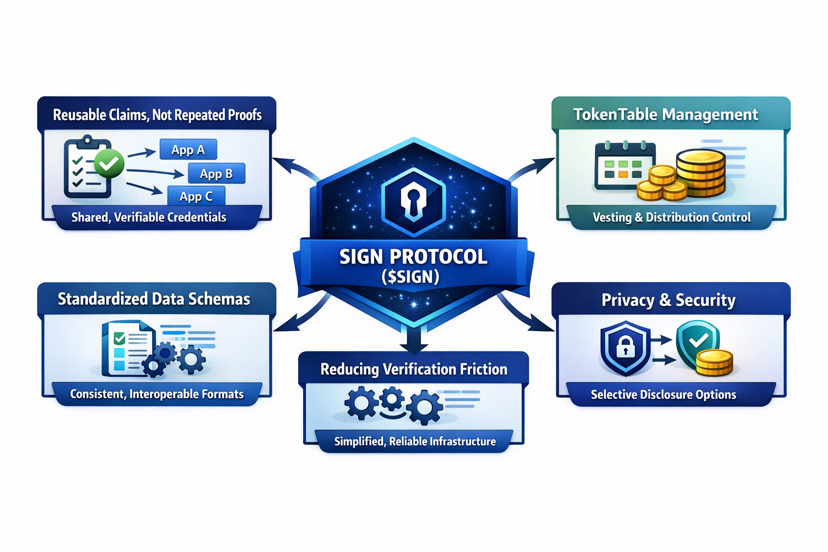
I didn’t get interested in Sign because it’s “another identity thing.” I actually like that it isn’t trying to be a loud identity layer. What grabbed me is the boring pain I’ve seen across Web3 for years: every app rebuilds the same verification flow from scratch — new allowlists, new KYC checks, new “prove you’re eligible” steps, new spreadsheets, new bugs, new support drama. And the user experience? You feel it as friction, but you don’t even realize how much time you’re wasting until you’ve repeated the same proof five different ways.
The shift that matters: claims you can reuse, not proofs you keep repeating
The way I understand Sign is simple: it turns “facts” into structured claims that can travel. If a wallet is verified, if someone passed compliance, if a contributor did real work, if a user is eligible for something — that shouldn’t live in random Discord roles, private databases, or one-off APIs. Sign makes those facts readable and verifiable in a clean format so other apps can reference them instead of re-checking everything again. That’s the difference between “checking once” and “stopping the industry from rechecking forever.”
Schemas sound boring… until you’ve shipped a product
This part is underrated: Sign leans hard into schemas (structure). To most people, that sounds like paperwork. To builders, it’s sanity. When data follows a defined structure, apps can actually interoperate without custom glue code every time. And when the structure stays consistent, the verification layer stops being a constant source of edge-case failures.
TokenTable is the other half people ignore
I also think TokenTable is more important than it looks. Everyone treats allocation/vesting/claims like “just ops,” until they’ve run a big distribution and watched it turn into chaos: wrong amounts, unlock schedules misread, manual reconciliation, “why didn’t I receive?” tickets, messy eligibility lists. TokenTable basically says: stop doing this with spreadsheets and vibes. Make it rules-driven, auditable, and tied to proven eligibility instead of “trust me bro lists.”
Privacy can’t be optional, and Sign seems to know that
What I like is they don’t pretend we want an internet where everything is public forever. Verification needs privacy options — selective disclosure, private or hybrid attestations, and the ability to prove something without exposing sensitive details. If this layer ever becomes widely used, privacy isn’t a feature… it’s survival.
My honest take
I see Sign as infrastructure. Not exciting in the “pump” way — exciting in the “this removes an entire category of repeated work” way. The only real question I’m watching is adoption: will enough apps agree on standards so reusable claims actually become reusable everywhere? If the ecosystem plugs into it, this becomes one of those invisible layers that quietly improves everything. If not, it’s still useful — just more isolated than it deserves to be.