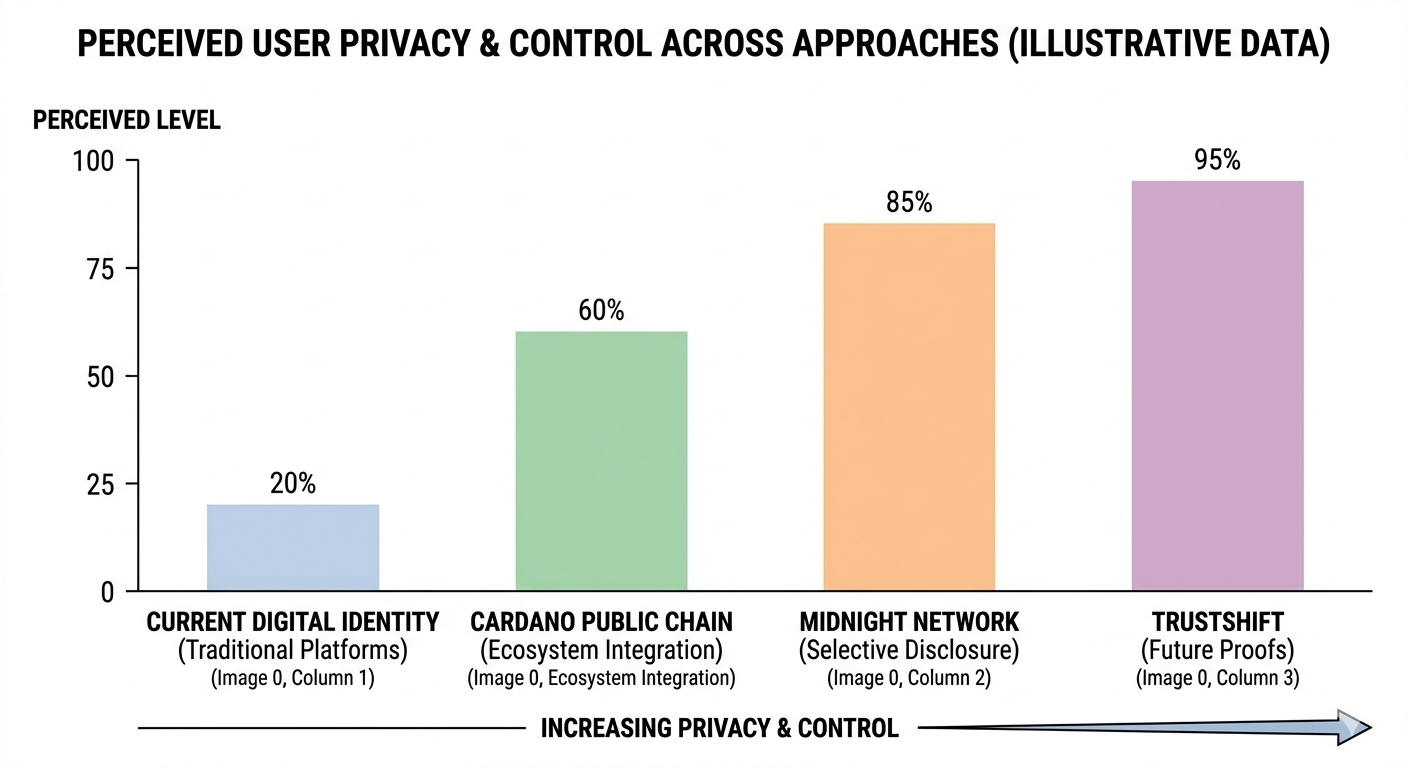
I’ve been spending the past few days diving into @MidnightNetwork documentation, and I have to admit it made me pause. Not because the project is flashy or revolutionary in the usual crypto sense, but because it touches on a problem that’s been haunting the internet for decades: digital identity.
We talk a lot about transparency in blockchain, but in practice, almost no one really controls their own information online. Every app, every login, every transaction leaves a footprint. Most of us have learned to accept this as the price of convenience, but as I read through Midnight’s design, I realized it’s trying to challenge that assumption in a very subtle way.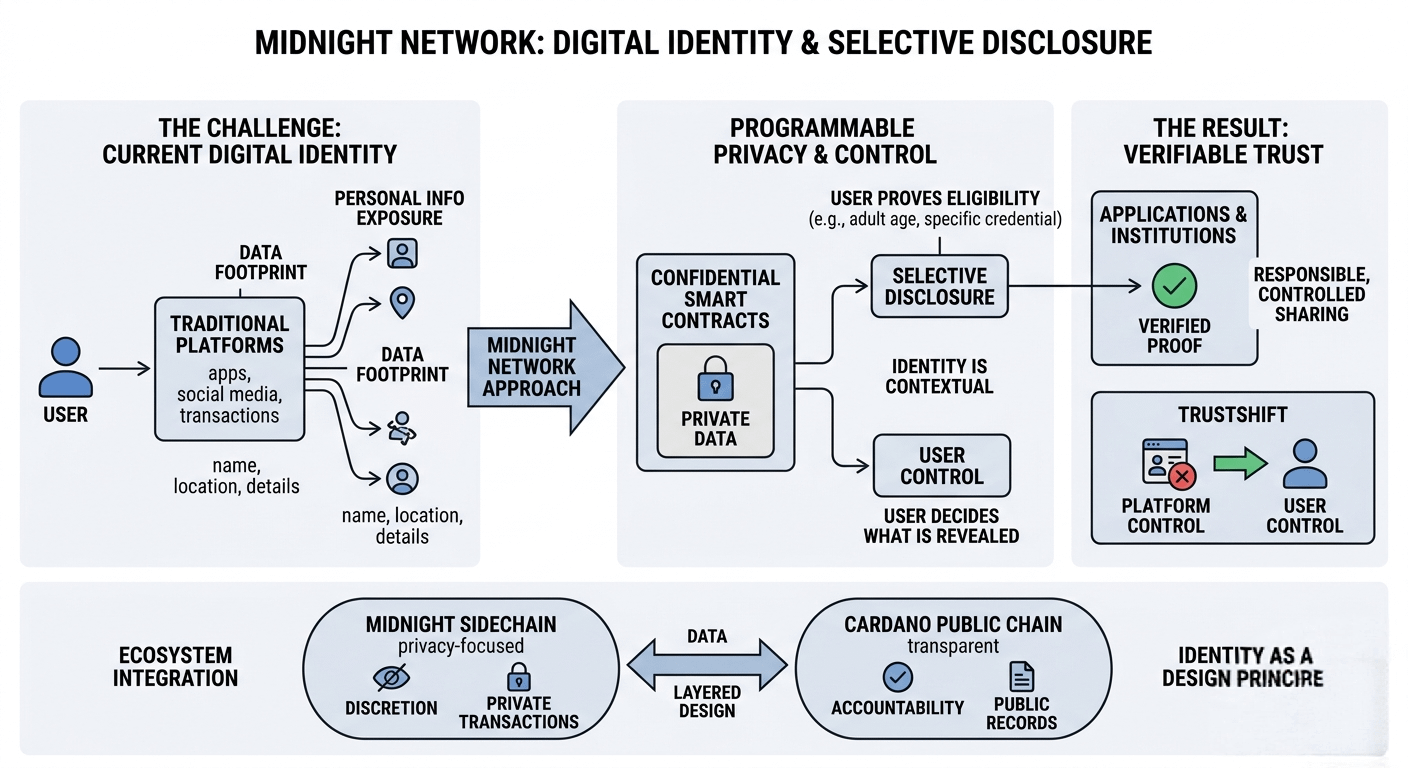
What caught my attention while reading the documentation was how Midnight combines confidential smart contracts with selective disclosure. Instead of forcing all data to be visible on-chain, it allows users to prove something about themselves without exposing the underlying information. For example, you could demonstrate eligibility or compliance without revealing every detail of your identity.
That might sound technical, but to me, it feels more human. It acknowledges something that most online systems ignore: identity is contextual. We don’t share everything about ourselves in every interaction in the real world why should it be any different online?
In my view, that’s what makes Midnight’s approach different. Digital identity here isn’t just a set of credentials on a ledger. It’s a tool for verifiable trust, where control sits with the user rather than the platform. And yet, there’s a tension. Programmable privacy is powerful, but it’s also fragile. Every contract defines what is revealed and what is hidden. Two developers working on the same platform could end up creating very different privacy outcomes. So even if the system is capable, it doesn’t guarantee consistency human judgment still matters.
Another aspect that stood out to me is how Midnight fits into the larger Cardano ecosystem. It’s not a standalone experiment. It’s designed as a privacy focused sidechain that can interact with public layers when transparency is required. That layered design shows a clear understanding that privacy and accountability aren’t opposites they’re two sides of the same coin. One allows for discretion, the other for trust.
Thinking about this, I started reflecting on incentives. Midnight subtly shifts the balance of power over data. Users retain ownership over their information, while institutions can still participate in verifiable, compliant systems. Applications built this way might reshape trust: not by forcing disclosure, but by enabling responsible, controlled sharing. And that, to me, feels like a step toward a more thoughtful internet, where privacy is treated as a design principle rather than an afterthought.
My takeaway so far is that Midnight isn’t just about building privacy tools. It’s experimenting with how we structure digital identity itself in a world where data is fluid and visibility is permanent. It raises the questions we often skip over: How much control should a user have? How do we balance verification and discretion? And can a network truly support both without relying on centralized intermediaries?
Curious how others are interpreting this approach to identity and privacy within the Midnight ecosystem.
Am I the only one seeing this as a small, quiet but important shift in how decentralized systems might handle personal information?