

I’ve been tracking $SIGN since the early days after launch, the kind of quiet obsession where you open DexScreener at odd hours, refresh holder lists, and cross-check unlock calendars against price action. Nothing flashy just me, a few spreadsheets, and the nagging sense that the market is staring at the wrong number. Everyone fixates on the FDV sitting around $470 million while the market cap hovers near $77 million. Classic red flag, right? Except the token isn’t behaving like every other high-dilution alt I’ve followed. The real story is how compressed the effective float has become, and how that compression is quietly setting up leverage most observers are sleeping on.
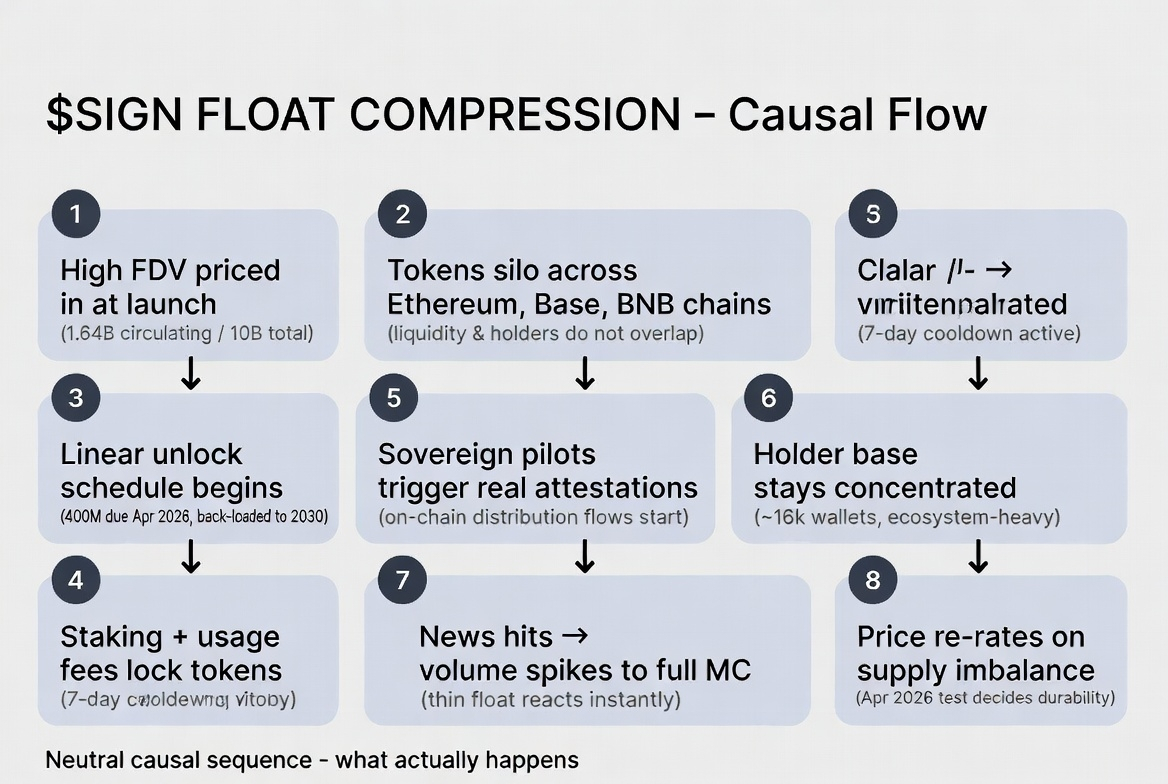
Pull up the numbers yourself and you’ll see what I mean. Circulating supply sits locked at 1.64 billion out of a 10 billion total exactly 16.4 percent unlocked. That next release on April 28, 2026, is roughly 400 million tokens to backers. On the surface it looks like a wall of supply, but the schedule is linear and drags all the way into 2030. No cliffs, no sudden floods. I’ve watched similar setups before; when dilution arrives in measured drips instead of dumps, the market often reprices upward long before the bulk ever trades. Add the multi-chain reality Ethereum with its sleepy 600-odd holders and low transfer count, Base carrying the real liquidity, BNB doing its own thing and you realize the tokens aren’t mingling in one big pool. They’re siloed in ecosystem wallets that don’t overlap easily. The daily float feels a fraction of the headline circulating figure.
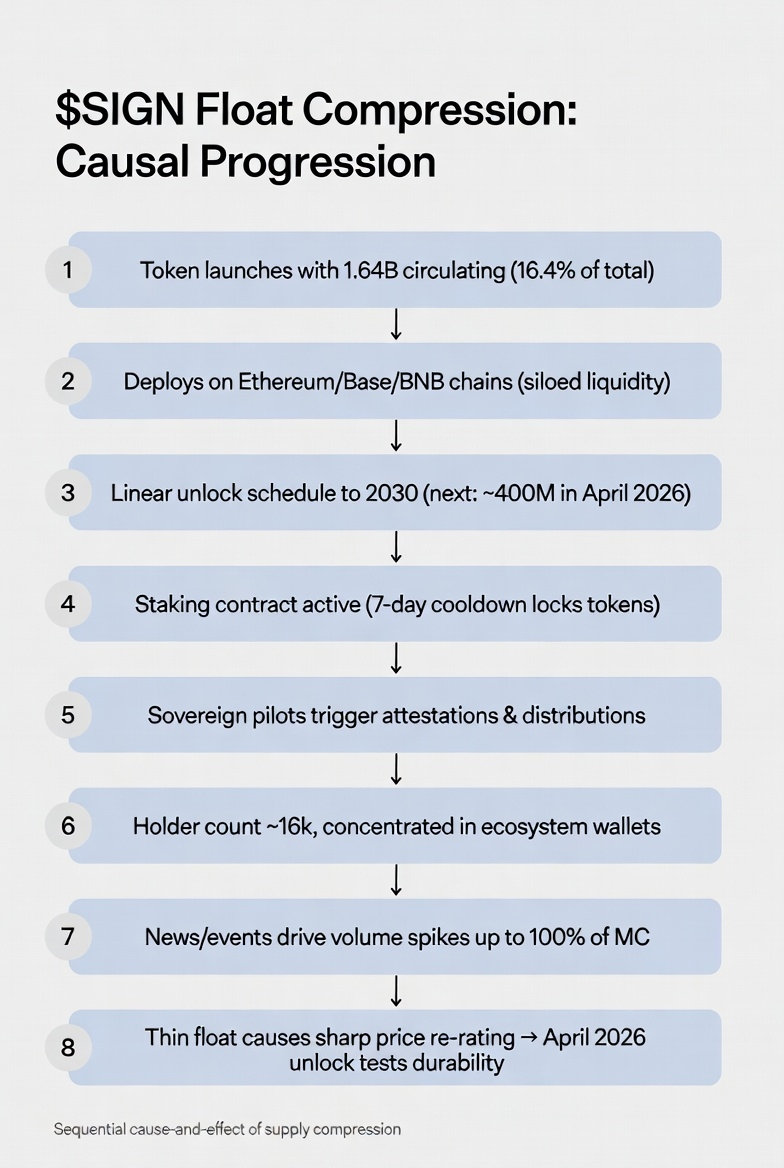
Volume tells the same tale in real time. Quiet stretches hover around a couple million a day, then a catalyst hits and you suddenly see $75 million change hands in 24 hours basically matching the entire market cap. I’ve only seen that kind of swing when supply is genuinely thin on the ground. It happened again just yesterday with the 12 percent price pop. The move wasn’t some meme frenzy; it was demand hitting a structure that had nowhere to run. Meanwhile the holder count across all chains sits at roughly 16,370. Not scattered retail bags everywhere just enough concentrated wallets to keep things reactive. Every incremental inflow punches harder because there isn’t a sea of casual sellers waiting to distribute.
The incentive layer adds another quiet lock. Staking mechanics and usage-based rewards are already pulling circulating tokens out of immediate reach, turning utility flows into longer term sinks before the heavy unlock waves in 2027 and beyond. I keep checking the on-chain flows tied to actual credential attestations and distribution events, and the pattern is consistent: tokens used for fees or grants tend to stick rather than rotate out. That’s the part I keep coming back to in my notes the demand mechanisms from real sovereign and enterprise pilots are starting to align exactly when the supply side is at its most constrained.
Of course I’m not blind to the counter. The most honest bear case is that patient backers and ecosystem wallets have simply been waiting for this April unlock to finally rotate. If they hit the market hard and the price drops 30 percent or more without recovering fast, the whole “compressed float” idea falls apart. We’ve seen it play out elsewhere: linear schedules still unwind when conviction is low.
What would actually convince me I’m right over the next few quarters? Holder count steadily climbing past 25,000 without a collapse, that April release getting absorbed with under 15 percent drawdown and quick recovery, daily volume settling above 30 percent of market cap on average days, and on-chain data showing fee or distribution flows feeding measurable staking growth. The opposite would kill it: volume drying to single digits outside events, holders stalling or dropping, or clear wallet dumps into the unlock that never get re-absorbed.
I’m not here waving pom-poms or predicting moonshots. I’m just the guy who’s been watching the order books and wallet clusters long enough to notice the mismatch. $SIGN’s supply isn’t loose the way the FDV implies. It’s coiled. And in a market that still prices it purely on dilution math, that single structural detail feels like the edge worth sitting with. The data will prove it one way or the other soon enough April’s not that far off.
@SignOfficial #SignDigitalSovereignInfra $SIGN
