
When people talk about digital infrastructure, most focus on speed, apps, or payments. But in reality, strong digital economies need something deeper: trusted identity, verifiable credentials, and fair systems for distributing value. That’s why I think @SignOfficial is working on one of the most important pieces of blockchain infrastructure today.
Sign is building around a simple but powerful idea: trust should be programmable, verifiable, and scalable. Its broader architecture describes infrastructure for identity, money, and capital systems, while Sign Protocol acts as the evidence layer that records and verifies structured claims through attestations. In practical terms, that means credentials, proofs, and records can be issued and checked in a way that is more transparent, portable, and efficient.
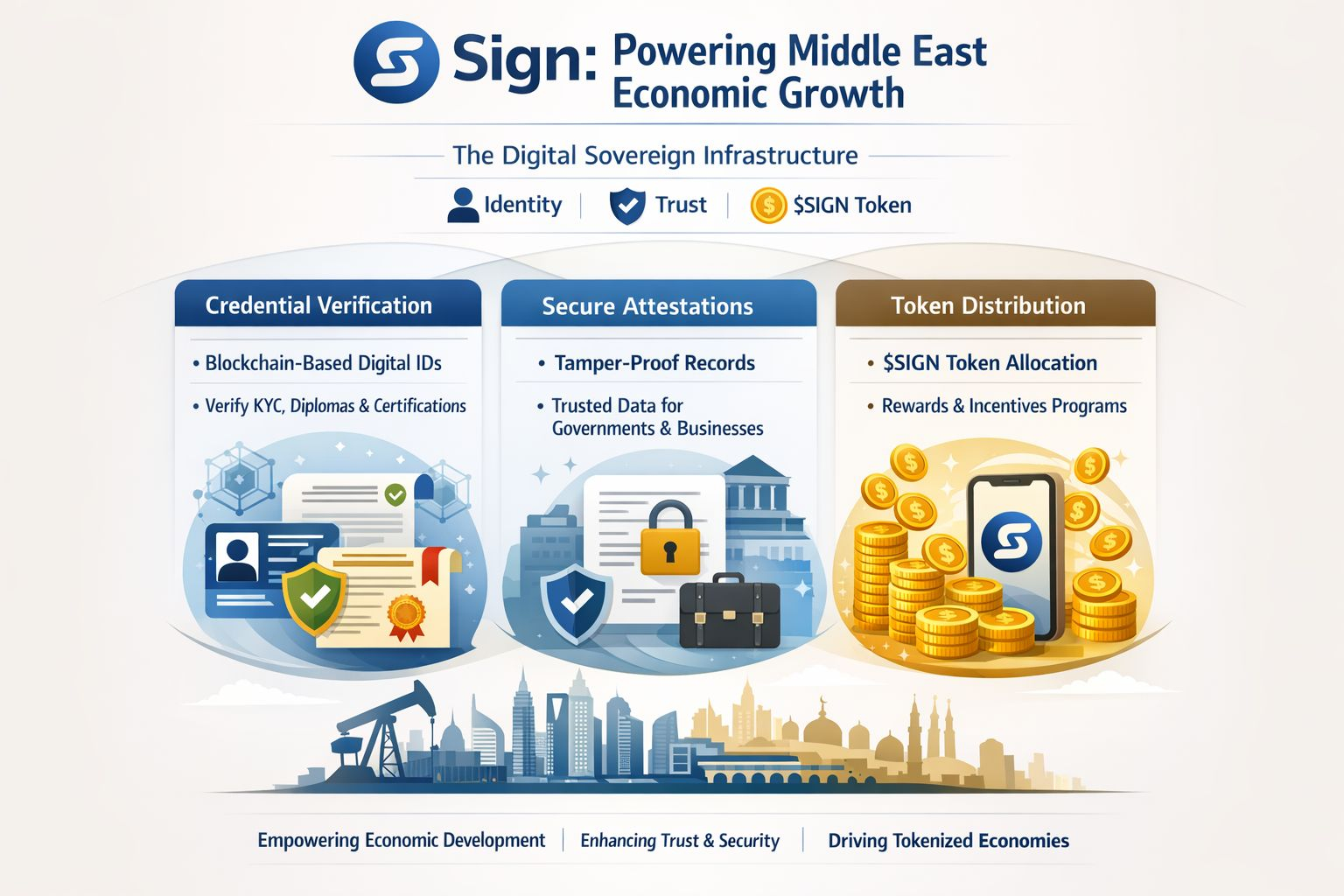
This matters even more for regions like the Middle East, where digital transformation is accelerating across government services, finance, and enterprise systems. Economic growth in that environment does not just depend on launching new platforms. It depends on creating trusted rails for onboarding users, verifying qualifications, managing compliance, and distributing incentives or support programs with accountability. Sign’s documentation explicitly frames S.I.G.N. as sovereign-grade infrastructure for national systems of money, identity, and capital, with use cases tied to verifiable credentials, privacy-preserving verification, and programmatic distribution.
Another reason this stands out to me is that Sign is not only about identity. It also connects verification with allocation. Products in the ecosystem include tools for attestations and token distribution, which makes the model especially relevant for grants, benefits, rewards, ecosystem incentives, and compliant capital programs. The official token page describes $SIGN as powering Sign protocols, applications, and ecosystem initiatives, while the MiCA whitepaper says the token functions as a utility that supports decentralized attestations and digital trust infrastructure.
What makes this compelling is the combination of real utility and long-term relevance. In the next phase of Web3, the winners may not be the loudest projects, but the ones building systems that institutions, developers, and users can actually rely on. Trusted credentials, tamper-resistant records, and transparent distribution are not niche needs. They are foundation-level requirements for digital economies that want to scale responsibly.
That is why I see @SignOfficial as more than just another crypto project. It looks more like infrastructure for digital trust, and that gives $SIGN a role tied to real usage rather than pure speculation. If the future of growth in the Middle East includes sovereign digital systems, better identity rails, and more efficient tokenized coordination, then Sign could become an important part of that story.
@SignOfficial #SignDigitalSovereignInfra $SIGN
