In a world rapidly shifting toward decentralization, one critical problem continues to persist—trust. Blockchain promised a trustless future, yet real-world systems still demand verifiable identity, proof, and structured distribution. This is where Sign Global emerges—not as just another crypto project, but as a foundational layer quietly engineering the backbone of digital credibility.
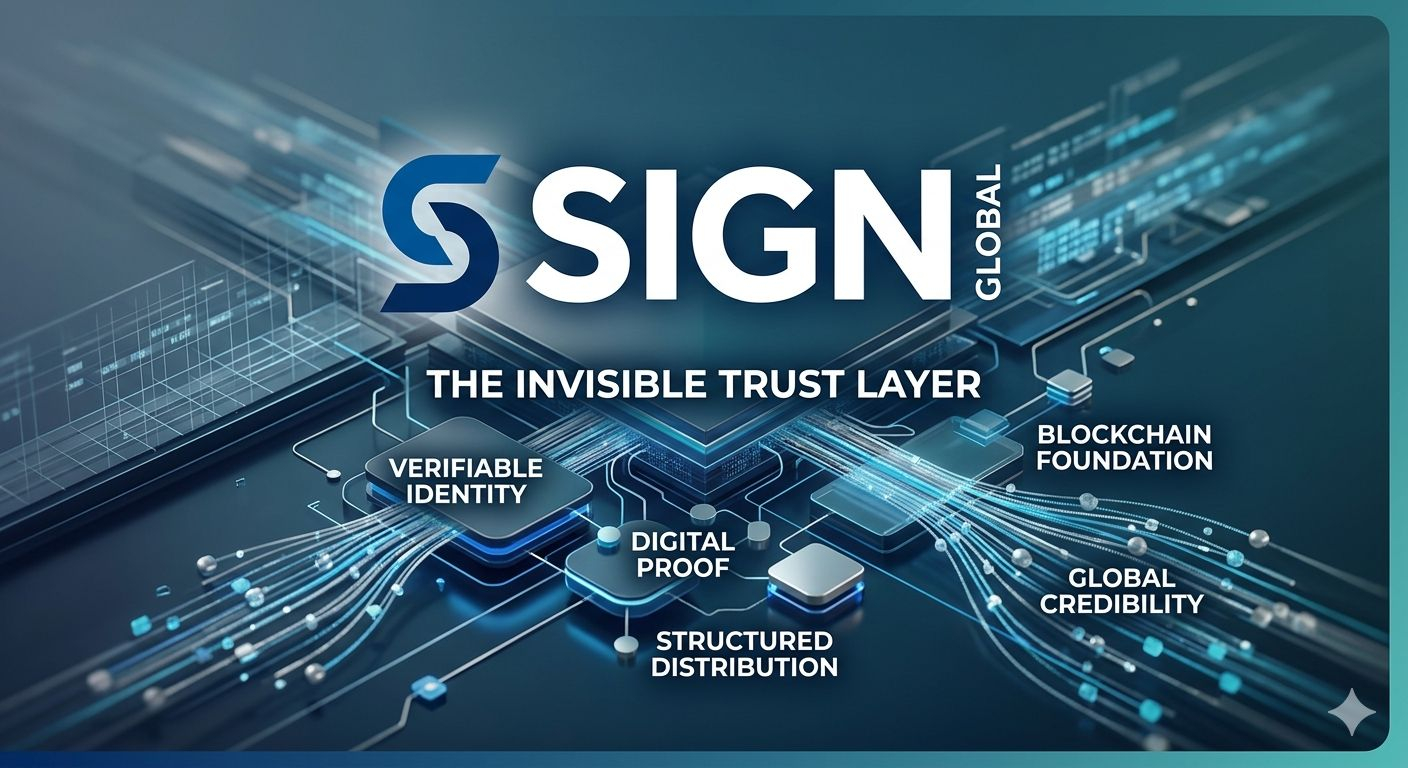
Sign is building something far deeper than a token—it is architecting a global infrastructure where information becomes verifiable, identities become portable, and value distribution becomes transparent at scale. Unlike traditional blockchain platforms that focus primarily on transactions, Sign focuses on proof—proof of identity, ownership, credentials, and agreements—turning blockchain into a universal verification engine.
At the heart of this ecosystem lies the Sign Protocol, an omni-chain attestation framework designed to function across multiple blockchains simultaneously. This protocol allows developers, institutions, and even governments to create tamper-proof records that can be verified instantly anywhere. Whether it's a diploma, a legal contract, or a financial credential, Sign transforms it into a trustable digital asset.
This idea becomes even more powerful when combined with real-world applications. Governments can issue digital identities, companies can validate credentials, and decentralized applications can operate with verified data instead of assumptions. In essence, Sign is not just connecting Web3 systems—it is bridging real-world trust into the blockchain universe.
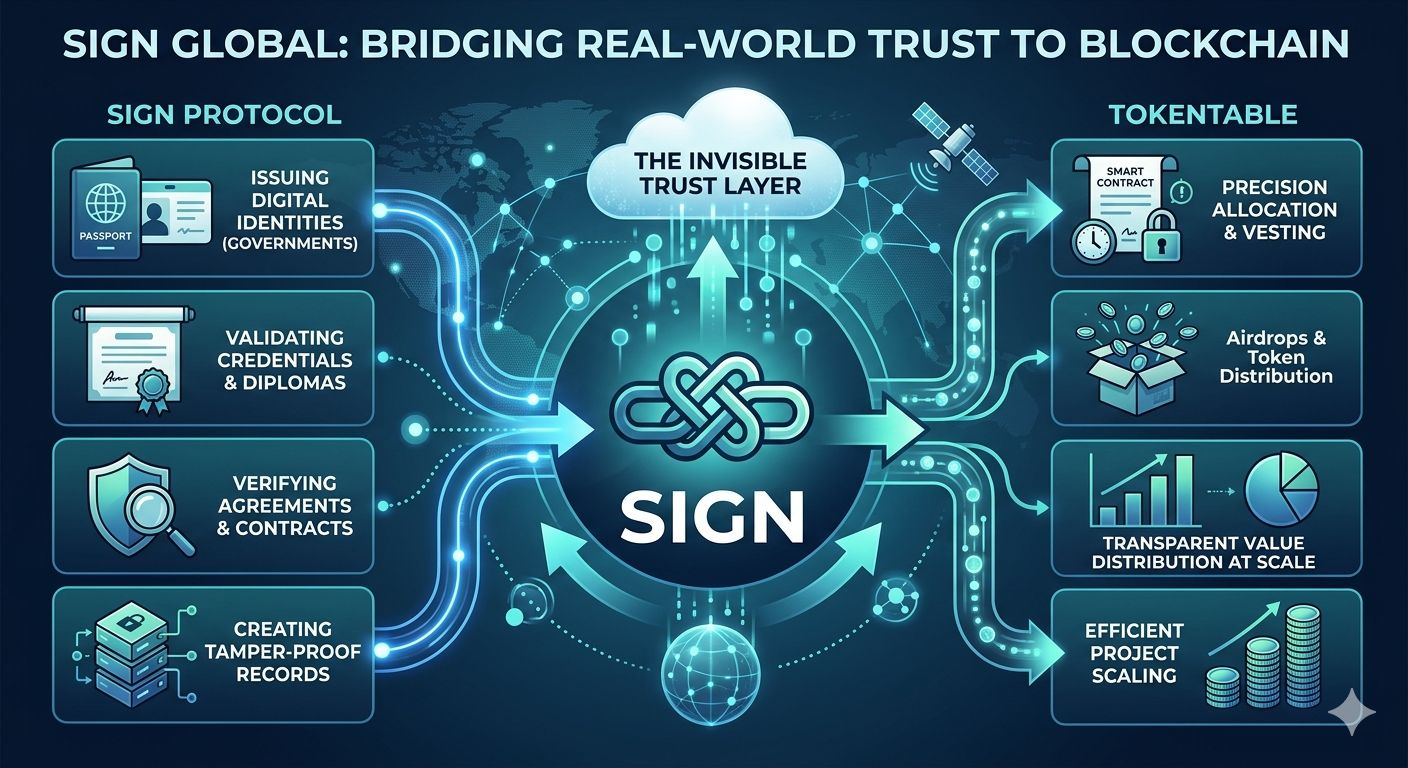
Parallel to verification, Sign introduces another critical innovation: TokenTable. In the current crypto landscape, token distribution is often chaotic, opaque, and inefficient. Sign solves this by providing a smart contract-based infrastructure where token allocation, vesting, and airdrops are executed with precision and transparency.
This dual-engine model—verification through Sign Protocol and distribution through TokenTable—positions Sign as a complete infrastructure layer, not just a single-purpose tool. It enables projects to scale efficiently while maintaining trust, which is one of the biggest barriers to mass adoption.
What makes this ecosystem truly remarkable is its real traction. Sign has already processed millions of attestations and distributed billions of dollars in tokens across tens of millions of wallets. This is not theoretical innovation—it is active infrastructure being used at scale.
But the vision doesn’t stop here.
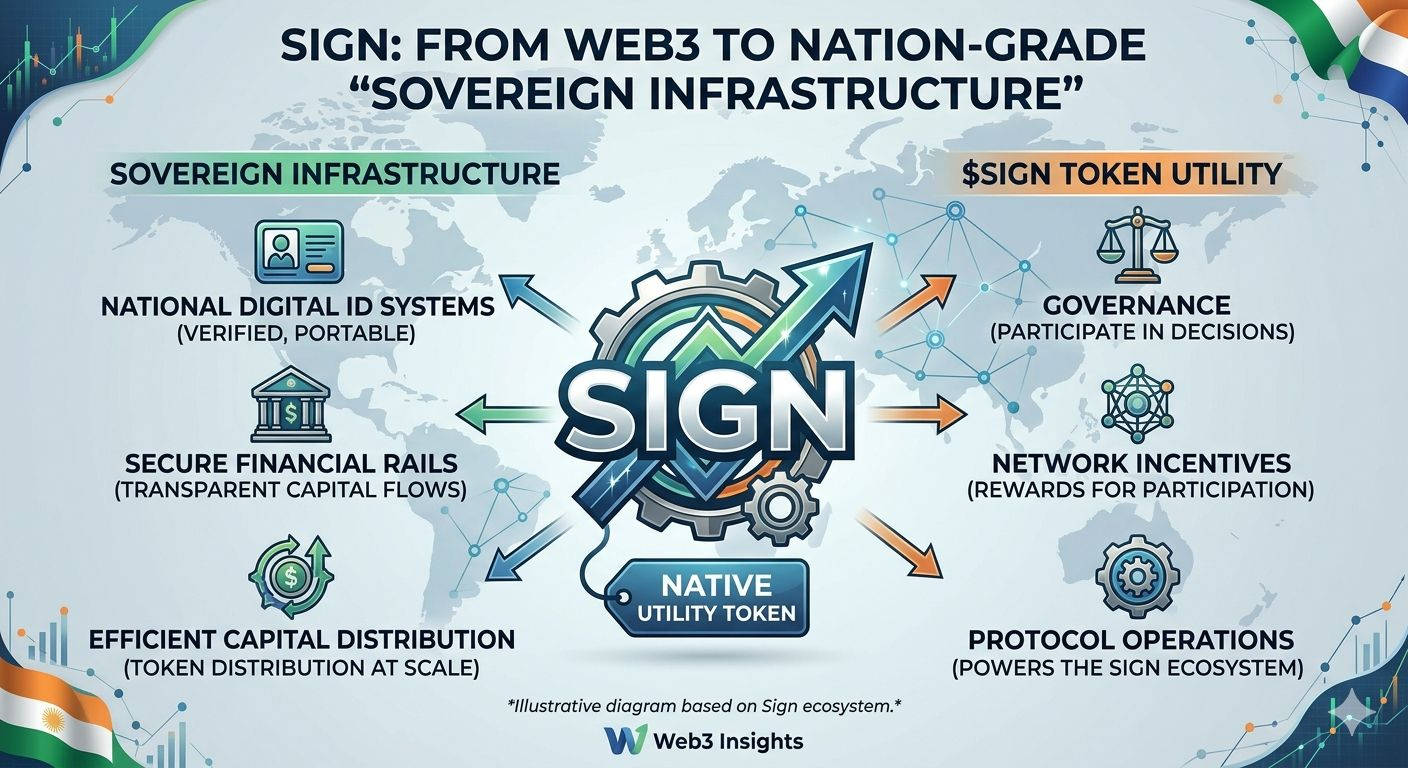
Sign is evolving into what it calls “Sovereign Infrastructure”—a system capable of supporting national-level digital frameworks, including identity systems, financial rails, and capital distribution mechanisms. This signals a shift from Web3 applications to nation-grade blockchain infrastructure, where entire economies could operate on verifiable digital systems powered by Sign.
Sovereign Infrastructure
The native $SIGN token plays a crucial role in this ecosystem. It is not just a speculative asset but a functional component that enables governance, incentivizes participation, and powers the protocol’s operations. By aligning users, developers, and institutions through incentives, the token becomes a driver of network growth and sustainability.
Looking ahead, Sign’s roadmap includes the expansion of its ecosystem into super apps, deeper government integrations, and scaling its infrastructure to reach hundreds of millions of users. If executed successfully, this could position Sign as one of the most important infrastructure layers in the Web3 era.
In a market crowded with hype-driven projects, Sign stands apart by focusing on something fundamental—making information trustworthy. It is not trying to replace systems overnight; instead, it is quietly embedding itself into the core of how digital systems verify, distribute, and operate.
The future of blockchain will not just be about transactions—it will be about trust at scale. And in that future, Sign is not just participating—it is building the foundatio
#signdigitalsovereigninfra @SignOfficial $SIGN $PHY