
While I sat there at 3 a.m. with three monitors humming and the Cardano ledger scrolling past, Midnight Network ($NIGHT) #Midnight @MidnightNtwrk stopped feeling like a project and started feeling like a quiet correction to how we’ve been doing privacy in crypto. I wasn’t hunting for hype. I was just tracing token flows from the latest thaw window, expecting the usual post-airdrop churn. What I saw instead was something subtler—holders quietly accumulating rather than rotating out.
The on-chain proof landed March 13, 2026: unique wallets holding NIGHT crossed 57,079, up 4.4% in days, verifiable right now on cardanoscan.io under policy ID 0691b2fecca1ac4f53cb6dfb00b7013e561d1f34403b957cbb5af1fa4e49474854. That number stuck because it didn’t come from retail frenzy. It came from wallets that had already claimed their thawed allocations and simply… kept them. No dramatic sells. Just steady presence.
I caught myself smiling at the irony. We spent years calling privacy coins “toxic” because they scared institutions. Yet here was a public, fully liquid governance token on Cardano doing the opposite—drawing regulated attention while the shielded layer handled the real work.
the contrast that stuck with me
The contrast that stuck with me is how investors are actually pricing this one. Surface narrative still calls Midnight “privacy-focused,” as if that alone explains the inflows. In practice, the attention comes from a mechanic most decks gloss over: the dual-token loop. NIGHT stays unshielded for governance and staking. Hold it long enough and it auto-generates DUST—the only token that actually pays for shielded transactions. No burning governance power to use the network. No forced choice between control and cost.
I noticed this when I pulled a small batch of recent redemption transactions around the March 11 Binance listing. Wallets weren’t dumping to chase yield elsewhere. They were parking NIGHT precisely because the passive DUST accrual turns holding into productive infrastructure capital. That’s the part institutions seem to be pricing in already.
Two market signals lined up right after. First, Binance ran its 90-million NIGHT trading event on March 14, pulling in volume that felt more like positioning than speculation. Then, just days later on March 17, Worldpay and Bullish joined the federated node alliance—names that don’t show up for vaporware. Both moves read less like hype and more like quiet bets on sustainable privacy economics.
hmm... this mechanic in practice
Hmm… this mechanic in practice creates a feedback loop I haven’t seen cleanly executed before. Public NIGHT secures governance and block production. Shielded DUST powers the private side without touching the stake. The result is a lattice where privacy isn’t a tax on participation—it’s subsidized by long-term alignment. Early Cardano days felt similar when staking rewards first clicked, but this adds the privacy dimension without the usual trade-offs.
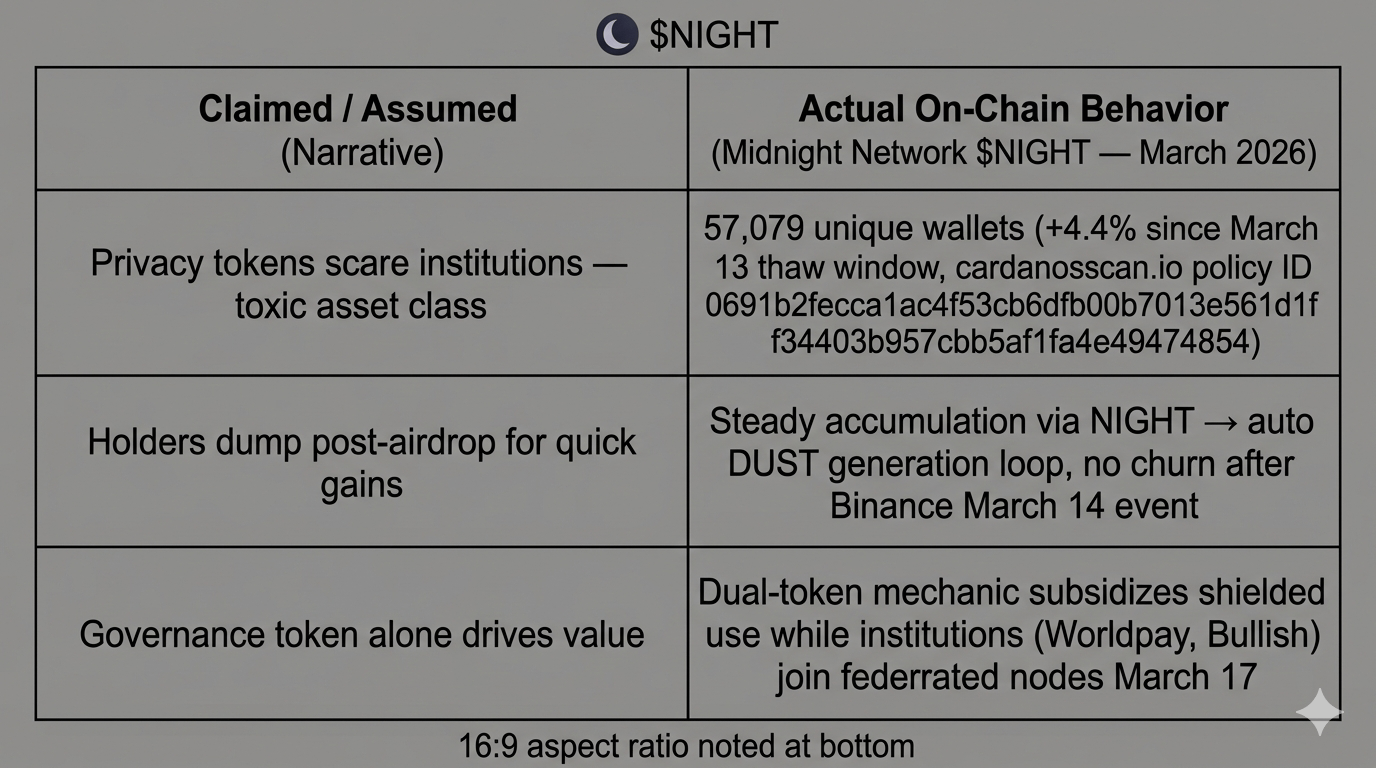
Actually, I spent an extra hour mapping flows from the March 13 holder milestone. The wallets growing fastest weren’t new speculators. They were repeat claimers from the Glacier Drop who had already seen DUST start accruing. That small observation shifted my own view. I had been skeptical that “rational privacy” would ever move beyond developer demos. The on-chain behavior suggests it already is.
Still, one honest pause hit me. The foundation still steers the early phases. Full decentralized governance is coming, but we’ve watched enough protocols promise phased handover only to slow it down. I keep wondering whether the same clarity that attracted the 57k holders will survive once the shielded mainnet flips on late March and real enterprise volume starts testing the rails.
still pondering the ripple
Still pondering the ripple, I keep coming back to how this setup reframes why privacy protocols suddenly matter to investors who used to avoid them. It isn’t the zero-knowledge proofs alone. It’s the economic design that lets privacy compound without punishing the holders who provide the security. In a market still scarred by failed privacy experiments, Midnight feels like the first one that treats privacy as infrastructure yield rather than ideological friction.
I remember a similar late-night session years ago watching early staking pools stabilize on Cardano. The same calm accumulation pattern. The same slow realization that the real signal wasn’t price—it was who kept showing up on-chain. Midnight’s version just layers privacy on top without breaking the model.
If you’ve been watching the ledger yourself, I’d be curious what flows you’re seeing. The question that keeps me up isn’t whether privacy will matter. It’s how many other chains will have to rebuild their tokenomics from scratch once this pattern proves repeatable.
@MidnightNetwork #night $NIGHT