
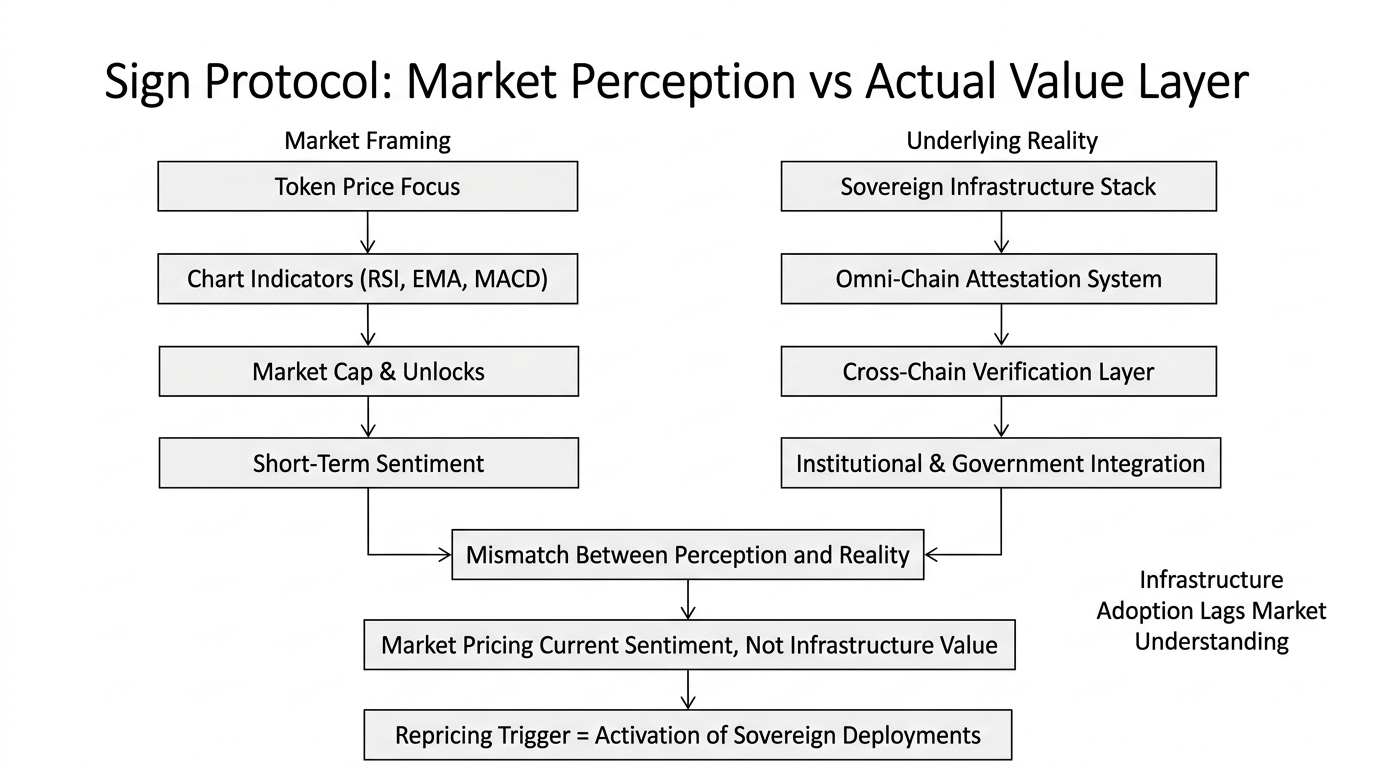
I have noticed something about the way most people talk about Sign Network. The conversation almost always defaults to the same entry point — price chart, token unlocks, market cap. Those things are real. But that framing is measuring the packaging, not the contents. And the gap between what the market thinks Sign is and what Sign has actually built is wider than $0.04678 suggests.
Sign is not primarily building for the trader watching the $SIGN chart on a 4-hour timeframe. It is building for the central bank that needs to issue a digital currency to an entire nation without rebuilding its verification infrastructure from scratch. It is building for the government ministry that needs to anchor citizen identity to a wallet address without creating a surveillance database. It is building for the financial institution that needs to distribute tokens, unlock vesting schedules, and verify compliance across 40 million wallets simultaneously without a single point of failure. The mechanism that makes all of those use cases possible is Sign's omni-chain attestation stack — and it is the most commercially serious architecture Sign has, even though most people discussing SIGN are still looking at EMA crossovers.
Sign's attestation stack works across chains. The basic idea is that a verified claim — you are who you say you are, your credential is valid, your transaction is compliant — can be created once on Sign Protocol and recognized across Ethereum, BNB Chain, Base, Starknet, Solana, TON, and Move-based networks simultaneously. You do not rebuild the verification layer for every chain. You do not maintain separate identity databases for separate ecosystems. Sign creates the attestation once and the entire omni-chain world can read it. That sounds like a developer convenience until you understand that every government, every bank, and every enterprise currently maintains exactly those separate siloed databases because there was no architecture that could connect them without compromising data integrity. Sign is that architecture.
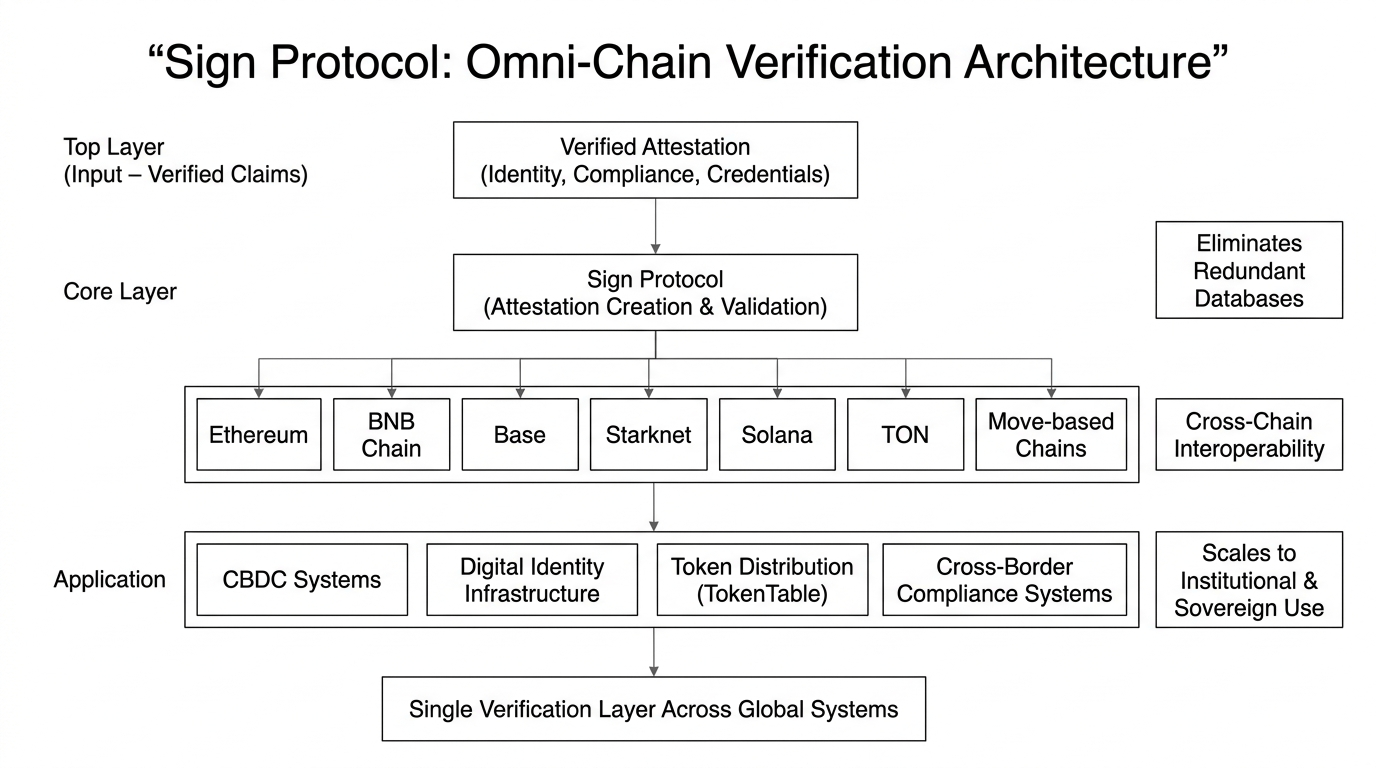
The reason this matters for the investment case right now is that Sign's addressable market is not the crypto infrastructure sector. That sector is real but narrow. Sign's addressable market is every institution in the world that currently spends money on verification, identity, and credential management — and cannot make those systems talk to each other across borders, chains, or jurisdictions. That is the Kyrgyz Republic, whose central bank has already signed a technical service agreement with Sign for the Digital SOM CBDC and given it legal status ahead of a full issuance decision at end of 2026. That is Sierra Leone, whose Ministry of Communication has signed an MOU with Sign for national blockchain-based digital identity. That is the UAE, where Sign is already operationally deployed inside one of the world's most aggressively digitizing financial ecosystems. None of those deployments happened because Sign had an interesting whitepaper. They happened because Sign had a working stack that sovereign institutions could actually use.
The price today is $0.04678, up 4.40% on the session. Volume came in at 225.99 million SIGN. RSI is at 63.42 — bullish momentum, not yet overbought. The EMA structure has Sign trading above its 20-period, 50-period, and 200-period moving averages simultaneously, with a confirmed MACD bullish crossover. The chart formed its bottom at $0.03906 and has recovered structurally. By technical measure, Sign is in early-stage recovery with every indicator aligned. But the chart is measuring market sentiment about Sign. It is not measuring what Sign has built, what Sign has deployed, or what Sign's sovereign contracts will generate when they move from pilot to full production scale.
Here is the risk I would sit with honestly. Sign's sovereign deployment strategy is real, but the distance between signed agreement and live national infrastructure is not a straight line. The Kyrgyzstan CBDC is still in pilot phase. The Sierra Leone Digital ID is still at MOU stage. Between where those deployments sit today and where they need to be to generate sovereign-scale revenue sit procurement processes, regulatory approvals, technical integration cycles, and political timelines that Sign cannot compress regardless of how good its technology is. Sign is asking the market to price infrastructure contracts that exist but have not yet activated at scale. That gap between existence and activation is where the skepticism lives, and it is not irrational skepticism.
The second risk is the token supply structure. Sign unlocks approximately 96.67 million tokens monthly into a circulating supply of 1.6 billion. That is a real and continuous supply expansion that requires proportional demand growth to absorb without structural price pressure. For Sign's price to recover meaningfully and hold, new deployments, new revenue, and new institutional attention need to arrive on a cadence that matches the unlock schedule. $15 million in annual revenue in 2024 is a strong foundation. It is not yet the revenue profile of a protocol inside multiple live sovereign monetary systems, which is what Sign is building toward.
What would make me more constructive on the Sign attestation thesis is specific. I want to see the Kyrgyzstan Digital SOM move from pilot to full legal tender production — the decision window is end of 2026 and that is close enough to matter for anyone holding SIGN today. I want to see Sign announce at least one new sovereign technical service agreement — not an MOU, but an actual contract with implementation timelines — from a country outside its current active deployments. And I want to see TokenTable's $4 billion in processed distributions scale toward $10 billion, because that number is the clearest evidence that Sign's revenue model compounds with adoption rather than requiring new government contracts to sustain itself.
Do not watch where SIGN is trading. Watch whether a central bank outside Kyrgyzstan signs a technical service agreement with Sign. That event arriving is the signal the price has not yet priced in. Sign has already built the stack. It has already signed the first sovereign contracts. It has already generated real revenue. The market is treating all of that as probability. It is not probability. It is infrastructure that already exists, waiting for the world to catch up with what Sign built.
$SIGN @SignOfficial #SignDigitalSovereignInfra
