
I got burned badly in 2019 on a project where the team allocated 70 percent of supply to themselves and insiders with generous vesting schedules, then marketed the token to retail as if it was a community-driven project. When price started collapsing, the team stayed focused on development and ignored market concerns, and I realized too late that their priority was building something they controlled, not building something that served token holders. The allocation structure told the whole story, but I ignored it because the technology sounded good. That mistake is why Fabric Foundation's 78 percent locked allocation keeps nagging at me, especially now that ROBO is trading 58 percent below all time high with almost no response from the team.
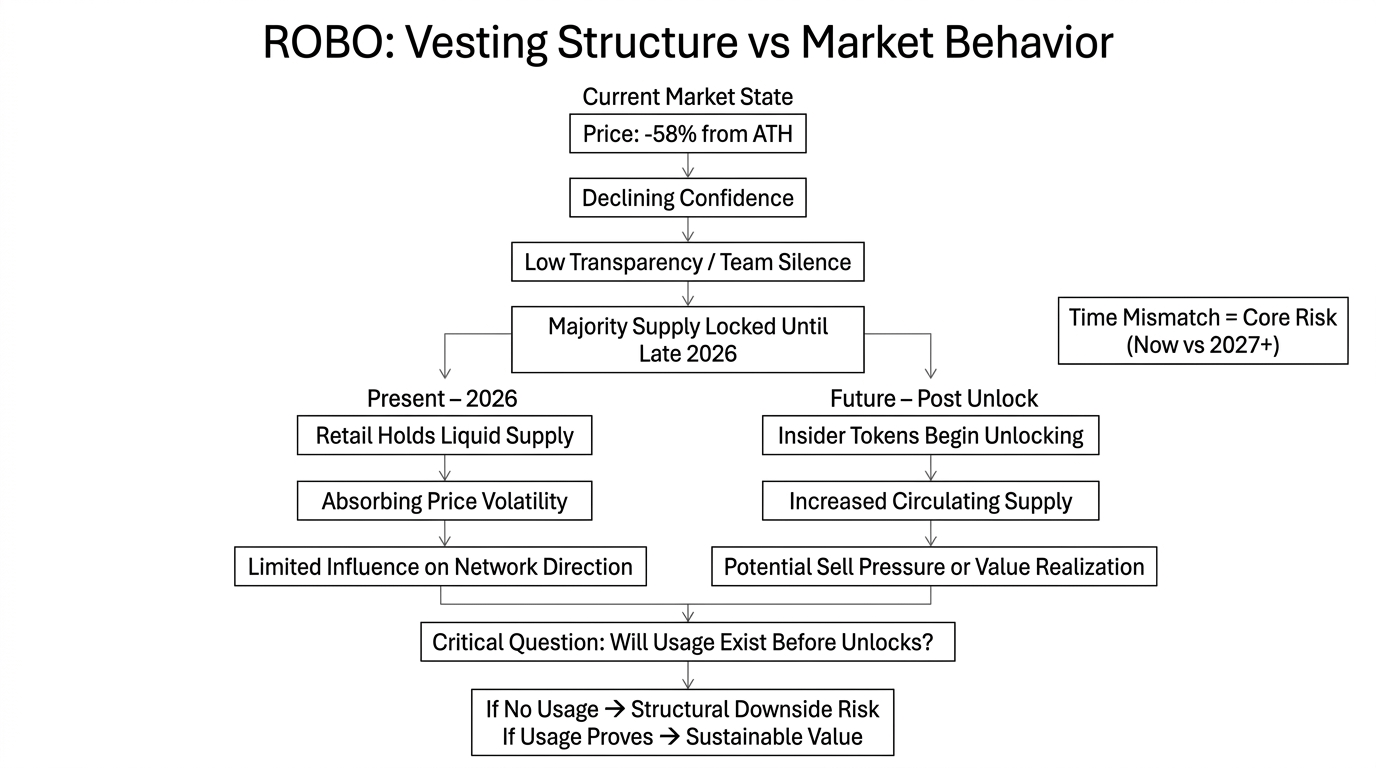
As of March 20, ROBO is trading at 0.02568 USDT, up 0.94 percent in the last 24 hours, moving in a range between 0.02542 and 0.02692. That modest bounce does not change the larger picture. The token hit an all time high of 0.06071 on March 2 and has since collapsed 58 percent over 18 days. Volume came in at 467.75 million tokens, translating to roughly 12.11 million USDT. The RSI at 30.24829 is still deeply oversold, and the MACD just barely turned positive at 0.00033, which suggests momentum is attempting to stabilize but has not confirmed recovery yet. What interests me more than the technicals is thinking through what Fabric Foundation's allocation choices reveal about who they are actually building for.
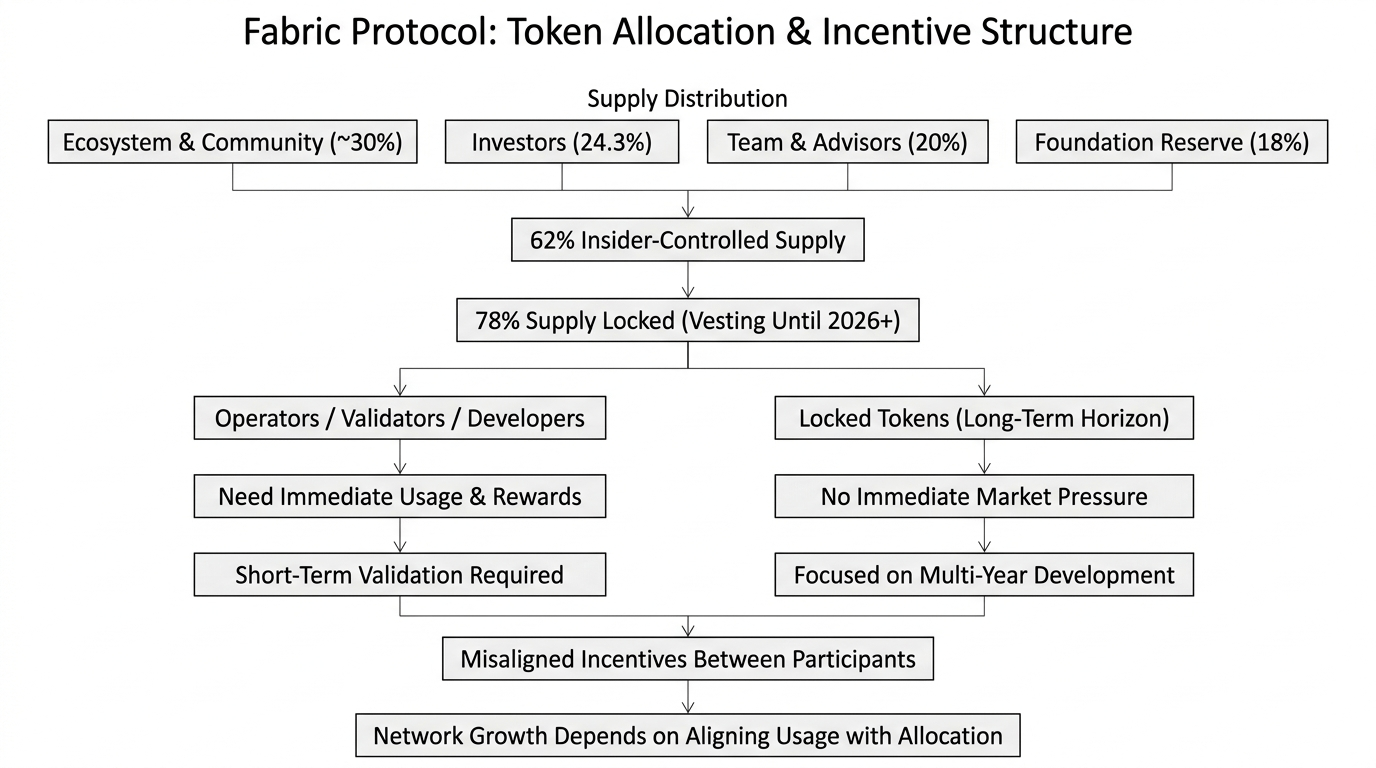
Here is the structure that bothers me. Fabric Foundation allocated 29.7 percent of ROBO to ecosystem and community, 24.3 percent to investors, 20 percent to team and advisors, and 18 percent to foundation reserve. That means roughly 62 percent of total supply went to insiders, investors, and the foundation itself, while only 30 percent went to ecosystem and community participants who might actually use the network. The circulating supply right now is around 2.23 billion tokens out of a 10 billion max, which means 78 percent of total supply is still locked under vesting schedules that start unlocking in late 2026. Those insiders and investors who control 62 percent of supply are watching ROBO collapse 58 percent without intervening, without communicating, and without publishing operational metrics that would validate the infrastructure thesis. That tells me their time horizon is longer than retail's time horizon, or they do not believe current price matters, or they know something retail does not know about development timelines.
I think the allocation structure reveals that Fabric Foundation is building for themselves and their vision, not for token holders who took risk by buying during the launch cycle. That is not inherently wrong. Plenty of successful projects are founder-driven with long time horizons. But it does mean that if you hold ROBO expecting the team to care about short-term price action or to respond to market pressure with transparency, you are misunderstanding the project's priorities. Fabric Foundation's silence during this collapse makes perfect sense if you understand that they allocated majority supply to insiders who are aligned with multi-year development timelines, not to community participants who need operational proof within months. The token is trading, retail is holding bags, and the team is building something they believe will matter in 2027 or 2028, regardless of what price does in 2026.
The problem with that approach is retention. Fabric Foundation needs robot operators, validators, developers, and users to participate in the network for the infrastructure to have value. If the allocation structure signals that insiders control 62 percent of supply and have multi-year lockups, why would operators or validators commit capital and time now? They are competing for the 30 percent of supply allocated to ecosystem and community, while insiders sit on 62 percent waiting for the market to catch up to the vision. That creates misaligned incentives. Operators who deploy robots, stake ROBO, and take operational risk are doing so with the knowledge that insiders control twice as much supply and have no immediate pressure to prove value because their lockups do not start releasing until late 2026. If I am a robot operator deciding whether to use Fabric Protocol or a competing solution, why would I choose the network where insiders control most supply and seem indifferent to current market conditions?
The other thing the allocation reveals is that Fabric Foundation raised enough capital from investors that they do not need retail participation for runway. The 24.3 percent allocated to investors, combined with the 18 percent foundation reserve, means Fabric Foundation likely has years of operating capital regardless of what ROBO price does. That is great for development stability, but it also means the team has no economic incentive to care about token holders who bought during launch. Retail bought into a story about robot coordination infrastructure, but Fabric Foundation is building on investor capital with insider-controlled supply, and retail is just along for the ride hoping the vision eventually materializes. The silence during this collapse confirms that dynamic. If Fabric Foundation needed retail support or community engagement, they would communicate during stress. Instead, they are quiet, which tells me they have the resources to keep building regardless of sentiment.
What would change my mind is if Fabric Foundation demonstrates that the allocation structure creates value for ecosystem participants, not just for insiders. If they publish metrics showing that the 30 percent allocated to ecosystem and community is flowing to operators, validators, and developers who are actively using the network, and if those participants are earning enough from network activity to justify their involvement, then the allocation starts looking like it aligns incentives correctly. If they can show that insiders with locked tokens are contributing to network growth rather than just waiting for vesting to start, that would help. But right now, the allocation structure looks like a standard VC-backed project where insiders control supply, retail provides exit liquidity, and the team builds something they believe will work eventually regardless of short-term price.
The vesting schedules make this dynamic worse. Fabric Foundation set up cliffs and linear vesting that start in late 2026, which means insiders do not have economic pressure to deliver value until those unlocks approach. That gives the team and investors roughly nine months from now before their tokens start becoming liquid, and it gives them no reason to care what happens to price between now and then. Retail who bought during launch has no lockup and is taking all the price risk while insiders with majority supply sit protected by vesting schedules. That is not a partnership. That is a structure where retail funds development and takes downside risk while insiders control upside through supply concentration and time-locked alignment that does not start mattering until 2027.
For now, I am watching Fabric Foundation's allocation strategy as a signal about who they are really building for. The token bounced modestly today, but the bounce does not change the structural reality that 62 percent of supply went to insiders and investors with long lockups, 30 percent went to ecosystem participants who need proof now, and 8 percent is circulating with retail who bought the story and got stuck in a 58 percent drawdown. Fabric Foundation's silence during the collapse makes sense when you understand they allocated supply to favor their own timeline over retail's timeline. Track whether the team starts publishing operational data that shows the ecosystem allocation is creating value for participants. Track whether insiders with locked tokens start intervening or communicating as vesting dates approach. And track whether Fabric Foundation adjusts their approach to acknowledge that token holders exist and deserve transparency. Until those things happen, the allocation structure is telling you exactly who Fabric Foundation is building for, and it is not retail.
#ROBO $ROBO @Fabric Foundation
