

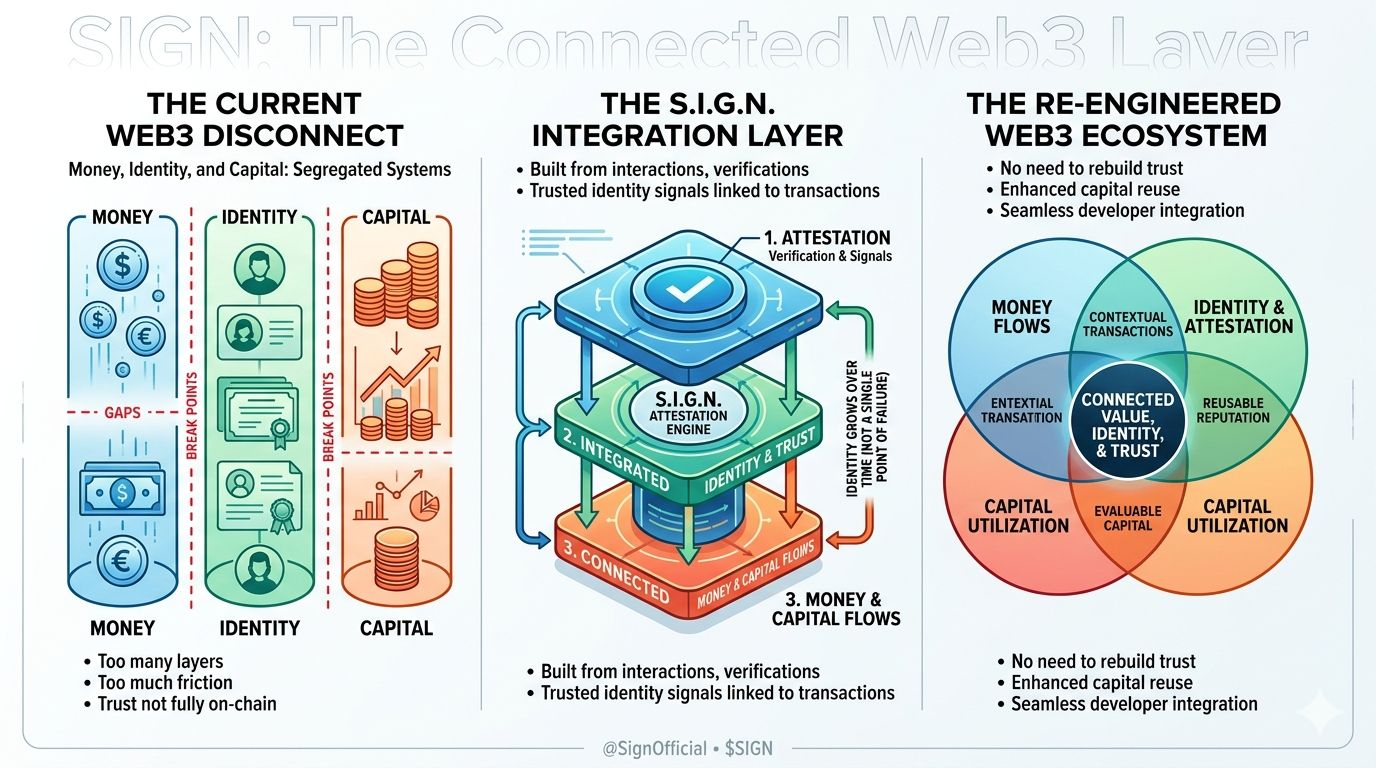
I’ll be honest-most “big ideas” in crypto sound powerful at first, but when you look closer, they fall apart. Too many layers, too much friction, and not enough real connection between systems.
One thing has always felt disconnected.
Money moves on one side. Identity sits somewhere else. And capital flows follow a completely different path.
They exist… but not together.
That gap is where things usually break. You can send funds, but you can’t always prove who is behind them. You can verify identity, but it rarely connects smoothly with how value actually moves. And capital often depends on trust that isn’t fully on-chain.
That’s where S.I.G.N. starts to feel different. Instead of treating these as separate pieces, it looks at how they can work together in one system. Not forced, not stitched together-but connected in a way that actually makes sense during real usage.
At the center of it is a simple idea: trust should not rely on a single point.
With attestations, identity becomes something that grows over time. It’s not just one record you create and forget. It’s built from interactions, verifications, and real activity. That makes it more flexible, but also more useful when money and capital come into play.
Because in reality, value doesn’t move in isolation.
If someone is sending funds, lending capital, or participating in a system, there’s always a question behind it-can this be trusted? Traditional systems answer that with middlemen. Web3 tries to remove them, but then struggles to replace that trust layer properly.
S.I.G.N. leans into that gap. It doesn’t just move assets. It connects actions with identity signals and trust proofs. So instead of blind transactions, you get context. Instead of isolated capital, you get something that can be evaluated and reused across systems.
That changes how things feel at a deeper level. Developers don’t have to rebuild trust every time. Users don’t have to rely only on reputation outside the system. And capital doesn’t have to move without context. Everything starts linking together.
Looking at the current market, SIGN/USDT is trading around 0.04952, with a 24-hour high of 0.05050 and a low of 0.04526. The pair is showing a gain of +6.08%, with around 133.99M SIGN and 6.42M USDT in 24-hour volume. This reflects active participation and growing interest, with the asset currently positioned among gainers while still moving within a defined range.
Of course, this kind of system is not simple. Connecting money, identity, and capital sounds clean as an idea, but execution is where most projects struggle. It requires balance-too much complexity and people won’t use it, too little and it loses meaning.
That’s the real test here.
But if it works, even partially, it could shift how Web3 systems are designed. Not as separate layers trying to interact, but as one connected environment where value, identity, and trust move together.
@SignOfficial #SignDigitalSovereignIntra $SIGN
