

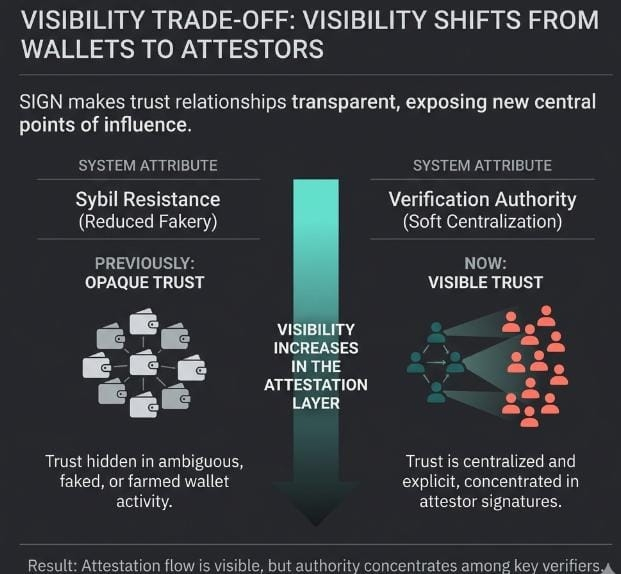
I think most token distributions fail because they trust wallets too much. Wallet activity can be faked, repeated, or farmed. SIGN tries to fix this by using attestations instead. Instead of guessing who deserves rewards, it lets attestors confirm it directly.
But this creates a new issue. The system stops trusting wallets and starts trusting attestors. The problem doesn’t go away. It just moves to a different place.
Attestations Make Eligibility Clear, But Not Truthful In SIGN, an attestation is a signed claim. An attestor defines a rule, signs it, and links it to a wallet. This becomes a credential.
Then TokenTable uses that credential. If it is valid, tokens are distributed. Simple and direct.
This is powerful because it removes guesswork. No need to analyze wallet activity. Everything is based on clear verification.
But there is a limit. SIGN can check if an attestation is valid in form. It cannot check if the claim is actually true. That depends fully on the attestor.
So the system works only as well as the people issuing these attestations.
Attestors Slowly Become Gatekeepers
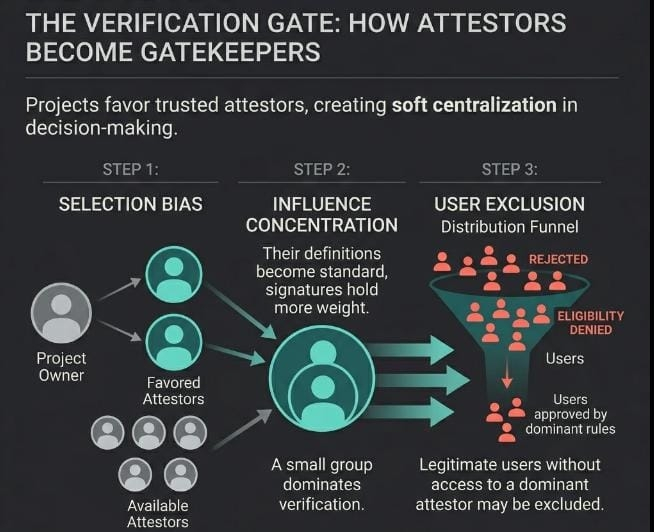
I see a pattern here. When attestations decide eligibility, attestors start gaining control.
Projects will prefer certain attestors they trust more. Over time, a small group of attestors can become dominant. Their signatures start carrying more weight than others.
This creates a soft form of centralization. The system is open, but influence is not equally spread.
SIGN reduces fake users, but it also creates a new layer where power can concentrate. And this layer is harder to question because everything still looks valid on-chain.
Who Checks the Attestor?
This is where things get tricky.
SIGN verifies signatures, structure, and revocation. But it does not verify the credibility of the attestor.
There is no built-in system to judge whether an attestor is reliable or biased.
So each project has to decide on its own which attestors to trust. This means different platforms may accept different credentials.
Identity in SIGN is not fixed. It depends on who verifies you and who accepts that verification.
Token Distribution Follows Attestor Decisions
In SIGN, verification and distribution are directly connected. Once an attestation is accepted, tokens are distributed automatically.
This makes the system efficient, but also sensitive.
If an attestor is too loose, unqualified users get rewards. If they are too strict, real users get left out.
So the final result depends heavily on attestor behavior, not just user contribution.
There is always a trade off. Strong control improves Sybil resistance but reduces access. Loose control increases access but weakens trust.
SIGN does not remove this trade-off. It makes it very clear.
I see SIGN as a system that makes trust more visible. Instead of hiding it in wallet data, it puts it in the hands of attestors.
That is a strong idea, but also a risky one if not handled carefully.
Because in the end, the system depends on who is trusted to issue the truth.
If a few attestors become too powerful, are we really improving fairness, or just changing who controls it??
$SIGN #SignDigitalSovereignInfra @SignOfficial