
TL;DR
I think SIGN matters in 2026 because crypto has a trust problem, not an information problem.
The core idea is simple: make claims, eligibility, records, signatures, and distributions easier to verify instead of asking users to trust screenshots and noise.
Sign Protocol is the evidence layer. TokenTable handles rules-based distribution. EthSign handles verifiable signing flows.
This feels timely because scams, impersonation, and low-quality campaign culture are still growing, while users expect smoother and safer UX.
I would not approach SIGN with blind excitement. I would use a checklist.

I’ll be honest, most people in crypto are not suffering from a lack of content.
They’re suffering from too much of it.
Too many threads. Too many “early” calls. Too many campaign posts that all sound weirdly similar. Too many people acting certain when they have not checked the source, the rules, or even the link.
I’ve seen this pattern too many times now. A creator rushes to farm attention. A user clicks fast because the post sounds confident. A team gets copied by fake accounts within hours. Then everyone acts surprised when trust collapses.
That is why SIGN makes sense to me in 2026.
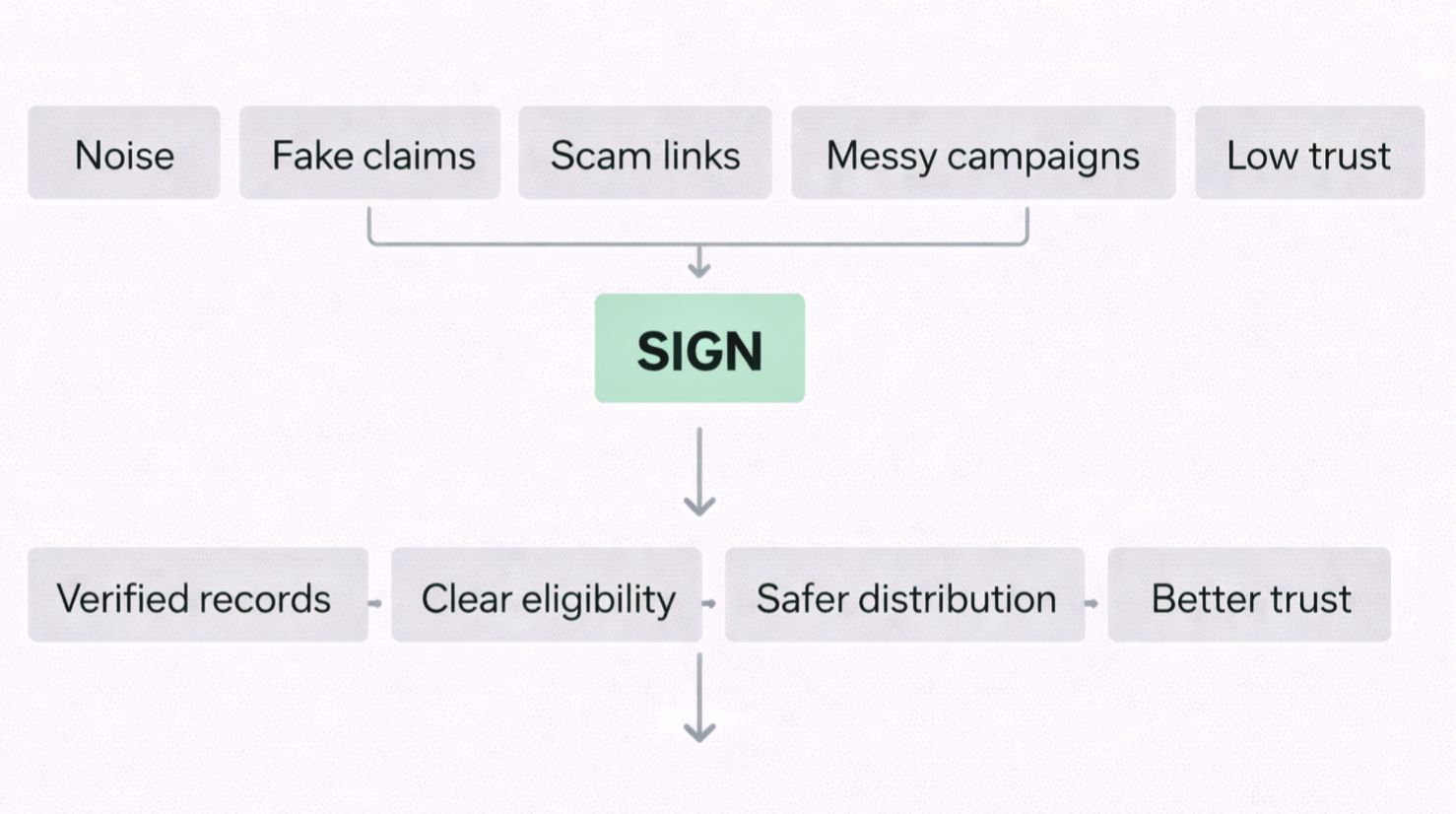
Not because the market needs another shiny dashboard. Not because every project suddenly needs a new slogan. But because crypto is getting bigger, and the old way of proving things still feels messy. We move value onchain pretty well. We still do a bad job proving context around that value. Who is eligible? Which record is real? Which signature counts? Which distribution rules were actually used? That is the gap SIGN is trying to fill. Its official docs frame S.I.G.N. as digital infrastructure for money, identity, and capital, with Sign Protocol acting as the shared evidence layer underneath.
That part matters.
Because once you strip the branding away, the actual pitch is pretty practical. Sign Protocol is there to let systems define structured records, issue attestations, and verify them later. The docs are very clear that it is infrastructure, not a consumer app. TokenTable focuses on distribution, meaning who gets what, when, and under which rules. EthSign is for agreement and signature workflows that leave verifiable proof behind.
In plain words, SIGN is trying to make proof less fragile.
If a person is eligible, that should be verifiable.
If a team says a distribution followed specific rules, that should be checkable.
If a document was signed, that proof should not just vanish into a closed platform.
If a wallet has a credential or some form of reputation, there should be a cleaner way to confirm it than trusting vibes and recycled posts.
And I think that problem is bigger now than it was a year ago.
Why now? Because the market has changed.
Users are more alert. Teams are more exposed. Scams are getting smarter. Chainalysis estimated that crypto scams and fraud reached $17 billion in 2025, with impersonation scams up 1400% year over year, and AI-enabled scams proving far more profitable than traditional ones. When that is the backdrop, trust infrastructure stops sounding abstract. It starts sounding necessary.
There is also a scale argument here that I do not think people should ignore. Binance Research said Sign Protocol grew from 4,000 to 400,000 schemas in 2024, while attestations rose from about 685,000 to more than 6 million. The same research said TokenTable distributed more than $4 billion in tokens to over 40 million wallets. That does not prove future success by itself, but it does show this is not just a theoretical product story anymore. It is already touching real distribution volume.
That is usually when I start paying more attention.
Not when the loudest people arrive. When the boring infrastructure starts handling meaningful load.
Who I think SIGN is really for :
I would split the audience into four groups.
Newcomers :
They want fewer traps. Clearer paths. Less chance of clicking the wrong thing. For them, the value is simple: better ways to verify whether a campaign, credential, or claim is actually real. They should still be careful, but at least the tooling direction makes sense.
Creators :
This one matters to me a lot. Creators do not just need topics. They need filters. A project becomes easier to write about when there is something concrete to examine: real records, real distribution logic, real usage, real documentation. Otherwise you just end up paraphrasing hype.
Project teams :
They need cleaner ways to distribute tokens, manage eligibility, handle vesting, and prove what happened later if someone asks questions. TokenTable is directly aimed at that problem. The docs describe the old process as too dependent on spreadsheets, custom scripts, and manual reconciliation. That sounds painfully familiar if you’ve watched enough campaign chaos.
Campaign hunters and active users :
They mostly want one thing: not to get played. They want to know whether the rules are real, whether access is fair, whether a claim is official, and whether they are signing the right thing.
A simple example :
Let’s say two creators see the same ecosystem campaign.
Creator A posts first. Fast thread. Big confidence. Says it is a huge opportunity. Adds a claim link from a reposted account. Never checks the rules. Never checks restrictions. Never checks whether the campaign logic is even transparent.
That post might get views.
But it can also get people hurt.
Creator B is slower. Checks official docs. Reads the claim conditions. Confirms whether the campaign uses real verification logic or just fake urgency. Tells readers what to look for before connecting a wallet. Maybe the post is less flashy. But it is more useful. And over time, useful usually beats loud.
That is the kind of difference a project like SIGN is built around.
My practical framework - the SIGN Score :
This is how I’d judge the project, or any campaign built around it.
Give each category 0 to 2 points.
1. Utility
Does it solve a real verification, distribution, or credential problem, or is it just wrapped in narrative?
2. Sustainability
Would the product still make sense if rewards cooled down?
3. Distribution quality
Are the rules clear? Can people understand who gets what, and why?
4. Transparency and security
Are the docs readable? Are official channels clear? Is the user being asked to trust less and verify more?
5. Community health
Is the conversation thoughtful, or is it just farming behavior dressed up as conviction?
Score guide:
8 to 10 = strong signal
5 to 7 = interesting, but keep checking
0 to 4 = probably more noise than substance
Good signal vs bad signal :
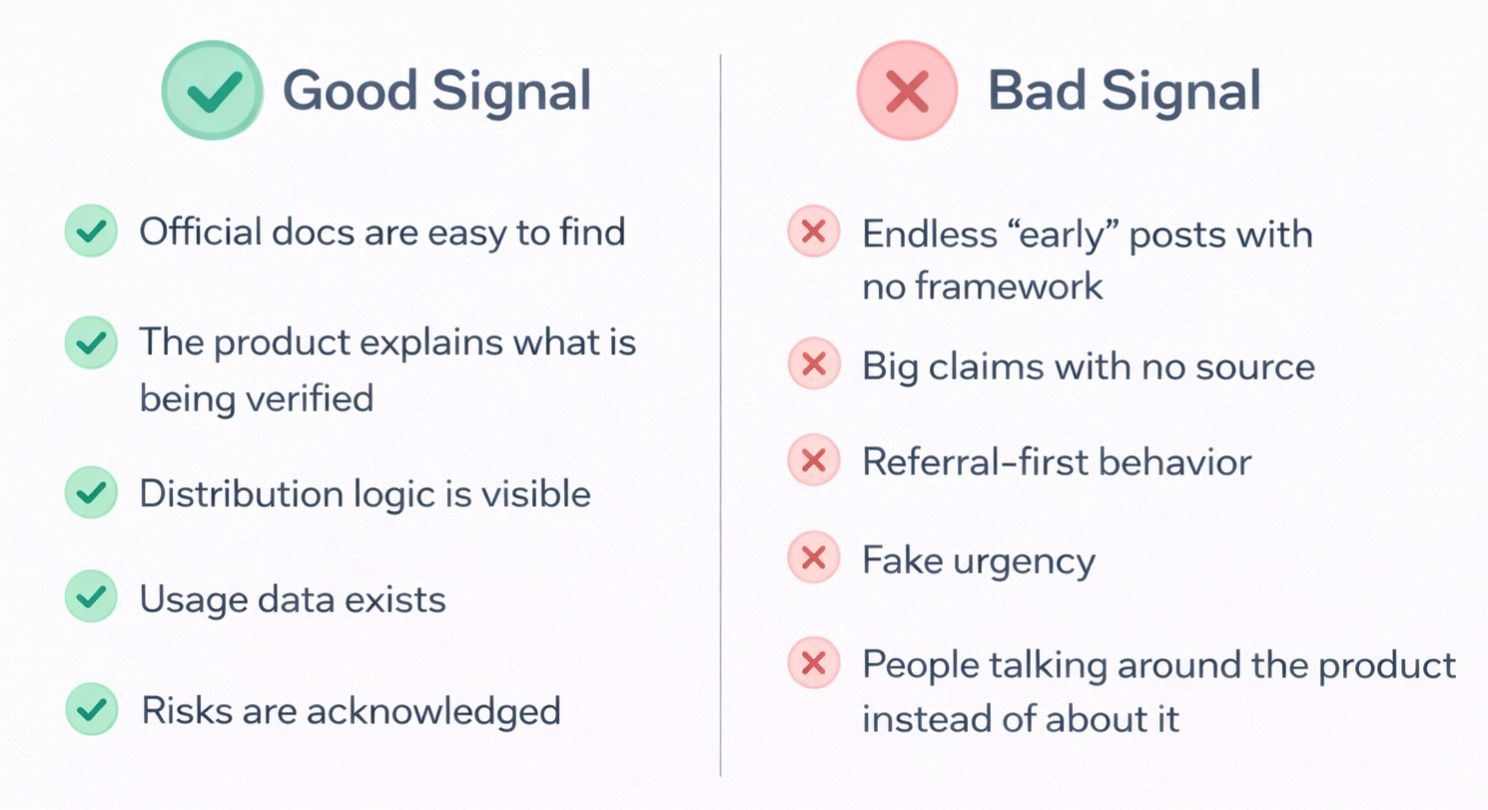
How I’d engage safely :
This part is non-negotiable.
Before joining any campaign or ecosystem activity, I would check:
First, the source.
Only official docs, official site, official socials.
Second, the action.
Am I claiming, signing, connecting, proving eligibility, or approving something else? Those are different actions.
Third, the rules.
Is there vesting? KYC? geo restrictions? timing conditions?
Fourth, the logic.
Can the team explain the distribution or eligibility process clearly?
Fifth, the risk.
Even with better infrastructure, phishing is still phishing. Cleaner rails do not replace basic caution.
Risks people should not ignore :
I like the problem SIGN is targeting. That does not mean I ignore the weak points.
Adoption risk is real. Infrastructure can be useful and still take time to become normal.
Token clarity matters too. A strong product stack does not automatically answer every question about long-term token value.
There is also incentive fatigue. Crypto users are very good at showing up when rewards are hot and disappearing when they cool off.
And of course, phishing and fake mirrors are not magically solved just because the project is about verification.
So no, I do not think this is a story where you turn your brain off.
I think it is the opposite kind of story.
Final thought :
The reason SIGN feels relevant to me in 2026 is not that it promises a perfect future.
It is that it is aiming at a very real weakness in crypto right now.
Too much trust is still informal. Too many claims are still weak. Too many distributions still depend on people believing the process instead of being able to inspect it.
And as the market gets larger, that starts to matter more than one more viral thread.
So that is my real takeaway:
SIGN is not trying to win the noise game. It is trying to make noise less powerful.
That is a better problem to solve.