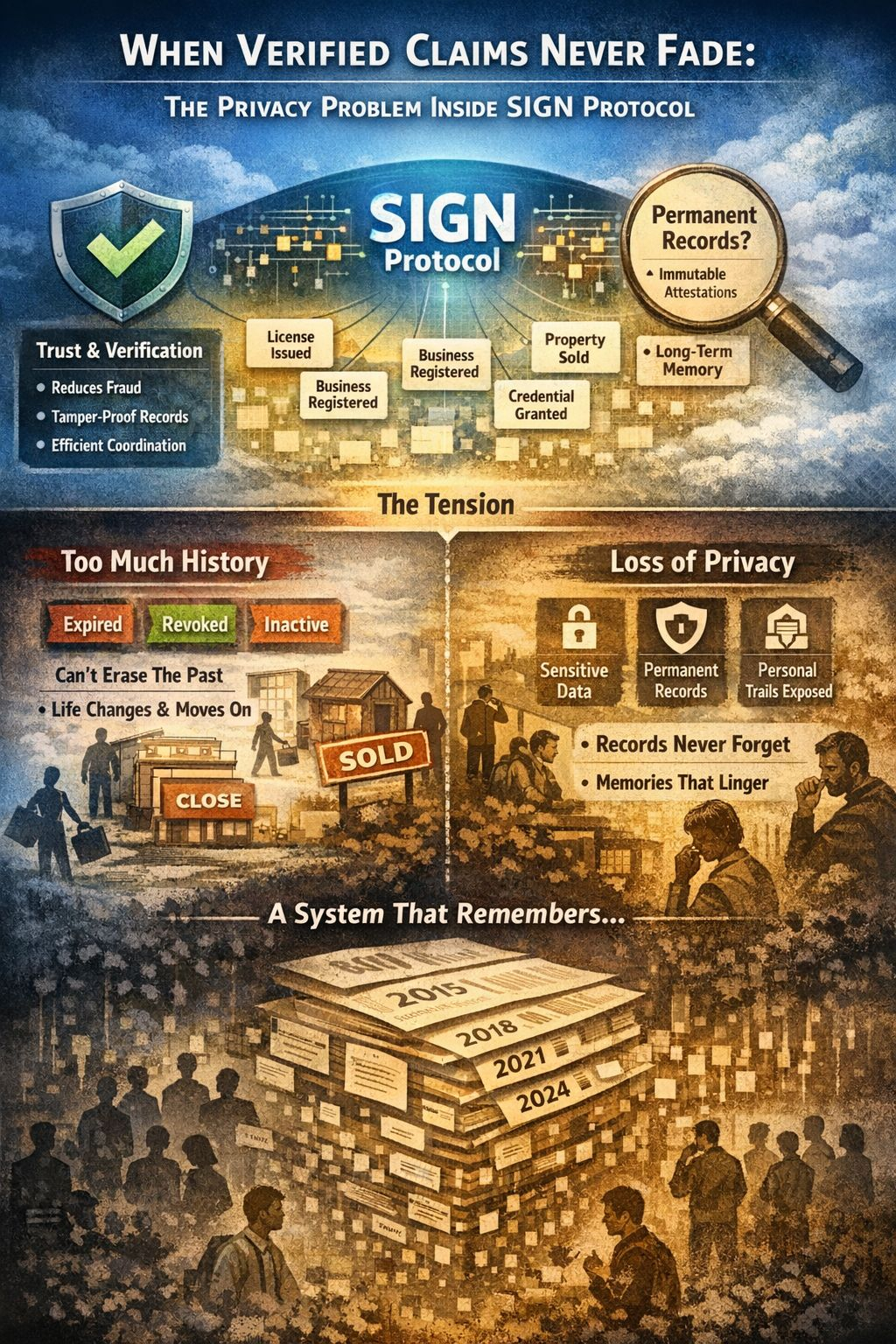
The more I sit with SIGN Protocol, the more it feels like it is doing something much bigger than it first appears to be doing.
At first, it sounds simple enough. It is an attestation protocol. A system for creating claims, verifying them, tracking whether they are still valid, and giving those claims a cryptographic backbone. On paper, that sounds useful. Maybe even necessary. The internet is full of claims that are hard to trust, hard to trace, and easy to fake. So a system that gives structure to trust naturally sounds like progress.
But the longer I look at it, the less I think the main question is whether SIGN makes verification easier.
The real question is what happens when verification becomes permanent.
That is the part I cannot stop thinking about.
Because once you move past the technical framing, SIGN starts to feel less like a tool for proving things and more like a system for remembering them. And remembering them for a very long time.
What SIGN is trying to solve is real. A lot of important things happen in digital systems, but the trust behind them is usually scattered everywhere. A license gets issued. A document gets approved. A business gets registered. A credential gets granted. An asset changes hands. But the actual proof behind those events is often messy. It lives in disconnected databases, emails, internal portals, PDFs, or institutions that do not really talk to each other.
That is where SIGN starts to make sense.
It wants to turn those moments into something structured. Something that can be issued by the right party, checked later, and understood without depending on vague institutional memory. That is why the protocol feels more serious than a lot of other crypto infrastructure. It is not really trying to manufacture excitement. It is trying to formalize trust.
And honestly, that is valuable.
But value and risk are sitting right beside each other here.
What really changed my view was realizing that a system like this only works because it keeps history.
That is its strength.
An attestation matters because it can be checked later. Because it leaves a trail. Because someone can come back and ask: who issued this, when was it issued, is it still valid, was it revoked, what was the status, what happened after?
That is exactly what gives it credibility.
But the second you apply that logic to actual human life, it starts to feel heavier.
Because then you are no longer talking about harmless little claims floating around in a protocol.
You are talking about real events.
A visa being issued.
A professional license being granted.
A business being registered.
A property transfer being recorded.
An education credential being issued.
A regulatory approval being given.
A border verification event happening.
All of those can become attestations.
And once they do, the question becomes: what happens to that history later?
Because life changes.
People move.
Businesses close.
Licenses expire.
Property gets sold.
Permissions get revoked.
Circumstances change.
Entire chapters of life end.
But if the system is built to preserve the record of those moments, then the fact that they happened may never really disappear.
That is the part that feels much bigger than a technical design choice.
A lot of infrastructure conversations become too abstract, and this is one of them.
It is easy to talk about immutability like it is automatically a good thing. And in some situations, it really is. If there is a dispute over ownership, a fraud investigation, or a need to prove that something was authorized by the right party, durable records are incredibly useful.
No question.
But human life is not just a chain of verifiable facts.
It is messy. Temporary. Contextual. Sometimes painful. Sometimes political. Sometimes sensitive in ways that are hard to capture in protocol language.
A person might live in one country for a few years, receive a visa, register a business, buy property, leave, dissolve the company, sell the asset, and move on. In real life, that chapter ends.
But in an attestation-heavy world, maybe it does not fully end.
Maybe the active legal meaning disappears, but the trace remains.
Maybe the current status says expired or revoked or inactive. But the historical existence of those events is still there. Still part of the record. Still something that can be seen, linked, or inferred from.
And that is where it starts to feel less like neutral infrastructure and more like a permanent memory layer.
One thing I think gets blurred too often is the difference between invalidating something and erasing it.
Those are not the same thing.
If an attestation gets revoked, that means it is no longer valid. But it does not mean it never existed.
If it expires, it may no longer work as proof. But its history is still part of the system.
If selective disclosure is used, that may protect which details are revealed in a specific moment. But that does not automatically mean the surrounding record disappears.
And that distinction matters a lot more than people admit.
Because a system can be very good at controlling present disclosure while still being very bad at letting the past fade.
That is the tension I keep coming back to.
What makes this especially interesting is that this is not really just a SIGN issue. It is a deeper issue with attestation systems in general.
Any system built around durable verification eventually runs into the same wall. The very thing that makes the system trustworthy is the thing that can make it invasive. It needs memory to be credible. But once it has enough memory, it starts accumulating human history in ways that may not always be healthy.
That is why I think the conversation around these systems is still too shallow.
People talk about privacy mostly in terms of what fields are shown. Whether a birthdate is hidden. Whether only one attribute is disclosed. Whether a user can prove something without revealing everything.
That is all important.
But there is another layer of privacy that matters just as much: the privacy of having parts of your life not become permanently legible as history.
That is a different kind of concern.
And honestly, it is the one that feels more important here.
To be fair, I do not think this makes SIGN inherently bad.
There is a real reason systems like this are attractive.
They can reduce fraud.
They can make records harder to tamper with.
They can make institutional coordination easier.
They can reduce dependence on disconnected intermediaries.
They can preserve evidence in disputes.
They can help prove that something came from the right authority.
That is not small.
In some environments, that could genuinely improve how trust works. It could make important systems more accountable and less corrupt. It could make verification faster and cleaner. It could reduce a lot of the quiet friction people deal with when institutions cannot reliably confirm anything.
So I do not think the right reading is to treat SIGN like some obvious dystopian machine.
That feels lazy.
The more honest reading is that it is powerful in both directions.
It can make trust better structured.
But it can also make history harder to leave behind.
I do not think the most important question is whether SIGN has privacy features.
It does.
The real question is what kind of defaults and design choices surround those features.
Does the system minimize what becomes permanent?
Does it reduce exposed metadata as much as possible?
Does it keep sensitive information off-chain where it can?
Does it treat historical accumulation as something dangerous rather than something automatically desirable?
Does it understand that not every verified event should become part of a durable public or semi-public memory?
That is where the future of a protocol like this gets decided.
Because the same infrastructure can be used very differently depending on what its builders and institutions optimize for.
One version becomes trustworthy infrastructure with restraint.
Another version becomes a quiet archive of human life events.
And the difference between those two outcomes matters more than most of the marketing language around attestations.
The more I think about SIGN, the less I see it as just an efficiency tool.
I see it as a system making a choice about memory.
That is why it feels important.
And that is also why it feels risky.
Because permanence always sounds good when you are thinking about fraud, manipulation, or broken records. But it sounds very different when you are thinking about ordinary people, complicated lives, changing circumstances, and the basic human need to move beyond past states.
That is the part I do not think gets enough attention.
SIGN may absolutely become valuable trust infrastructure.
But if too many meaningful life events become attestations, and too many of those attestations leave behind durable traces, then what gets built is not just a verification layer.
It becomes a historical layer.
A system that remembers people long after the original moment has stopped mattering to them.
And I think that changes the privacy calculus more than most people realize.
#SignDigitalSovereignInfra @SignOfficial $SIGN