
Credential verification has become one of those things people only notice when it fails. A graduate wants their qualification accepted in another country. A worker needs to prove eligibility without exposing extra personal data. A platform wants to know a wallet is real, but not learn everything about the person behind it. The whole system works best when it disappears into the background, and that is exactly why it matters. In 2025, the standards side of this world moved forward in a very visible way: W3C published Verifiable Credentials Data Model 2.0, and its credential overview now frames the ecosystem as a set of issuer, holder, and verifier roles rather than a single monolithic identity product.
W3C 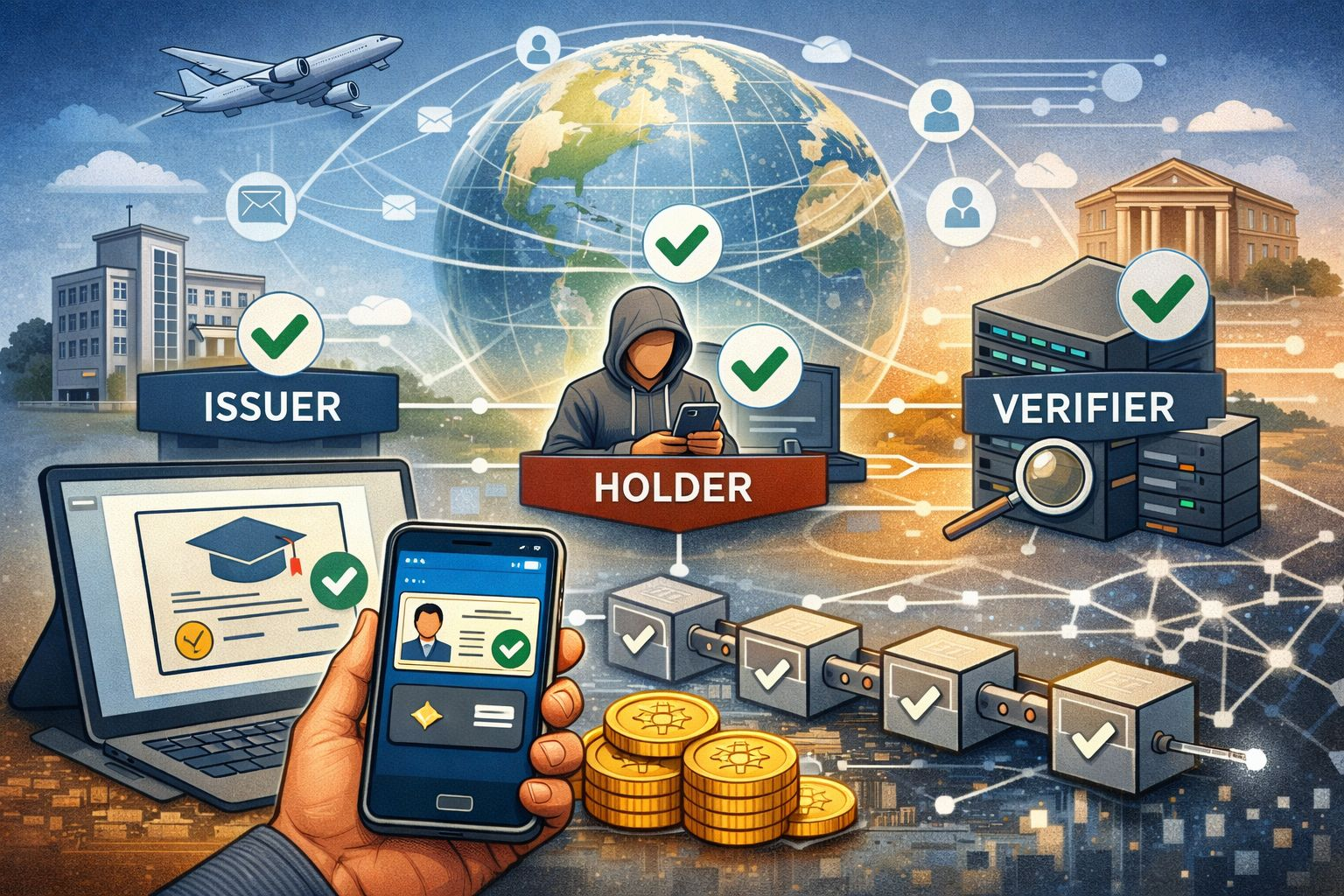
That shift sounds technical, but the practical meaning is simple. Trust is no longer supposed to live in one central database. It travels. A credential can be issued once, stored by the holder, and presented only when needed. That is a cleaner pattern for education records, professional licenses, age checks, and membership proofs. The newer OpenID work makes this more usable in real products: OpenID for Verifiable Credential Issuance reached final status in September 2025, and OpenID for Verifiable Presentations reached final status in July 2025, both built to fit into familiar OAuth-style flows and modern wallet experiences.
OpenID Foundation
That is the part builders care about most. Not the slogan. The plumbing.
Because once credentials are portable, the next question appears almost immediately: who gets rewarded, and how cleanly can that reward be distributed? Token systems have spent years wrestling with the same problem in different clothes. Airdrops get gamed. Grants miss the people who actually did the work. Reputation is hard to measure, and even harder to verify at scale. A global infrastructure for credential verification gives token distribution a better spine. It lets a protocol reward verified participation instead of raw noise. That is a blunt truth, but it saves everyone time.
The interesting part in 2025 is that the ecosystem is no longer just talking about this in theory. OpenID Foundation reported interoperability testing for OpenID4VCI with seven issuers and five wallet providers in July 2025, which is the kind of detail that matters because it shows multiple implementations can actually talk to each other. On the presentation side, the OpenID4VP work also settled into a final specification in 2025, and its baseline now includes both traditional HTTPS-based flows and a route through the Digital Credentials API.
OpenID Foundation
That matters for distribution, because a token drop is only as fair as the proof behind it. If a community wants to reward early testers, active contributors, or users who passed a compliance step, it needs a way to verify the claim without turning the experience into a mess. Selective disclosure helps here. So does the ability to reuse a credential across systems without rebuilding the entire trust chain each time. W3C’s 2025 VC 2.0 publication reflects that direction clearly, and the related credential resources now include status lists, controlled identifiers, and data integrity tooling that support more practical deployments.
W3C
The community mood has changed too. A few years ago, identity conversations often felt abstract, like something policy people argued about in quiet rooms. Now the tone is different. Product teams talk about user friction. Wallet teams talk about interoperability. Protocol teams talk about sybil resistance without sounding embarrassed by the phrase. In Europe, the digital identity effort keeps pushing toward a common wallet and age-verification approach, and the Commission said in 2025 that it released a blueprint for an EU age-verification app and later an enhanced second version of that blueprint. That is not a side note; it is a signal that the market is moving from experiments to shared infrastructure.
digital-strategy.ec.europa.eu
There is still a lot that can go wrong. Issuers can be sloppy. Wallets can be clunky. Verifiers can ask for too much. Tokens can still land in the wrong hands if the rules are weak. And yes, some systems will pretend they have solved trust when they have only moved the paperwork somewhere else. That happens all the time. But the direction is hard to ignore: credential verification is becoming the layer that lets distribution feel earned instead of random, and that makes token systems a little less theatrical and a lot more useful.
The most useful infrastructure rarely looks exciting at first. It just keeps working while everyone else gets on with the real job.
@SignOfficial $SIGN #SignDigitalSovereignInfra
