
I live in Dhaka, and almost every part of my day depends on separate systems. One app for payments. One for rides. Another for banking. Another for documents. I keep moving, but my history, trust, and proof never really move with me. I have to re-enter things, re-verify things, and start over more than I should.
That’s exactly why the multi-chain future in crypto feels so familiar to me.
For me, the real multi-chain problem isn’t just moving assets. It’s moving trust.
A wallet can jump from one ecosystem to another, sure. But what about proof of eligibility, reputation, past activity, or verified credentials?
That’s where SIGN official starts to matter.
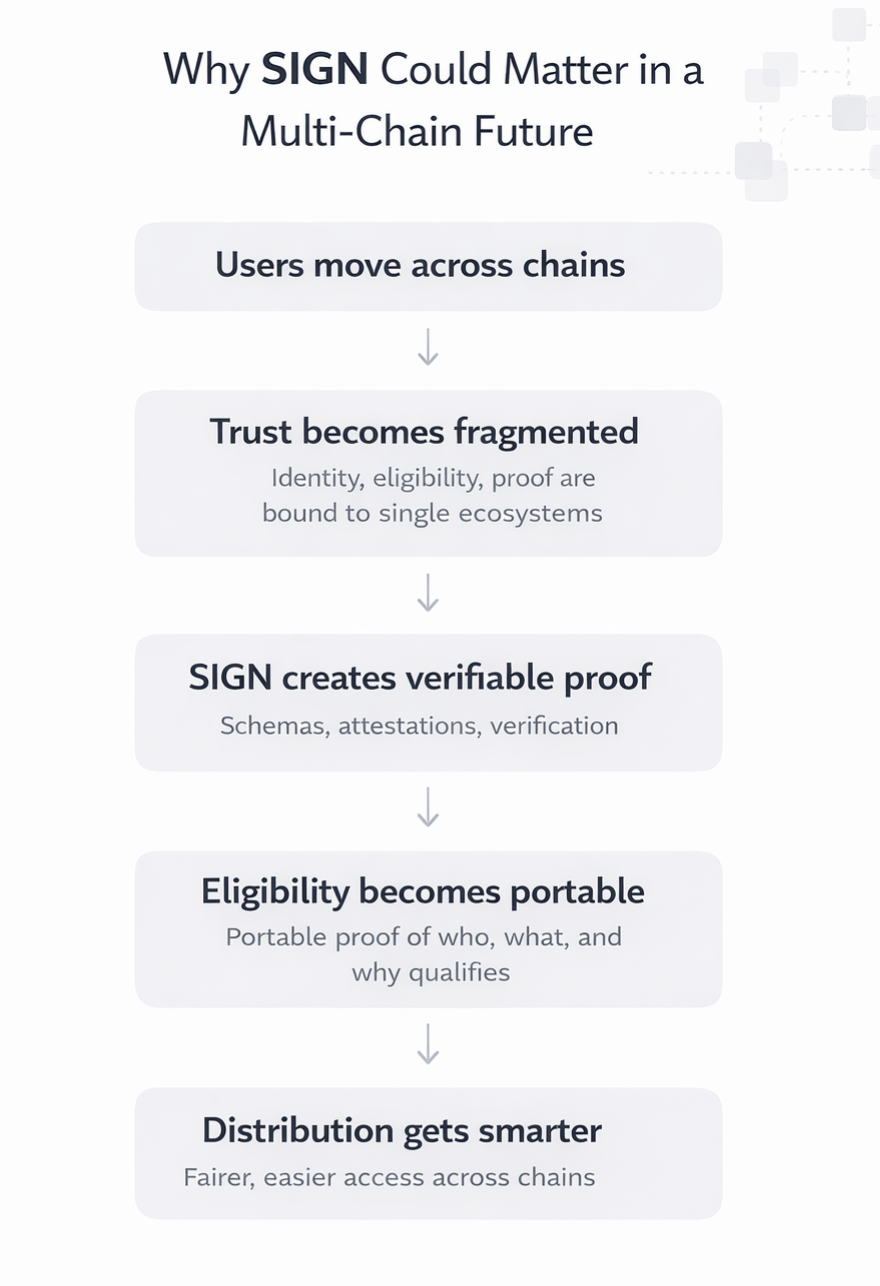
Sign Protocol is described in the project’s docs as an omni-chain attestation protocol, a trust and evidence layer where structured claims can be recorded on-chain or via decentralized storage, then discovered, queried, and verified later.
What caught my eye even more is that this isn’t just a one-chain idea. SIGN’s official docs currently list Sign Protocol deployments across 14 active mainnets, including Ethereum, Base, BNB Chain, Arbitrum One, Optimism, Polygon, Scroll, Celo, Gnosis, opBNB, Cyber, Degen, OKX X Layer, and ZetaChain.
To me, that matters because it shows the team is building for a world where users and applications already live across many ecosystems, not one closed lane.
I also like that SIGN doesn’t frame trust as a vague slogan. It turns trust into something usable.
Schemas define how facts should be structured. Attestations are signed records tied to issuers and subjects. The docs explain that this helps standardize how data is written, linked, queried, and audited across chains and systems. That’s the kind of infrastructure that becomes more valuable as crypto gets more fragmented, not less.
Then there’s TokenTable, which makes the story more practical. SIGN describes it as the allocation, vesting, and distribution engine of the ecosystem, focused on who gets what, when, and under which rules, while leaving evidence and verification to Sign Protocol. That connection is important to me.
In a multi-chain future, fair distribution won’t be solved by speed alone. It will be solved by portable proof.
And that’s why I think SIGN could matter more than people expect.