
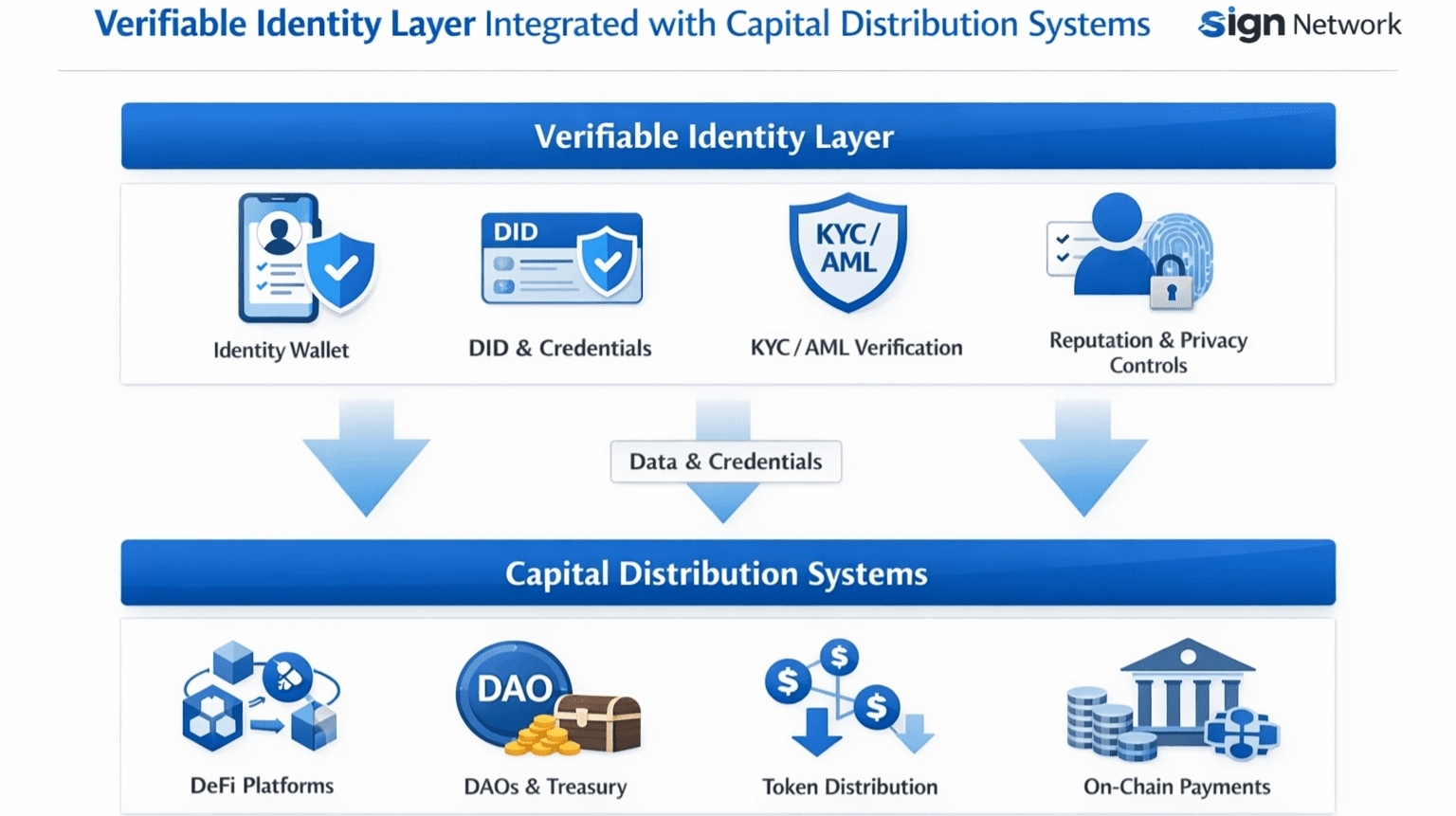
I’ve been turning this over in my mind for a while now, watching the blockchain space mature in fits and starts. Two stubborn problems keep showing up, no matter how many new chains or flashy apps we throw at them: verification and distribution. How do you prove, in a decentralized way, that someone really is who they say they are or that they genuinely qualify for something—without putting them through the same exhausting, privacy-draining checks over and over? And once you’ve got that proof, how do you actually get the right tokens, grants, benefits, or access into their hands at scale, without the usual mess of sybil attacks, duplicate claims, or opaque processes? Most projects treat these as separate fixes—one tool for airdrops, another for identity—but what if they’re really two sides of the same coin? That’s the quiet, practical idea behind SIGN, the project that grew out of Sign Protocol and TokenTable and now frames itself as a kind of sovereign infrastructure for verifiable credentials and programmable flows.
The real issue it’s tackling isn’t some shiny new narrative; it’s the same brittle trust that’s plagued digital systems forever. Governments push out subsidies through databases that don’t talk to each other. Companies rerun KYC for every new platform. Crypto teams launch tokens and then watch sophisticated actors game the system with armies of wallets. Every eligibility check turns into its own little ritual—frustrating for users, a headache for issuers, and a black hole for resources. People who deserve help get left out, fraud creeps in, and nobody can really audit the whole thing independently. What strikes me about SIGN is that it doesn’t try to reinvent the wheel with yet another all-encompassing blockchain. Instead, it builds a portable layer of evidence—cryptographically signed attestations that you issue once and can reference anywhere—then connects that evidence straight to the rules that actually move value around.
At its heart is the Sign Protocol, which I think of as a kind of decentralized notary that works across Ethereum, Solana, and whatever else without forcing everyone onto the same ledger. You define a schema—a straightforward template that says “this kind of claim looks like this”—and then you issue an attestation, a signed record that fits it perfectly. It might confirm something simple like “this person meets eligibility criteria X, issued by authority Y on date Z.” Checking it is refreshingly straightforward: anyone can verify it with the public keys and schema, no middleman required. They’ve handled privacy with zero-knowledge proofs and selective disclosure, so you can prove you qualify without handing over your whole life story. Need to update, revoke, or dispute something? Just add another attestation. It keeps everything append-only but still manageable, and it can live fully on-chain for transparency, off-chain with an anchor for scale, or somewhere in between.
Sitting right on top of that is TokenTable, which turns those attestations into actual distribution logic. Hook a credential to an allocation, set your vesting or anti-dupe rules, and the system handles the flows and the audit trail automatically. It’s not reinventing primitives so much as making the ones we already have finally work together in the real world. The bigger S.I.G.N. picture ties it all together: programmable money that can carry policy controls, digital identity built on verifiable credentials, and sovereign capital mechanisms for grants or tokenized assets. What feels smart about the design is how flexible it is—omni-chain, hybrid public-or-private deployments, and standards-compliant so it can actually plug into the government and enterprise systems that already exist instead of demanding a full replacement.
On the economic side, the $SIGN token feels grounded rather than speculative. Capped supply, used for protocol interactions, contract signing, reward claiming, that sort of thing. A big chunk is set aside for community incentives and ongoing grants, with vesting schedules that actually encourage sticking around instead of dumping early. It’s the classic infrastructure play: the token’s value should grow if real usage compounds—more attestations issued, more distributions executed, more meaningful integrations. Whether that happens depends on whether the layer actually sticks in practice, not on hype.
I’ve noticed early signs that it’s already moving beyond pilots. TokenTable has powered distributions that reached millions of users, and the team has been working quietly with public-sector folks on digital ID systems, benefit programs, and even some CBDC-style experiments in places like the Kyrgyz Republic. These aren’t the kind of announcements that light up timelines, but they feel like the incremental, boring-but-important steps that could embed this kind of verifiable, programmable trust into systems that touch real lives—fairer token distributions in crypto, smoother public aid delivery, credentials you can actually reuse across borders or institutions.
Stepping back, this fits into a bigger shift I’ve been watching in blockchain’s evolution. We started with permissionless money, exploded into DeFi and consumer apps, and now we’re quietly moving toward infrastructure that regulated entities and everyday economies can actually adopt. SIGN strikes me as the connective tissue—taking the hard-won tools we’ve spent years refining (signatures, proofs, composability) and packaging them in a way that respects policy realities, legal frameworks, and plain old usability without throwing decentralization out the window where it matters. If mass adoption has always been held back by friction for normal people and regulatory hesitation, a reusable credential layer that governments can run themselves—with privacy knobs and real auditability—could ease both bottlenecks. It’s not about replacing the old systems; it’s about giving them better rails.
That said, none of this is a sure thing. Scalability is still a practical concern—national-scale rollouts can’t live with unpredictable fees or latency, so the hybrid design will have to prove itself under real pressure. Usability remains the same old crypto headache; civil servants and regular folks need interfaces that feel familiar, not like another experimental wallet. Ecosystem growth will hinge on whether developers actually fill it with rich schemas and whether enough attestations start circulating to create genuine network effects. And there’s that built-in tension in “sovereign” infrastructure: private or permissioned setups make adoption easier, but they also make you wonder how much true portability and censorship resistance will survive when national policies take the wheel.
In the end, $SIGN doesn’t claim to solve identity or money from scratch. It’s doing something more patient—building the plumbing that lets verifiable claims flow naturally into programmable actions, across chains and across old trust boundaries. In an industry that still loves chasing the next big narrative, that kind of steady, connective work feels like the sort that quietly compounds over years. Whether it becomes the default evidence layer for digital governance or settles into a more focused role will come down to execution, continued real-world interest, and the slow build-up of actual usage. But the problem it’s targeting is genuinely painful, the approach feels pragmatic, and the timing lines up with where blockchain infrastructure seems to need to go. It’s the kind of project that makes you sit back and think maybe—just maybe—the industry’s long, messy growing pains are finally starting to produce tools that matter beyond the speculation cycles.