
Why the Largest Whale Accumulation Since 2013 Is Happening at $68K, Not $126K
Bitcoin sits at $68,200 today, down 46% from its October 2025 all-time high of $126,198. The commentary is predictable: bear market, macro headwinds, end of cycle. But the on-chain reality tells a fundamentally different story. The largest cohort of capital in this market is not exiting. It is repositioning.
THE DATA THE MARKET IGNORES
In Q1 2026, addresses holding between 100 and 10,000 BTC experienced an average daily realised loss of approximately $337 million; the worst quarterly performance for large holders since the 2022 bear market. Net Bitcoin ETF outflows totalled $496.5 million for the quarter, with $1.8 billion fleeing in January and February alone.
This is the narrative: capitulation, institutional retreat, structural weakness.
Now read the other side of the ledger.
Wallets holding 1,000+ BTC accumulated approximately 270,000 BTC over recent weeks; roughly $23 billion at current prices and 1.3% of total circulating supply. This represents the largest net purchase by this cohort in over thirteen years. The number of entities holding at least 1,000 BTC has risen from 1,207 in October to 1,303. Meanwhile, wallets holding 100+ BTC hit a record 20,031, each worth a minimum of $7.15 million at today’s prices.
The Bitcoin Scarcity Index on Binance has climbed to approximately 5.10; its highest level since October 2025. Available supply for immediate sale has fallen below its historical average. Holders are moving Bitcoin into cold storage, not onto exchanges.
THE DIVERGENCE THAT DEFINES THIS MOMENT
What is happening is not complex. It is simply invisible to the retail lens.
Glassnode’s Accumulation Trend Score by wallet cohort reveals a clean split: the largest whales maintain a neutral-to-slightly-positive balance trend, what analysts classify as “light accumulation.” Every smaller cohort, particularly retail holders with less than 10 BTC, is in persistent distribution.
This is a textbook structural divergence. Retail sells fear. Institutions buy value. The same pattern preceded market bottoms in 2017 and 2021.
But there is a nuance that most analysis misses: not all “whale accumulation” is equal. CryptoQuant’s head of research, Julio Moreno, noted earlier this year that many signals interpreted as whale buying were actually exchange wallet consolidation; internal housekeeping, not conviction. The sophisticated observer filters for non-exchange addresses, long-term holding patterns, and cold storage transfers. When you apply those filters, the signal remains clear: genuine accumulation by entities with multi-year time horizons.
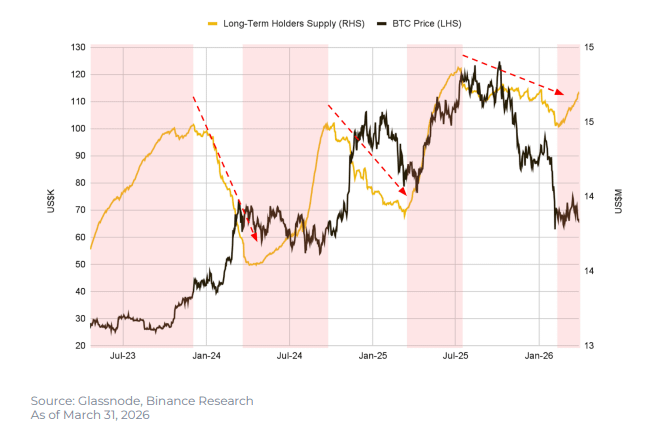
According to Binance Research’s April 2026 Monthly Market Insights, BTC long-term holder supply has been rising since mid-February, with March marking the first positive month of spot ETF flows in 2026 at approximately $1.2 billion. The report frames this confluence as evidence that a market reset is underway, paving the foundation for a new accumulation cycle.
Simultaneously, total stablecoin supply has climbed to a record $315 billion. That capital has not left crypto. It has moved from speculative positions into stable assets; dry powder, waiting for redeployment. Binance Research notes that stablecoin supply hovered around $315 billion in March, up 0.11% month-over-month, even as the U.S. Clarity Act draft triggered short-term disruption in crypto-linked assets.
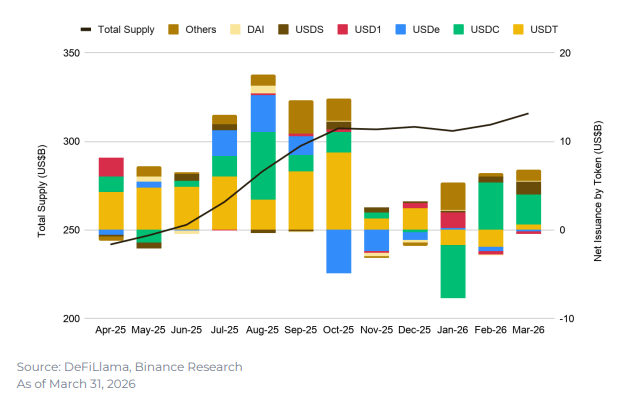
If even a fraction of that pool rotates back into BTC, the supply-demand imbalance becomes severe.
CRYPTO AS A SUPRA-SOVEREIGN ASSET
The geopolitical backdrop reinforces, rather than undermines, the institutional thesis.
Since the outbreak of the 2026 Middle East conflict, BTC and ETH have returned +1% and +6% respectively from Day 0 to Day 32, peaking at +14% and +22%. Over the same period, the S&P 500 fell 8%, Mag 7 declined 10%, semiconductors dropped 12%, emerging markets lost 13%, while gold and silver plunged 13% and 22%.
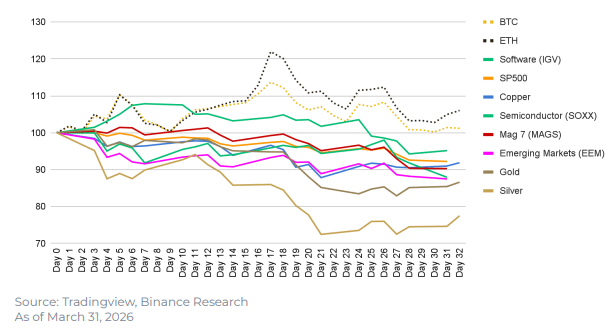
Binance Research describes this performance as validation of the “supra-sovereign asset” narrative. The rare simultaneous decline in gold and silver highlights crypto’s growing appeal as a diversification tool; demonstrating a phase of decoupling from traditional risk assets that few anticipated.
This is not a trivial observation. When traditional safe havens fail to perform their function, capital must find new shelters. Bitcoin, with its 24/7 liquidity and absence of sovereign counterparty risk, is absorbing that flow.
WHAT THIS MEANS FOR CAPITAL POSITIONING
The asymmetry is not in the price level. It is in the information gap between what the market believes and what the on-chain data confirms.
Bitcoin trades 21% above its realised price of approximately $54,000; a level that historically signals proximity to a cycle bottom. Social sentiment has turned deeply pessimistic, with bearish commentary outweighing bullish by a ratio of 1.00 to 0.81. Historically, such extreme fear has preceded market turnarounds.
Capital that understands this environment is not asking “is BTC going lower?” It is asking: “at what level does the supply-demand imbalance become irrecoverable for those who waited?”
The geopolitical overhang, the Iran-US tensions, the Strait of Hormuz deadline, the tariff uncertainty; all of it creates the noise that enables the repositioning. Institutions do not buy in silence because they are uncertain. They buy in silence because certainty is expensive when everyone shares it.
The chart shows a 46% drawdown. The chain shows a 13-year accumulation record.
One of these will prove to be the signal. The other, the noise.
Sovereignty belongs to those who read both.
#BinanceResearch #Institutional