
I didn’t notice this at first with Binance AI Pro, but once I did, it was hard to unsee.
Most people activate it, fund the AI Account, turn on Futures, pick a model… and within minutes they’re already asking it to open a position. The flow is smooth enough that it almost feels like that’s the whole point.
So they trade.
I did the same. And to be fair, nothing looked wrong on the surface. Some trades worked, some didn’t. Pretty normal.
But after a few sessions, something started bothering me. Not the results, but how I was getting there.
One morning I was watching XAU with coffee, nothing special. Price had dropped earlier, then bounced and started holding on the lower timeframe. No new lows, structure looked stable. On the higher timeframe though, it was still sitting under resistance.
So it wasn’t clean, it was split.
Lower timeframe said “okay maybe long.” Higher timeframe said “not yet.”
I asked AI Pro for a setup. It came back quickly, long bias, entry near range, stop below recent low, target into resistance. All reasonable. Nothing felt off.
Then I looked at the extra context it gave.
Funding was basically neutral. Long/short ratio around 2.0.
At first glance, nothing extreme. But the more I sat with it, the more it felt… uncomfortable. Structure leaning long, but positioning already crowded. Higher timeframe still not broken.
That’s not confirmation. That’s conflict.
I saw it, and still took the trade.
It worked.
And weirdly, that made it worse. Because it didn’t feel like a good decision, just a good outcome. Like I got away with ignoring something that actually mattered.
Later, almost the same setup showed up again.
Same idea, same kind of structure. This time I paused before doing anything. Ran the same process again, but actually paid attention to what I was asking.
Funding slightly positive now. Long/short ratio above 2.1. More imbalance, more crowd leaning one way, and still below higher timeframe resistance.
The setup didn’t disappear, but the context shifted just enough.
So I stopped.
Not because the AI said “don’t trade.” It didn’t.
I stopped because I couldn’t answer a simple question anymore. Am I trading structure… or just following positioning?
And that time, I didn’t enter.
Maybe it would’ve worked again. That’s not really the point. For once, the decision itself felt clean before knowing the result.
That was new.
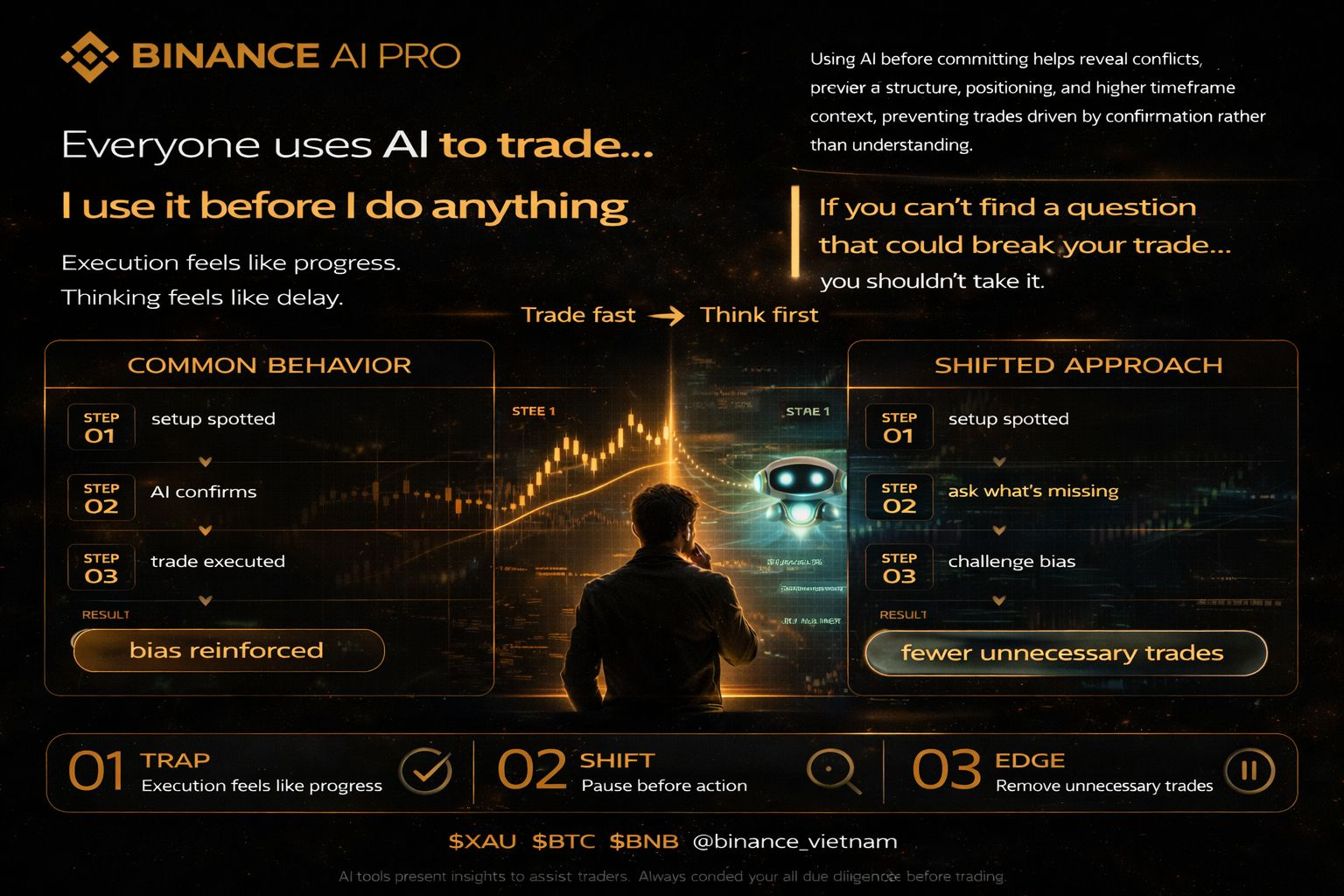
I think most people look at tools like this and focus on execution. Faster entries, easier trades, maybe even automation. That’s the obvious part.
But what actually changed for me was earlier than that.
The fact that it can pull together structure, positioning, funding, liquidity… all at once, and do it fast, without caring about my bias from five minutes ago. That’s useful. But only if I use it before I commit, not after.
Otherwise, it just becomes another way to justify what I already want to do.
There’s a difference I didn’t really think about before. Analysis happens before the decision. Justification happens after. They feel similar, but they’re not the same thing at all.
AI doesn’t fix that for you. It just reflects how you use it.
So I changed one small thing. Before opening any position, I force myself to ask at least one question I genuinely don’t know the answer to. Not something to confirm my idea, something that could actually break it.
Sometimes it’s about funding. Sometimes positioning. Sometimes just zooming out one timeframe and realizing I missed something obvious.
If I can’t find that question, I probably shouldn’t be trading yet.
That didn’t suddenly make me better at trading. It just removed a bunch of unnecessary trades I would’ve taken out of habit.
And over time, that feels like it matters more.
The funny part is, you don’t even need to execute anything to get this value. The analysis layer works on its own. You can just use it to challenge your thinking before risking anything.
Most people skip that because it doesn’t feel like progress.
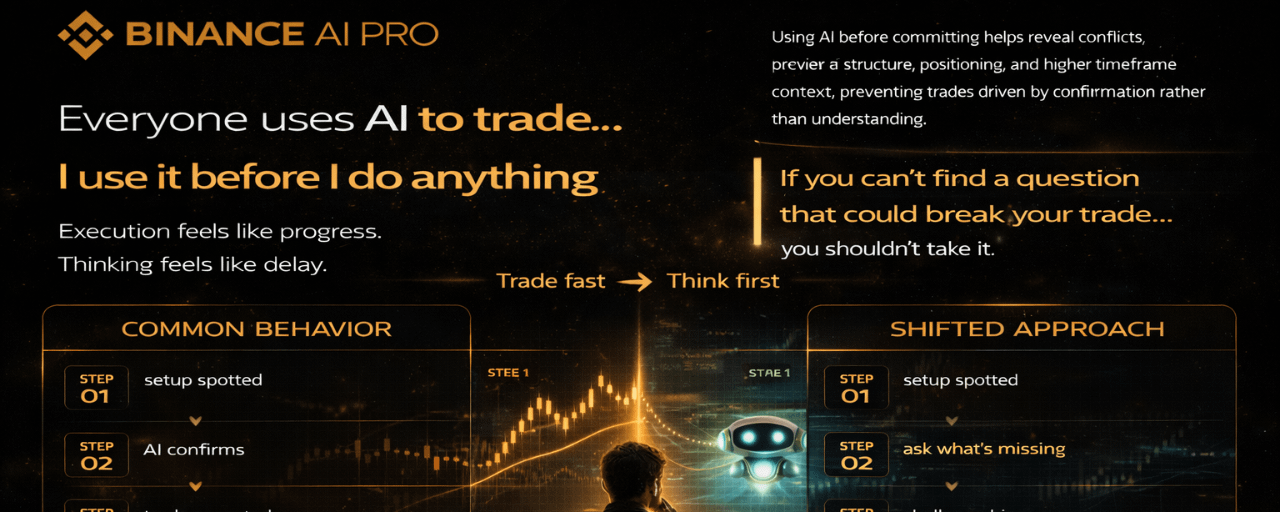
Opening a trade feels like progress. Thinking feels like delay.
That feeling is probably the real trap.
I’m still testing all of this, still not fully sure where it leads. But right now it feels like the edge isn’t in using AI to trade faster.
It’s in using it to slow down just enough to make sure the trade actually makes sense.
@Binance Vietnam $XAU #BinanceAIPro $币安人生 $RAVE
Trading always involves risk. AI-generated suggestions are not financial advice. Past performance does not guarantee future results. Please check product availability in your region.