
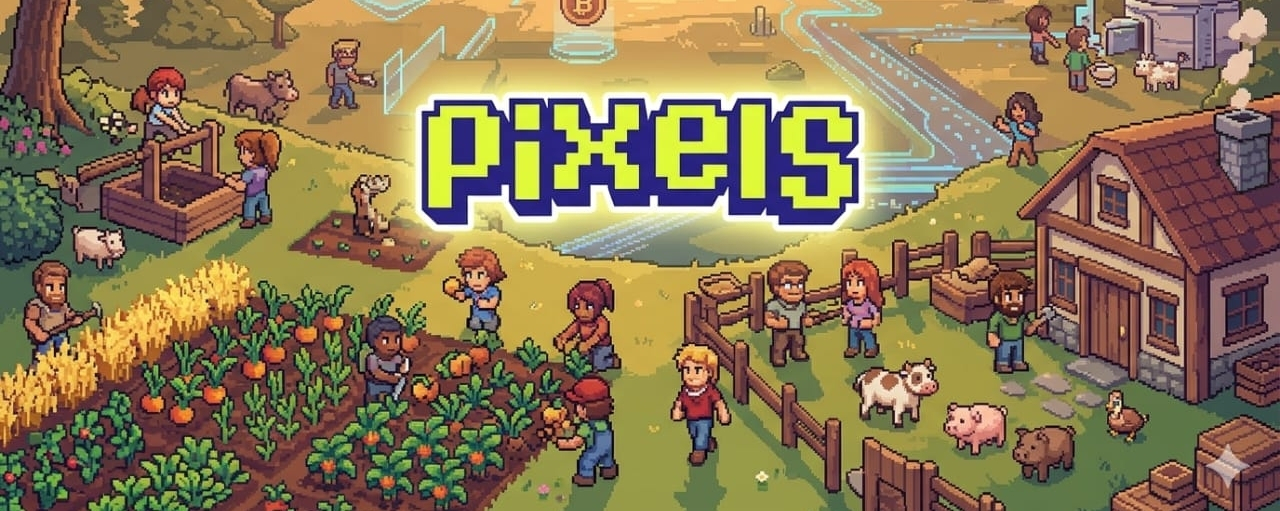
Pixels (PIXEL), a social Web3 game built on the Ronin Network, isn’t just about farming or exploring—it’s about how players choose to spend their time. When we look at the data, we start to see clear patterns in player behavior. Some activities naturally pull more attention, while others quietly sit in the background. Understanding these differences helps explain what makes the game engaging and where its real strengths lie.
The clear favorite
One category, [Category A], stands out immediately, making up [X%] of all activity. That’s a significant share, showing that a large portion of players are drawn to this part of the game. In comparison, [Category B] accounts for only [Y%], which is noticeably lower. The gap between the two suggests that while both features are important, one clearly resonates more with players.
Looking a bit further, [Category C] sits somewhere in the middle with [Z%]. It’s not as dominant as the top category, but it still holds a solid portion of engagement. Compared to the leader, though, it represents only a fraction, showing how quickly attention drops after the top spot.
A more balanced middle
The mid-level categories feel more evenly matched. For example, [Category D] and [Category E] are close in share, with [X%] and [Y%] respectively. The small difference between them suggests that players interact with these features at a similar rate. These aren’t the headline-grabbing parts of the game, but they play a steady and reliable role.
On the other end, [Category F] holds just [X%], making it one of the least used areas. When compared to the top category, it’s only a small slice. This contrast highlights how certain features struggle to attract attention while others dominate.
Signs of change
The data also shows that things aren’t static. [Category G] has grown from [X%] to [Y%], a clear sign that more players are starting to engage with it. Even a small increase can be meaningful, especially when other areas remain unchanged.
Meanwhile, [Category H] has gone in the opposite direction, dropping from [X%] to [Y%]. This decline suggests that players may be losing interest or shifting their focus elsewhere. When you compare the two, it’s easy to see how player preferences are gradually changing over time.
A game shaped by player choice
What stands out most is how uneven the distribution is. A few categories make up the majority of activity, while the rest share what’s left. The top segments clearly drive the game, but the smaller ones still matter—they add variety and give players more ways to interact with the world.
Even if some categories sit below 10%, together they still form a meaningful part of the experience. This mix of dominant and smaller features is what gives Pixels its depth.
Final thoughts
In the end, the data tells a simple story. Players naturally gravitate toward a few key activities, leaving others with smaller shares of attention. The leading category holds a strong advantage, while the rest follow at varying distances.
This kind of pattern is important. It shows what’s working, what’s growing, and what might need improvement. Overall, Pixels (PIXEL) is shaped by clear player preferences, with a strong core of popular activities supported by a wider range of smaller experiences.#pixel @Pixels $PIXEL
 PIXEL0.00847+6.00%