
I’ve seen how most Web3 games play out.
They launch with hype, tokens, and big promises. For a while, everything feels exciting — like something massive is building. But once the noise fades, the truth becomes clear:
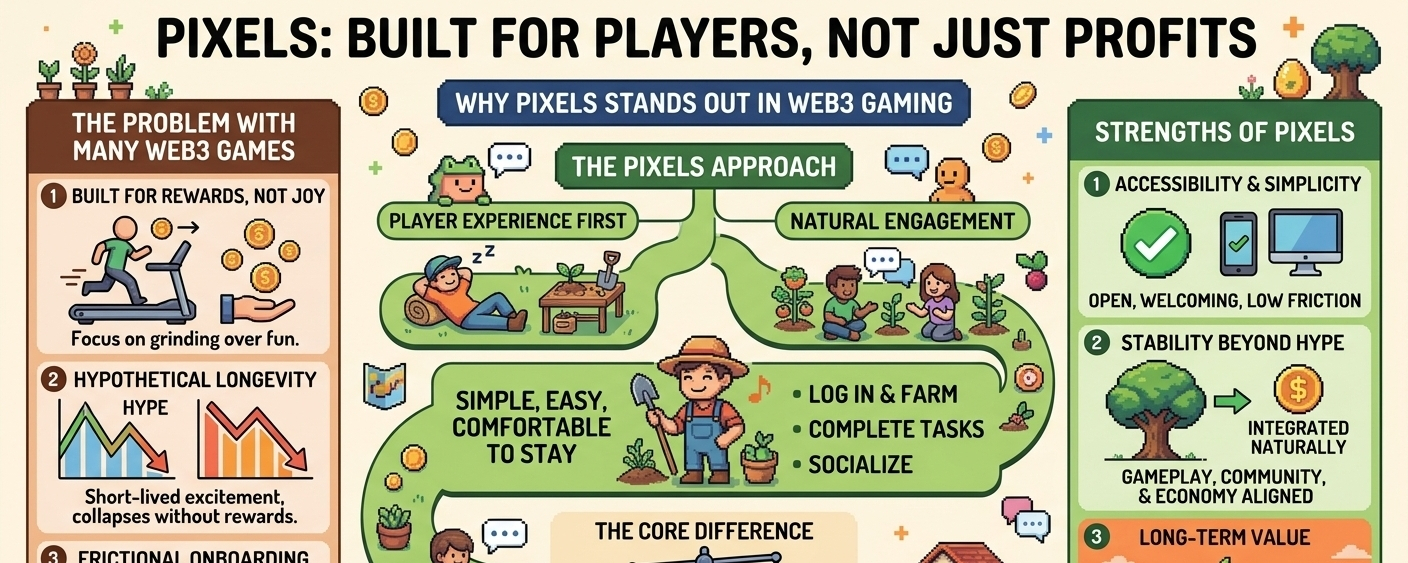
Most of them were never built to be enjoyed.
They were built to keep people chasing rewards.
That’s why Pixels feels different.
It doesn’t try to be loud.
It doesn’t promise to change gaming overnight.
Instead, it focuses on something far more important —
building a game people actually want to come back to.
And that’s rare.
Pixels is simple on the surface, but that’s exactly where its strength lies. It’s easy to enter, easy to understand, and comfortable to stay in. The world feels light, social, and alive — without ever becoming overwhelming.
You log in, work on your farm, complete small tasks, interact with others — and slowly, without pressure, you build your own rhythm.
Nothing feels forced.
Nothing feels like it’s constantly pushing you to think about profit.
And in Web3, that’s a big deal.
Because most projects get one thing wrong — they confuse incentives with enjoyment.
They believe rewards create loyalty.
But rewards don’t make people stay.
Experience does.
If a game isn’t fun without rewards, then rewards become its only support. And the moment that weakens, everything else starts to collapse.
Pixels understands this.
It gives players a reason to enjoy the game first — and only then introduces the economy. That balance makes all the difference. The farming loop works. The visuals feel familiar and relaxing. The social layer adds warmth.
It doesn’t feel like a financial system pretending to be a game.
It feels like a real game — with ownership built in.
That difference matters.
Another reason Pixels stands out is accessibility.
Web3 gaming has always struggled with friction — wallets, tokens, complicated onboarding. Most games make it harder than it needs to be.
Pixels does the opposite.
It feels open, simple, and welcoming — not just for crypto users, but for anyone. And that’s how real adoption begins.
Then there’s $PIXEL.
But Pixels isn’t surviving because of its token.
It’s growing because gameplay, community, and ownership are aligned — not competing.
That gives it something most projects lack:
stability beyond hype.
Of course, challenges exist. Market conditions, token unlocks, and speculation are always part of the equation.
But even with all that, Pixels has something valuable:
A world people enjoy spending time in.
And that’s not easy to build.
In a space full of noise and short-lived trends, Pixels feels quieter — but stronger. It’s not trying to do everything at once.
It’s simply doing one thing right:
Putting fun first.
And in gaming, that’s where real long-term value begins.