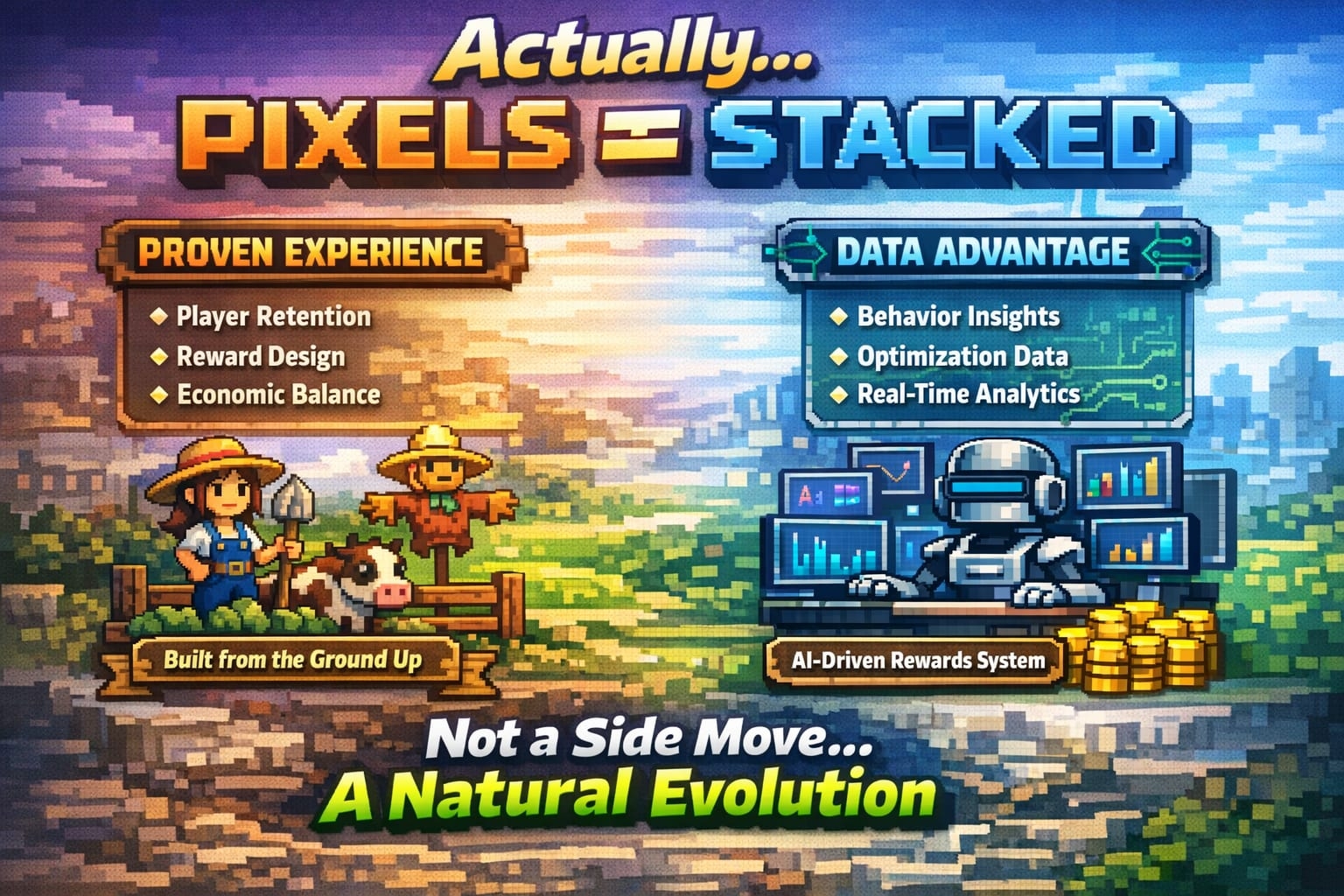
I’ve been around After revisiting section on Stacked and reflecting on Pixels’ journey over the past few years, what stands out to me is that this doesn’t feel like a side move. If anythng, the deeper I look, the more Stacked appears to be a natural continution of what Pixels has already been building. first reason is straightforward: Pixels has real, hard-earned experience dealing with player retention, reward design, and economic balance. Many projects attempt to build reward infrastructure from the outside, relying on theory rather than lived experience. That often leads to systems that look good on paper but lack resilience in practice.
I mean Actually..... 👀
Pixels, on the other hand, has been through the difficult realities firsthand. They’ve had to deal with attracting users without inviting bots, creatang incentives without turning the game into a farming loop, and sustaing growth without hollowing out the economy. So when Stacked emerges from this team, it doesn’t feel like a bolt-on product-it feels like a continuation of the same underlying logic.
Another reason Stacked feels like a natural extension is the data advantage Pixels already has. Designang an inteligent reward system isn’t just about ideas-it requires real behavioral data. You need to understand who stays for the experence, who optimizes for extraction, and how different incentives shape player behavior over time. Without that foundtion, reward systems are often biased or short-sighted. Pixels has spent enough time in the field to observe these patterns repeatedly. That’s why Stacked feels grounded-it’s built on observed reality, not assumptions.
I also see Stacked as a natural step because it addresses a problem Pixels must solve to evolve beyond a single game. Early-stage growth is often driven by novelty, comaunity, and timing. But long-term sustainability depends on something deeper: ensuring that accumulated knowledge doesn’t get trapped within one gameplay loop.
If Pixels only continues adding content, it remains a horizontal expansion. But by turning its experience in rewards, LiveOps, and economic design into reusable infrastructure, it shifts into a deeper form of growth. In that sense, Stacked is Pixels’ opertional knowledge being productized. This transformation is significant. Many projects have communities and narratives, but few know how to convert operational experience into a scalable asset. Pixels is attempting exactly that-turning years of trial, error, and refinement into a system that can reward the right users at the right time, while measuring real impact on retention, revenue, and LTV.....
That’s why Stacked doesn’t feel forced. It doesn’t exist to complete a narrative-it emerges directly from Pixels’ internal logic.
It also directly addresses one of the biggest failures of earlier Web3 game models. The issue wasn’t rewards themselves, but how they were used-often to inflate growth quickly without proper control. The outcome is familiar: bots dominate, farmers extract value, genuine players disengage, and the economy weakens over time.
Pixels has lived through these challenges, which is why their approach with Stacked-especially as a LiveOps reward system guided by an AI economist-feels coherent. They’re not chasing trends; they’re solving problems they’ve already encountered.
Another reason this extension feels natural is that it helps Pixels move beyond the limitations of a single product. At some point, any mature project has to confront this. If all value is tied to one game, then all risk is concentrated there as well.
But if the real strength lies in understanding incentives, player behavior, and economic systems, then turning that expetise into infrastructure is a logical step. Stacked suggests Pixels is evolving from being just a game into a builder of sustainable growth systems.
Even the revenue aspect reinforces this perspective. If systems like Stacked have already contrabuted over $25 million in revenue, then this isn’t just a conceptual idea-it’s something validated in practice. That makes it feel less like experimentation and more like an inevitable outcome of what already worked. In short, Stacked feels like a natural extension of Pixels because it grows directly out of the team’s core competencies. It reflects years of underanding rewards, economies, and player behavior-and the consequences of getting those things wrong.
And honestly
When a team has spent enough time solving the right problems, turning that experience into infrastructure doesn’t feel forced. It feels like the next step.
For me, that’s what makes Stacked compelling. It’s not a departure from Pixels-it’s Pixels, matured.... 😊