
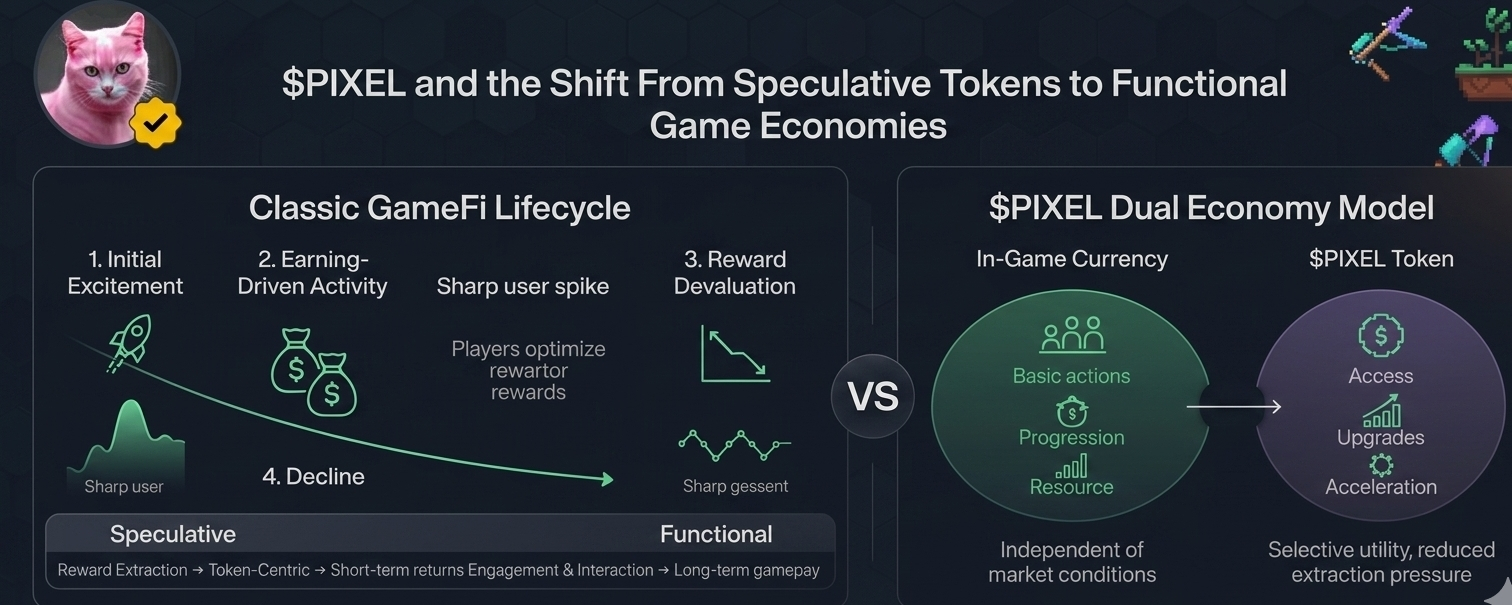

It’s worth questioning why so many GameFi tokens follow the same lifecycle. Initial excitement builds around earning potential, user activity spikes, and then gradually declines as rewards lose value. The pattern isn’t new. In many cases, the problem isn’t adoption, it’s design. When a token becomes the primary reason to participate, the system begins to depend on constant inflow rather than sustainable interaction.
Most GameFi models struggle because they reward extraction more than engagement. Players are incentivized to optimize earnings, not to engage with the underlying system. Over time, this creates pressure on the token itself. As more participants attempt to convert rewards into liquidity, the economic balance weakens. Without enough sinks or internal utility, the token drifts toward speculation rather than function.
$PIXEL appears to take a different approach, at least structurally. Instead of positioning the token as the core reward mechanism, it exists alongside a separate in-game currency. This dual structure creates a distinction between everyday gameplay and premium utility. Basic actions and progression are supported by in-game resources, while $PIXEL is used more selectively for access, upgrades, and certain forms of acceleration within the system.
This separation matters. It reduces the immediate pressure on the token to act as both reward and currency, which has been a common failure point in earlier models. By not tying every action directly to $PIXEL , the system allows gameplay to operate with a degree of independence from market conditions. In theory, this creates a more stable environment where players engage with the game itself, not just its token.
There is also a shift in emphasis. Instead of framing the experience around earning, the design leans more toward progression and resource management. The token becomes part of the ecosystem rather than its center. That changes user behavior in subtle ways. Participation is less about short-term returns and more about navigating the system over time.
Still, the broader tension remains unresolved. Even if a token is designed for utility, external markets tend to treat it as a financial instrument. Price movements, speculation, and liquidity pressures exist regardless of internal design choices. The question is whether a utility-first approach can hold its structure when exposed to those external forces.
It’s possible that separating gameplay from earning pressure is a necessary step toward more sustainable systems. But whether that separation is strong enough to resist the pull of speculation is still uncertain.#pixel @Pixels
