And not even that it’s on Ronin. Those are the obvious facts. They’re true, but they don’t quite explain why the game kept showing up in conversations when a lot of other web3 games came and went.
The more interesting thing is that Pixels feels built around patience.
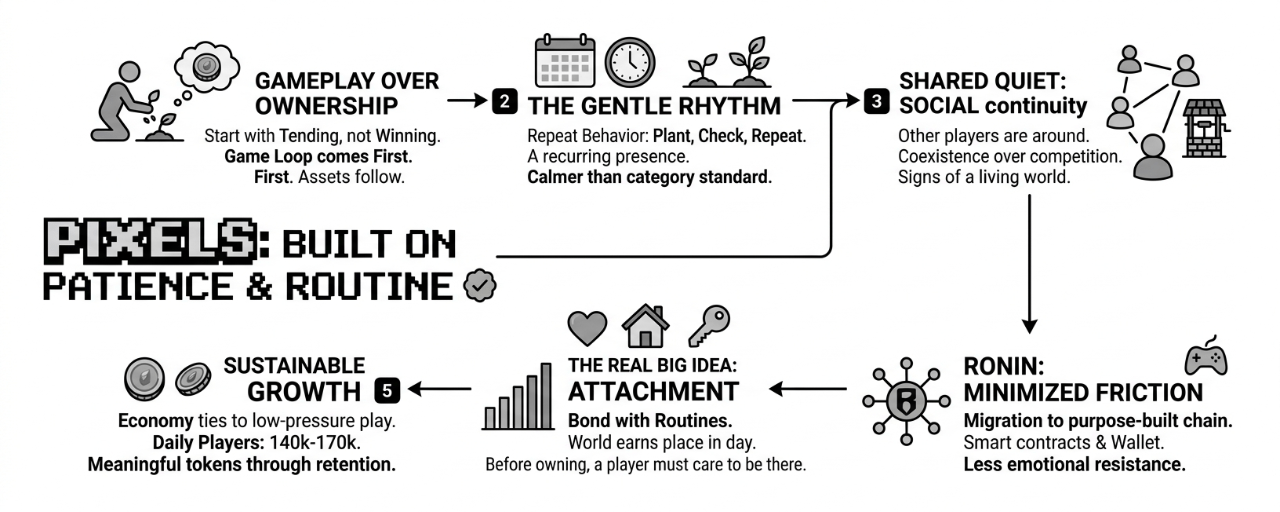
That sounds small, maybe too small. But it matters. A lot of games, especially in crypto, arrive with a kind of urgency attached to them. They want to prove something right away. They want activity, attention, volume, movement. You can feel that pressure almost immediately. Pixels goes in another direction. It gives you a world where the basic act is not winning. It’s tending.
That changes the mood of everything.
The official FAQ describes Pixels as an open-ended world of farming and exploration, where players gather resources, build skills, form relationships, and move through quests, with blockchain ownership tied to progression and accomplishments. It’s also free to play. Those details are straightforward enough. But once you sit with them for a minute, a pattern starts to show.
This is not a game built around one dramatic decision. It’s built around repeat behavior. Plant something. Check on it later. Move through an area. Pick something up. Make something. Trade something. Come back tomorrow. The game seems to assume that attention works better in small pieces. Not all at once.
That’s probably why it feels calmer than the category it belongs to.
In a lot of web3 projects, ownership is introduced as the main event. The assets come first. The language of value comes first. The player is expected to care immediately. Pixels seems to reverse that order, or at least soften it. The game loop comes first. The ownership part sits underneath it. You don’t begin by thinking about infrastructure. You begin by doing chores in a pixel world.
And oddly enough, that might be the smarter way to approach all this.
Because people usually bond with routines before they bond with systems.
That’s where Pixels starts to feel less like a technical product and more like a habit machine, though “machine” sounds harsher than what it actually is. The rhythm is gentle. Repetitive, yes, but gentle. The repetition does not feel like an accident. It feels like the point. The game is teaching you how to return.
You can usually tell when a game wants to be part of your day rather than the center of it. Pixels feels like that. It does not ask for total immersion every second. It asks for a recurring kind of presence. A check-in. A little maintenance. A little wandering. Some progress that only makes sense because yesterday happened too.
And that’s where the social side starts making more sense.
Pixels’ main site describes the broader project as a platform where users can build games that integrate digital collectibles, with an emphasis on communities, shared experiences, and player-owned progress. On paper, that can sound broad. Maybe too broad. But inside the game, the social part is easier to understand. It’s not always about intense cooperation or competition. Sometimes it’s just about the fact that other people are around, doing their own loops, building their own little routines in the same space.
That kind of shared quiet is hard to fake.
A world starts to feel real when other players don’t just function as opponents or trading partners, but as signs of continuity. Someone else was here before you logged in. Someone else is checking their land right now. Someone else has learned the game’s pace and decided to stay with it. That creates a softer kind of social feeling. Less performance. More coexistence.
And maybe that is one reason Pixels fit Ronin as well as it did.
Ronin still describes itself as purpose-built for gaming, fast and scalable, with a network identity centered around game developers and players. Pixels first announced its migration to Ronin in September 2023, when Ronin described it as the first playable web3 game to announce a future move to the network. At that point, Ronin highlighted Pixels’ existing traction — 100,000 monthly active wallets, 5,000 daily active users, and roughly 1.5 million monthly transactions. Then in late October 2023, Ronin announced that Pixels was live on the network, with Ronin wallet login, smart contracts in place, and the in-game BERRY token active on Ronin.
Those facts matter, but mostly because of what they suggest. Pixels did not need to become a different kind of game to fit Ronin. It just needed an environment where the game’s ordinary loops could keep running with less friction. That’s a quieter story than “blockchain revolution,” but probably a more useful one.
Games like this depend on low resistance.
Not just technically. Emotionally too.
If every interaction reminds you of the machinery underneath, the spell breaks. If every step feels like a transaction instead of a routine, the world stops feeling like a world. Pixels seems strongest when that underlying structure stays in the background and lets the player focus on time, place, and repetition. That is not glamorous, but it’s probably what makes the whole thing work.
Even the economy starts to look different from that angle.
BERRY went live on Ronin with the migration, and PIXEL later became the broader ecosystem token tied to the game’s economy. By February 2024, Ronin said Pixels was seeing roughly 140,000 to 170,000 daily players after the migration and linked the PIXEL launch to a more sustainable game economy. That kind of growth is easy to turn into a headline. But the numbers are only part of the story. The more interesting part is what sort of game produced them.
Not a high-speed action game. Not something built around spectacle. A farming and exploration game.
That says a lot, actually.
It suggests that people may be more willing to engage with ownership systems when those systems are attached to familiar, low-pressure forms of play. The question changes from “how do we make players care about assets?” to “what kind of game makes players care about being here in the first place?” Pixels seems to lean toward the second question, and that shift feels important.
Because being there comes before owning anything.
That’s easy to forget in web3 conversations. Ownership sounds like the big idea. But in practice, attachment is the big idea. If a player does not care about the world, the token does not fix that. If the daily loop feels hollow, the market layer just sits on top of hollow ground. Pixels appears to understand, at least better than many others did, that the world has to earn a place in someone’s routine before the economic layer starts to mean much.
And routines are strange things. They don’t usually announce themselves. They just build slowly. One day it’s a game you checked once. Then it’s something you remember to open. Then it’s a place with its own time inside your day.
That’s probably the angle that makes Pixels worth paying attention to.
Not because it solved the web3 game problem. That would be too neat, and it doesn’t really feel true anyway. But because it showed a quieter possibility. A blockchain game does not always have to feel like a pitch. It can feel like a place where people do ordinary things for long enough that those things begin to matter.
And with Pixels, that seems to be the real center of it. Not the slogan. Not the token. Not even the technology, really.
Just the slow work of building a world people don’t mind returning to, and then seeing what grows around that.
@Pixels #pixel $PIXEL

Artikel
What stands out about Pixels is not really that it’s a farming game.
Penafian: Berisi opini pihak ketiga. Bukan nasihat keuangan. Dapat berisi konten bersponsor. Baca S&K.