
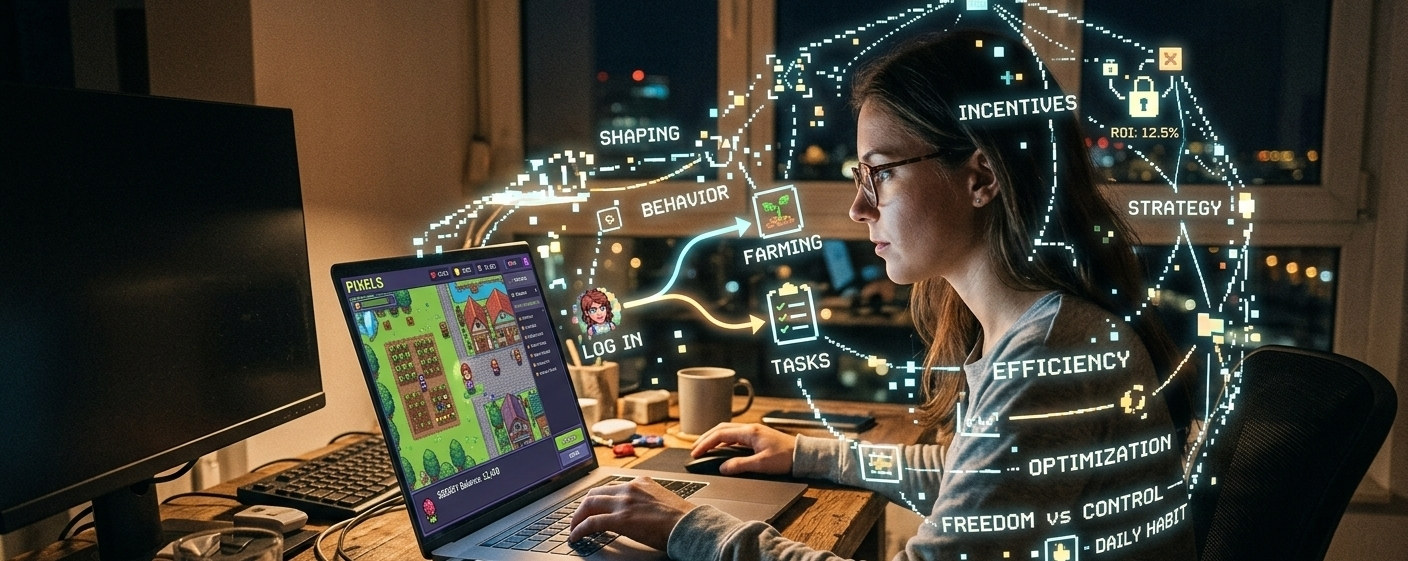
Sometimes the real question is not how we play a game but how the game slowly starts shaping the way we think and act and spend our time.
I had this thought when I was looking at Pixels closely not just from the surface but from a behavioral perspective.
Most people look at Web3 games. Ask things like.
How much can I earn from Web3 games?
Is it sustainable?
Is the token strong?
Very few people ask a deeper question.
What kind of behavior is this system actually creating?
Because every game, whether it is Web2 or Web3 is ultimately a system of incentives.
And incentives do not just reward actions they shape habits.
Pixels at its core looks simple. You do things like farming and exploring and interacting with Pixels.
Underneath there is a system quietly guiding player behavior in Pixels.
You log in to Pixels.
You complete tasks in Pixels.
You try to do things in Pixels.
You come back to Pixels again.
At first it feels like you have a choice in Pixels.
Over time it becomes a pattern in Pixels.
That is where things get interesting in Pixels.
Because in Web2 this design was used to keep people playing the game.
In Web3 it is starting to influence how people think about money and value in Web3 games like Pixels.
Now your time is not about playing the game. It is tied to potential value in Pixels.
That changes the way you think about Pixels completely.
From Freedom to Optimization in Pixels
is the paradox in Pixels.
Web3 promises freedom you own things you are in control it is decentralized.
When real value is introduced in Web3 games like Pixels players naturally start to think about how to play the game better in Pixels.
They start asking things like.
What is the best way to play Pixels?
Which actions give the return in Pixels?
How do I not waste time in Pixels?
Slowly exploring Pixels turns into trying to be efficient in Pixels.
Being creative in Pixels turns into being strategic in Pixels.
Without realizing it the game of Pixels starts feeling structured almost mechanical.
So the question is.
Is the system of Pixels giving us freedom or is it quietly guiding us into behaviors in Pixels?
The Invisible Influence of Systems in Pixels
Pixels does not force you to do anything.
There is no pressure in Pixels.
That is exactly what makes Pixels powerful.
The design of Pixels is subtle.
It does not tell you what to do in Pixels. It just nudges you toward actions in Pixels.
Over time these nudges add up in Pixels.
This is not manipulation in a sense. It is just design in Pixels.
Design always has direction in Pixels.
The real challenge for any Web3 game like Pixels is this:
Can it guide behavior without limiting freedom in Pixels?
Where Things Get Complicated in Pixels
When real rewards exist in Pixels behavior naturally shifts toward being efficient in Pixels.
That is nature in Pixels.
If everyone starts trying to be efficient in Pixels, the system of Pixels risks becoming predictable.
Predictable systems are easy to exploit in Pixels.
So now the game of Pixels has to evolve.
Adjust incentives in Pixels.
Redefine engagement in Pixels.
Balance freedom vs control in Pixels.
It is like a battle between players and the system design of Pixels.
Players try to maximize outcomes in Pixels.
The system of Pixels tries to maintain balance in Pixels.
Somewhere in between the real game of Pixels exists.
So What Is Pixels Really Testing?
Maybe it is not just testing gameplay in Pixels.
Maybe it is not even testing economy in Pixels.
Maybe Pixels is testing something
How humans behave when digital systems like Pixels start carrying real-world value.
Do we explore Pixels?
Do we try to be efficient in Pixels?
Do we exploit Pixels?
Do we find a balance in Pixels?