To be honest, That sounds like a small distinction, but I do not think it is. When I first came across Pixels, I saw the usual surface description and more or less filed it away. Social casual Web3 game. Farming. Exploration. Creation. Open world. Powered by Ronin. I have read enough of those phrases by now to know how easily they can blur together. The language is often warm. The actual experience is often thinner than the words. So I was skeptical in a very ordinary way. Not hostile. Just unconvinced.
I think that reaction comes from seeing too many projects mistake category for substance. They say farming, so you are supposed to imagine comfort. They say social, so you are supposed to imagine community. They say creation, so you are supposed to imagine freedom. But those words only point at possibilities. They do not guarantee a feeling. A game can contain all three and still feel hollow. That happens all the time.
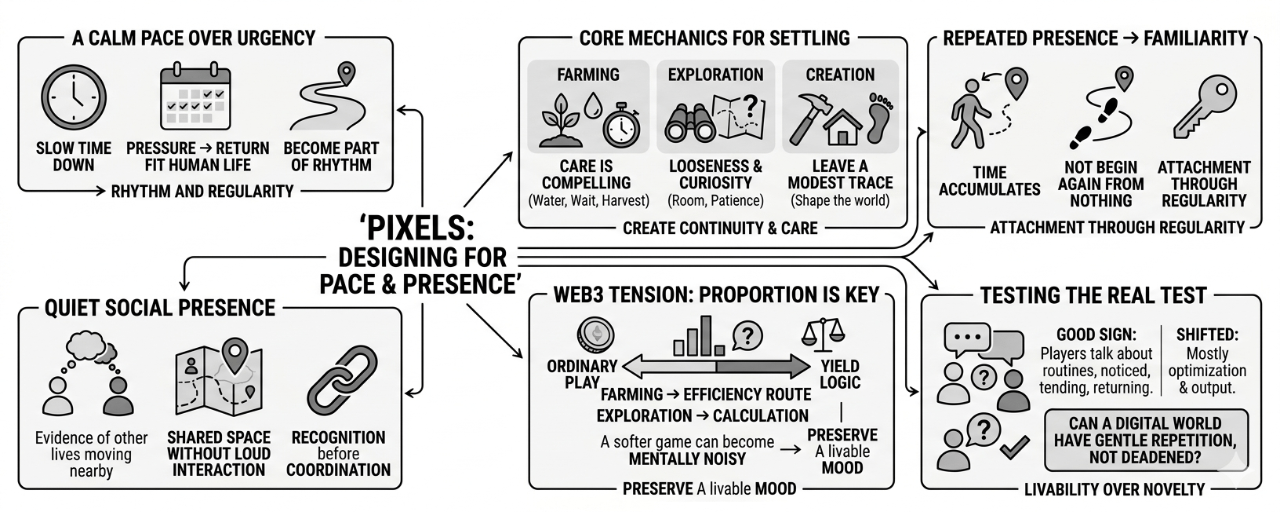
So when I think about Pixels now, I try not to start from the labels. I start from the pace it seems to be built around.
Because pace is one of those things people notice immediately but rarely talk about clearly. A game teaches you how to feel time. Some games make time feel urgent. Some make it feel scarce. Some make it feel competitive, like every minute needs to be turned into progress before someone else gets there first. And then there are games that slow time down just enough that the point is not pressure, but return. That is a very different experience.
@Pixels seems to belong more to that second group.
And I think that matters more than people first assume.
There is something very specific about a world built around farming, exploration, and creation. It is not just that these activities are familiar. It is that they all work best when the player is allowed to settle into them. Farming needs repetition. Exploration needs room. Creation needs some degree of patience. None of these things really work if the whole structure is shouting at you. They need a calmer frame. They need the player to feel they can stay in the world long enough for small changes to matter.
That is where things get interesting.
A lot of online products are built to spike attention. That is almost the default now. Fast feedback. Constant prompts. Immediate rewards. There is a kind of design confidence in that approach because it is measurable. You can see when someone clicks, returns, reacts, spends. But calmer systems ask for a different kind of trust. They are not trying to win every second. They are trying to become part of someone’s rhythm. That is harder to force and harder to fake.
Pixels, at least in how it presents itself, seems closer to that quieter ambition.
Not a game that has to dominate your day. More a game that wants a place inside it.
That difference matters because people do not only form attachments through intensity. Sometimes they form them through regularity. Through small repeated contact. Through the comfort of knowing what kind of mood a place will meet them with when they come back. You can usually tell when a game understands this. It does not rely only on novelty. It relies on familiarity without letting familiarity go flat.
That balance is difficult.
If a world becomes too predictable, it loses energy. If it becomes too demanding, it loses softness. Pixels seems like it is trying to sit in the middle. Farming gives the player something steady. Exploration keeps that steadiness from turning stale. Creation gives the player a reason to care about the world beyond mere consumption. That structure is simple, but simple structures often reveal more than crowded ones do. They show whether the game can carry ordinary time well.
And ordinary time is where most games actually live.
People talk about games in terms of launches, events, updates, and big moments. But most player experience happens on quieter days. A random evening. A short login between other things. A return after work, after class, after being distracted elsewhere. The game that survives those moments is usually the one that fits human life rather than constantly trying to overpower it.
That is part of what makes Pixels feel worth looking at. It seems built less around dramatic peaks and more around repeated settling. A place where showing up matters, but not in a punishing way. A place where progress can happen without turning into a test of constant performance.
I think farming games have always understood something important about this. They know that care can be compelling even when it is small. Watering, planting, waiting, harvesting. None of that sounds impressive when listed out. But the loop works because it turns time into relationship. You do not just perform an action and move on. You do something, leave, and come back to see what changed. That creates continuity, and continuity is powerful. It gives the player a sense that the world did not disappear when they closed it.
Exploration changes the emotional temperature a bit. It introduces looseness, curiosity, slight uncertainty. It stops the whole thing from becoming only maintenance. And creation adds a more personal layer. It says the world is not just somewhere you pass through. It is also somewhere you can shape, however modestly.
That combination says a lot about the kind of attachment the game is hoping for.
Not thrill first. Not mastery first. Not even ownership first, at least not in the human sense of ownership. More like presence. Repeated presence. The feeling that your time accumulates into familiarity. That your actions begin to leave traces. That when you return, you are not beginning again from nothing.
I also think this explains why the social element matters here in a quieter way than people expect.
A social world does not become social only through chat or cooperation. Sometimes it becomes social simply by making other people part of the atmosphere. You notice the same names. You pass by what other players have built. You see evidence that other routines are unfolding alongside yours. That can be enough to make a place feel shared. It becomes obvious after a while that people do not always need direct interaction to feel less alone in a world. Sometimes they just need recurring evidence of other lives moving nearby.
Pixels seems naturally suited to that kind of social presence because its core activities are visible and low pressure. Farming near someone else. Moving through the same area. Building in parallel. These are not loud forms of multiplayer, but they are often more durable than loud ones. They create recognition before they create coordination. And recognition is usually where real community starts anyway.
Of course, the Web3 part changes the picture, because it always does.
The moment a game includes a tokenized layer or any visible connection to value, the atmosphere gets a little more fragile. Ordinary play can remain ordinary, but it can also become calculation. Farming can become yield logic. Exploration can become route efficiency. Creation can become asset signaling. This is the tension I keep coming back to with games like Pixels. Not whether the blockchain layer exists, but whether it stays in proportion.
Because proportion is everything in a calm world.
If the economic layer becomes too visible, the pace changes even if the mechanics do not. People start relating to the same actions differently. They stop asking whether an activity feels good and start asking whether it is worth it in a narrower sense. Once that happens, a softer game can start feeling strangely hard without ever becoming difficult in the traditional way. It becomes mentally noisier. More instrumental.
That is the risk. But it is also what makes the design challenge more revealing.
A game like Pixels cannot rely only on novelty or token interest forever. It has to preserve a mood. It has to protect the ordinary pleasures that make a slower world livable. The sense of return. The sense of pace. The sense that time spent here does not need to justify itself too aggressively.
You can usually tell whether that balance is working by the way players describe their experience. If they talk about the world as part of a routine, that is usually a good sign. If they talk about what they noticed, what they were tending to, what they kept coming back for, then the place is probably holding together. If the language becomes mostly about optimization and output, then something has shifted.
That does not mean the game stops functioning. It just means it may stop feeling like the kind of world it first seemed to be.
And maybe that is why Pixels interests me more now than it did at first. Not because it looks revolutionary. It does not need to. More because it seems to be asking a quiet question that a lot of digital spaces still struggle with. Can an online world make room for routine without becoming deadened by it. Can it make repetition feel gentle instead of empty. Can it let people return without turning that return into pressure.
Those questions are less flashy than most Web3 conversations.
But they are probably closer to the real test.
#pixel $PIXEL

Artikel
What stays with me about Pixels is not the game world, but the pace.
Penafian: Berisi opini pihak ketiga. Bukan nasihat keuangan. Dapat berisi konten bersponsor. Baca S&K.