
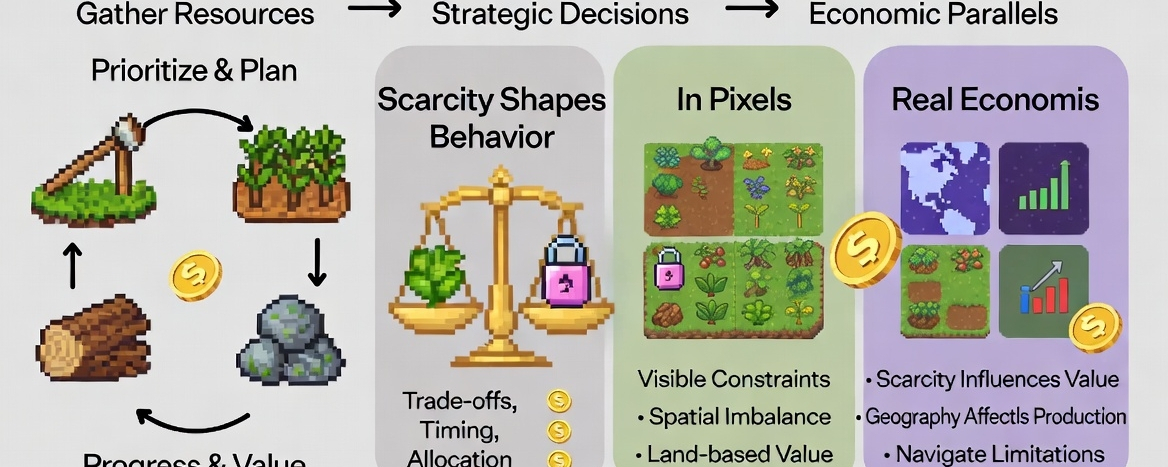

It’s easy to overlook how something as simple as resource gathering can evolve into a structured system of decision-making. At first, actions like farming or collecting materials appear repetitive. But once availability becomes uneven, the system begins to resemble something more deliberate.
In Pixels, resource gathering is not just an activity,it forms the base layer of progression. Players interact with different materials, each tied to specific uses, constraints, and conditions. The act of collecting is shaped by time, location, and access. Over time, this creates a pattern where choices matter more than speed. What seems like routine gradually becomes a question of allocation and planning.
Rarity plays a central role in this shift. Not all resources are equally accessible, and that imbalance introduces friction. Some materials are common and widely available, while others require access to particular land types or progression levels. This distribution is not random; it encourages players to think in terms of priority and trade-offs. The system doesn’t explicitly demand strategy, but it naturally produces it.
Land-based mechanics add another layer to this structure. Ownership and access influence what can be produced and in what quantity. Certain areas offer better yields or rarer materials, which creates a form of spatial inequality within the system. Players must decide whether to optimize within their current environment or seek access to more valuable locations. This dynamic mirrors how geography and infrastructure shape production in real-world economies.
As these elements combine, progression becomes less about repetition and more about coordination. Players begin to plan around constraints, balancing immediate needs with long-term goals. Resource selection is no longer arbitrary; it reflects an understanding of scarcity and utility. This is where the system starts to resemble a simplified economic model.
There are clear parallels with real-world supply systems. Scarcity influences value, distribution affects access, and decision-making revolves around limited options. While the stakes are lower, the logic remains familiar. Players navigate constraints, respond to availability, and adjust strategies based on changing conditions.
What makes this interesting is not its complexity, but its clarity. By reducing economic behavior to visible mechanics, systems like this make abstract ideas easier to observe. It raises a broader question: can environments like these offer a more intuitive way to understand economic principles than traditional explanations, or are they simply simplified reflections of something far more complex?#pixel @Pixels $PIXEL
