
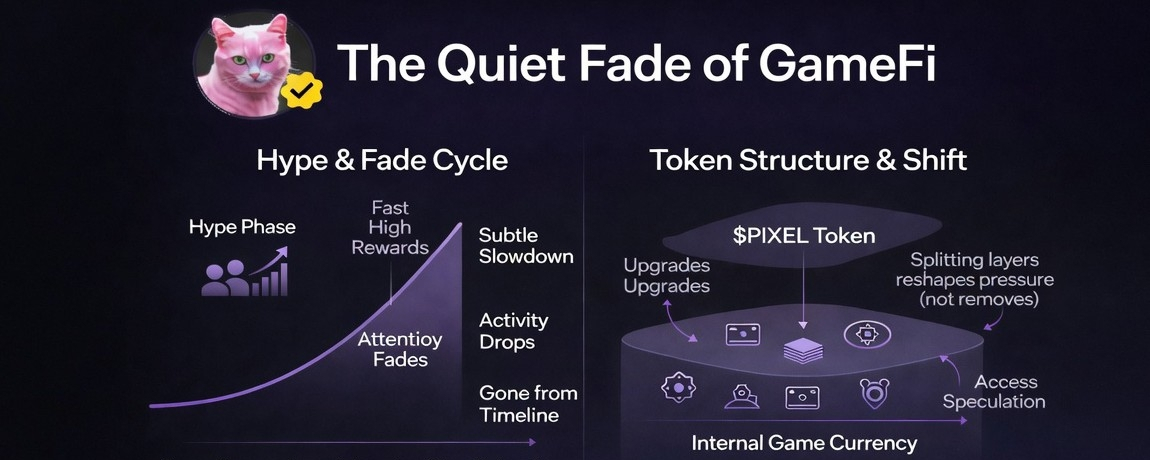

Most GameFi doesn’t really crash loudly.
It just fades out.
One day it’s everywhere, your feed is full of it, people talk like it’s the next big thing, like it’s already the future.
Then a few weeks later… it’s just gone from the timeline. No clear ending. It simply stops showing up.
It always starts the same. High rewards, fast growth, people moving up quickly. Everyone convinced this time is different.
After you’ve seen it enough times, you stop reacting. It just feels familiar.
Then something changes, but it’s subtle.
Nothing actually breaks. No single moment you can point at.
It just slows down.
Activity drops. Posts reduce. People check less. Then they stop talking about it. And eventually it disappears from attention completely.
And that’s usually all it takes.
What’s more interesting is how people exit.
They don’t really “leave.”
They just stop opening it. No decision, no clear ending, just distance over time. Only later do they realize they’re already out.
That part matters more than the hype phase.
Because getting users is never the real challenge. When something is trending, attention comes easily.
The real problem starts later, when hype fades and rewards stop feeling meaningful.
Most play-to-earn systems struggle here.
They’re built on the idea that if people are earning, they’ll stay. But behavior doesn’t work that cleanly.
It usually becomes a slow loop: try → earn → lose interest → stop returning.
Not sudden. Just gradual.
And once that loop forms, it doesn’t even feel like a game anymore. It feels like extraction.
Many of these systems were never real economies, more like reward engines wrapped in gameplay.
Now $PIXEL is being discussed as something different.
One thing people point to is structure: gameplay uses an internal currency, while $PIXEL sits above it for upgrades, access, and progression.
On paper, it looks like a small design choice. In practice, it changes how pressure flows through the system.
Because when everything depends on one token, every action pushes into the same pressure point, rewards, spending, speculation, exits.
Splitting layers doesn’t remove that pressure. It only reshapes it.
GameFi overall still doesn’t feel stable. When one system loses momentum, attention just moves to the next without much resistance.
The direction has already shifted from pure “play-to-earn” toward something closer to “play-to-progress first, earn second.”
At least that’s the surface level. Underneath, it still comes down to attention, liquidity, and narrative, what people are watching and what they stop caring about.
We’ve already seen stronger-looking systems fade simply because attention moved elsewhere.
With $PIXEL , the real question isn’t theory.
It’s whether anything built around gameplay-first logic can survive once the hype cycle cools down.
Or maybe nothing changes, just the narrative does.#pixel @Pixels
