
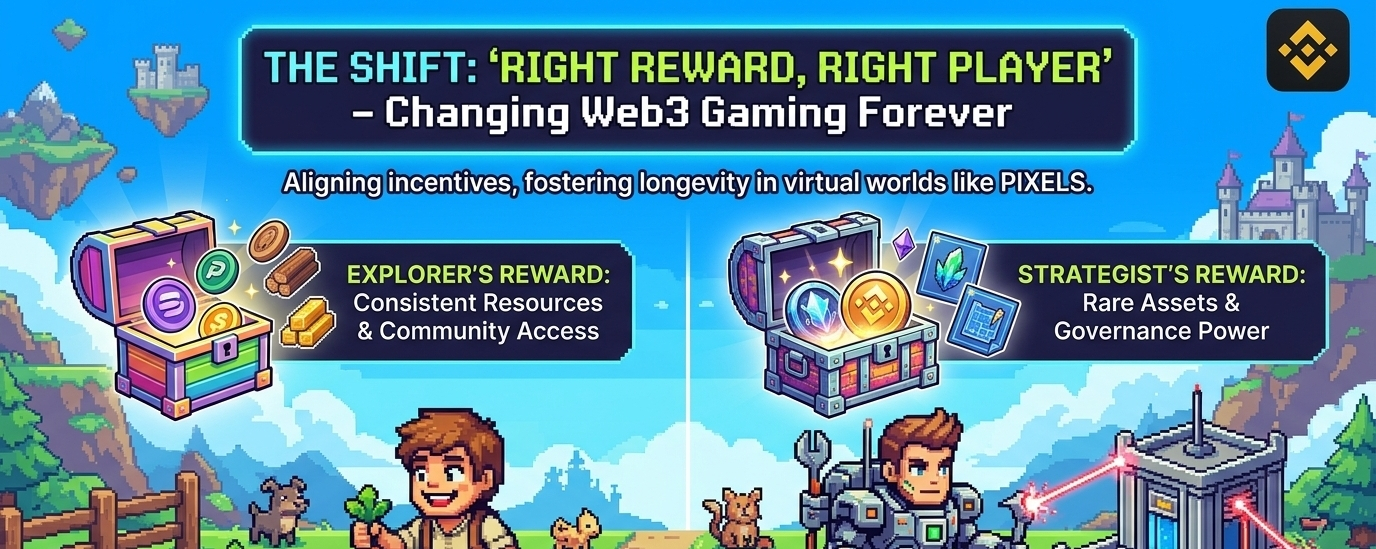


After spending time across different Web3 games, one thing has become very clear to me most reward systems don’t really care who the player is. They only care what the player does. Complete a task, get a reward. Repeat it enough times, and you maximize output. On the surface, that sounds fair. But in reality, it creates a system where every player is pushed toward the exact same behavior.
I’ve fallen into that loop myself.
You stop playing in your own style and start following whatever gives the best return. Over time, the game becomes less about choices and more about efficiency. And when everyone is doing the same thing, the system gets crowded, rewards lose meaning, and the experience starts to feel mechanical.
That’s where the idea of “right reward, right player” feels different.
Instead of treating all activity equally, the focus shifts toward context.People play differently. I’ve had days where I barely do anything, and other days where I’m fully focused on improving my setup. Some players just take it way more seriously. If a system can recognize those differences and respond accordingly, it changes the entire dynamic.
From what I’ve observed around @Pixels , the direction seems less about giving bigger rewards and more about keeping the overall system balanced. It doesn’t feel like you’re being pushed into one optimal path. That alone makes the experience feel less forced and more open.
What stands out to me is how this could affect long-term engagement. In traditional models, once players feel like they’re not getting enough out compared to others, they leave. But if rewards feel more aligned with how you actually play, there’s less frustration and less pressure to constantly compete at the highest level.
It also reduces the “race” mindset.
When rewards aren’t purely tied to a single optimized loop, players don’t need to rush or exploit the system as aggressively. That can slow down the typical boom-and-bust cycle we see in GameFi, where everything grows fast and then collapses just as quickly.
Of course, this kind of approach isn’t easy to execute. Player behavior is unpredictable, and no system can perfectly match rewards to every individual. But even moving in that direction feels like a step forward compared to static models.
From my experience, the biggest shift isn’t technical it’s how it makes you feel while playing. You’re less focused on beating the system and more focused on being part of it.
And if Web3 gaming wants to last, that shift might matter more than anything else.
