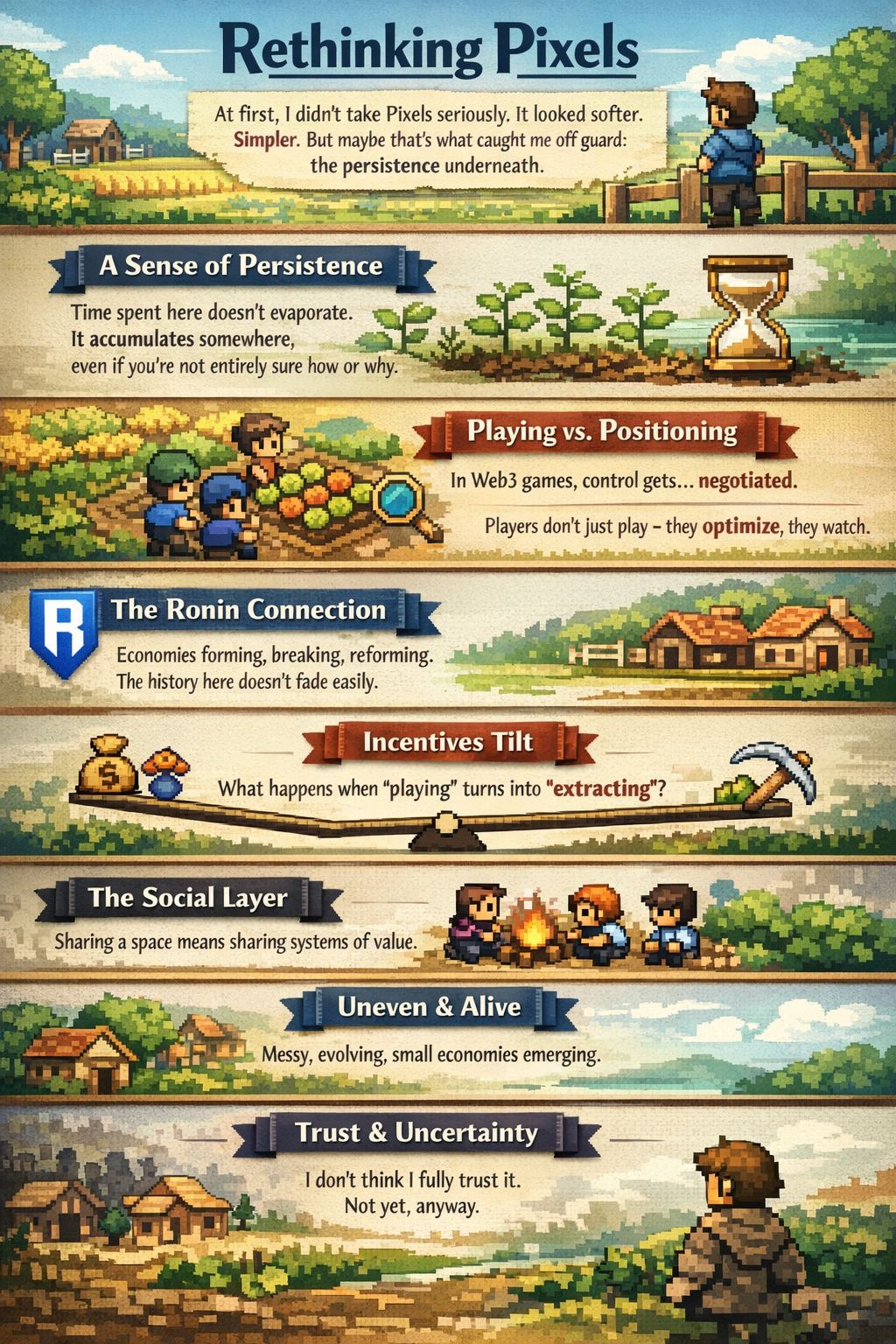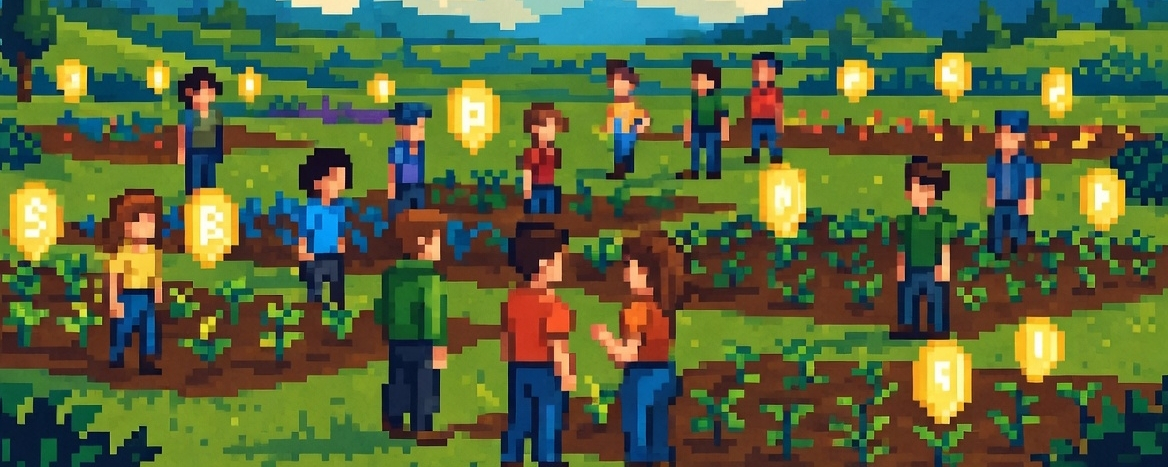

says more about me than the game, but still I’ve seen too many “casual” Web3 games that quietly orbit speculation more than play. Farming loops, token sinks, social layers… it all starts to blur after a while.
Pixels looked… softer. Simpler. Which, in this space, usually means something else is doing the heavy lifting underneath.
And maybe that’s what caught me off guard. Not the mechanics themselves — farming, wandering around, collecting, building — those are familiar, almost deliberately so. It’s the feeling of persistence that sits underneath it. The sense that time spent here doesn’t fully evaporate, that it accumulates somewhere, even if you’re not entirely sure how or why.
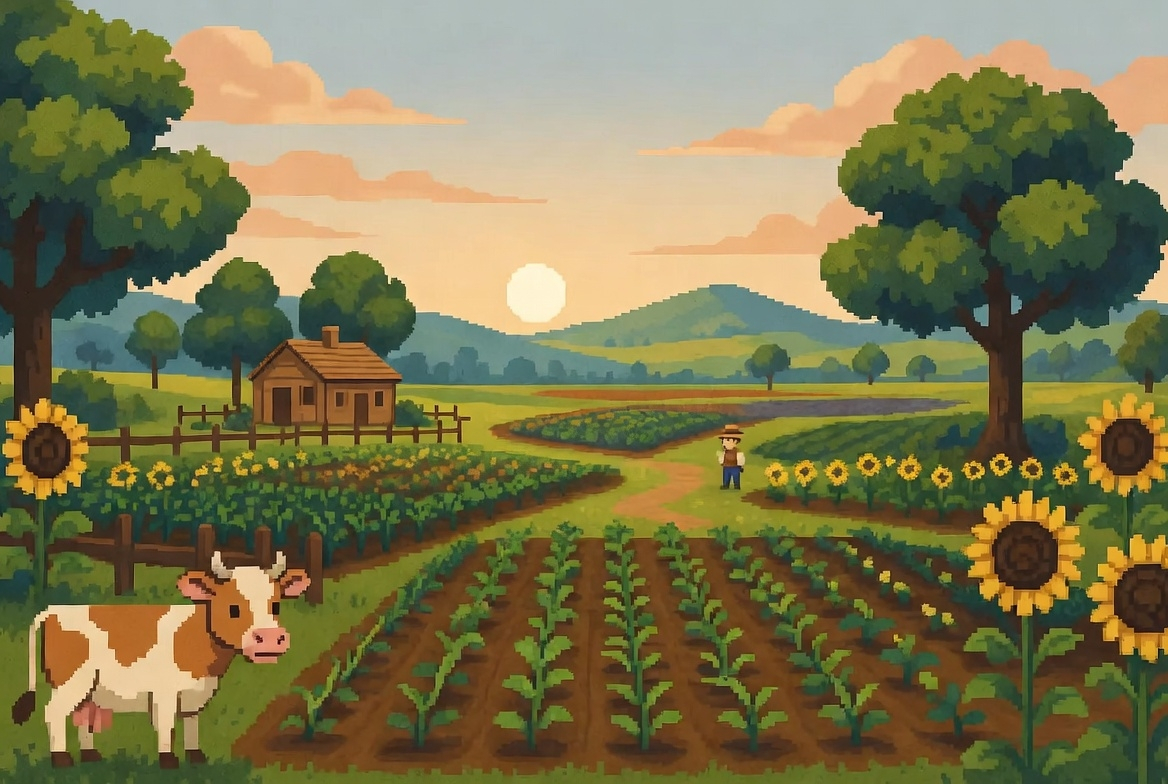
I keep coming back to that.
Because in most games, especially the ones that last, progression is carefully managed. Designers control pacing, scarcity, friction. In Web3 games, that control gets… negotiated. Or diluted. Or externalized. However you want to frame it. Players don’t just play — they position. They optimize. They watch.
And Pixels leans into that more than it admits.
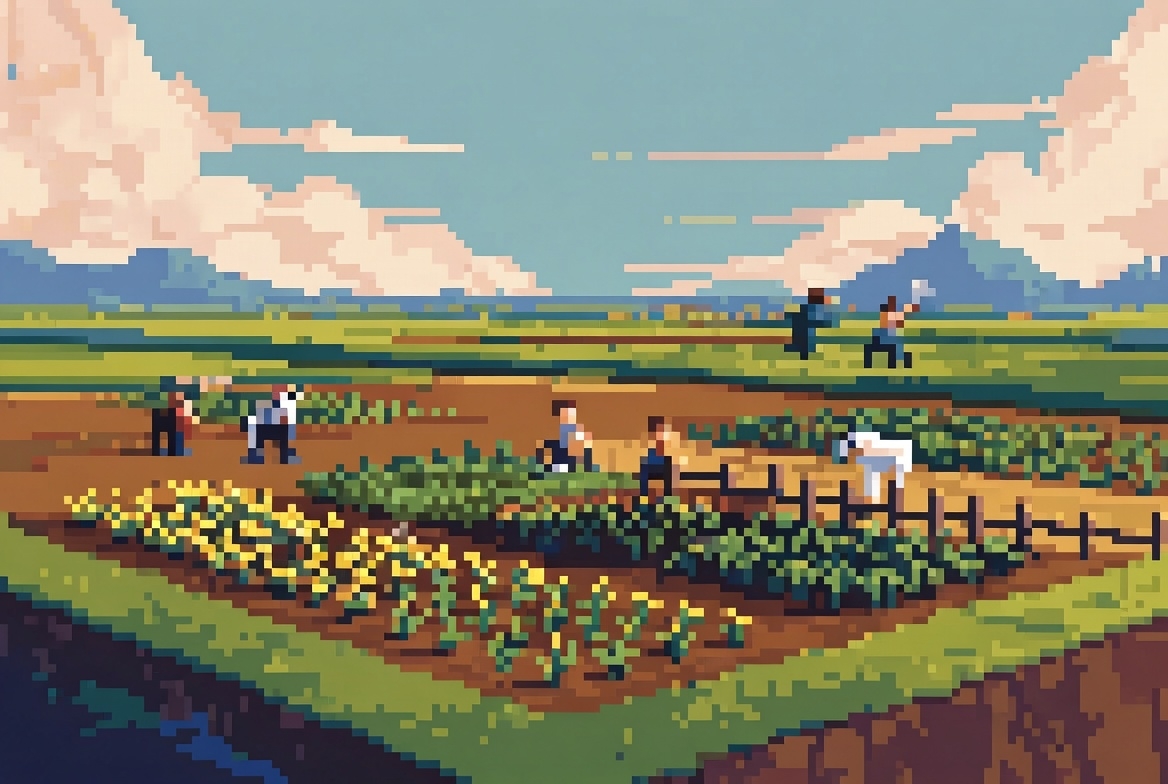
On the surface, it feels like a gentle loop. Plant, harvest, explore, maybe chat with someone nearby. But spend enough time and you start noticing how behavior shifts. People cluster around efficiency. Around what yields. Around what might matter later. Even the social layer starts bending toward coordination — who knows what, who has access, who’s early, who’s not.
That’s where it starts to feel less like a game and more like a system quietly training its participants.
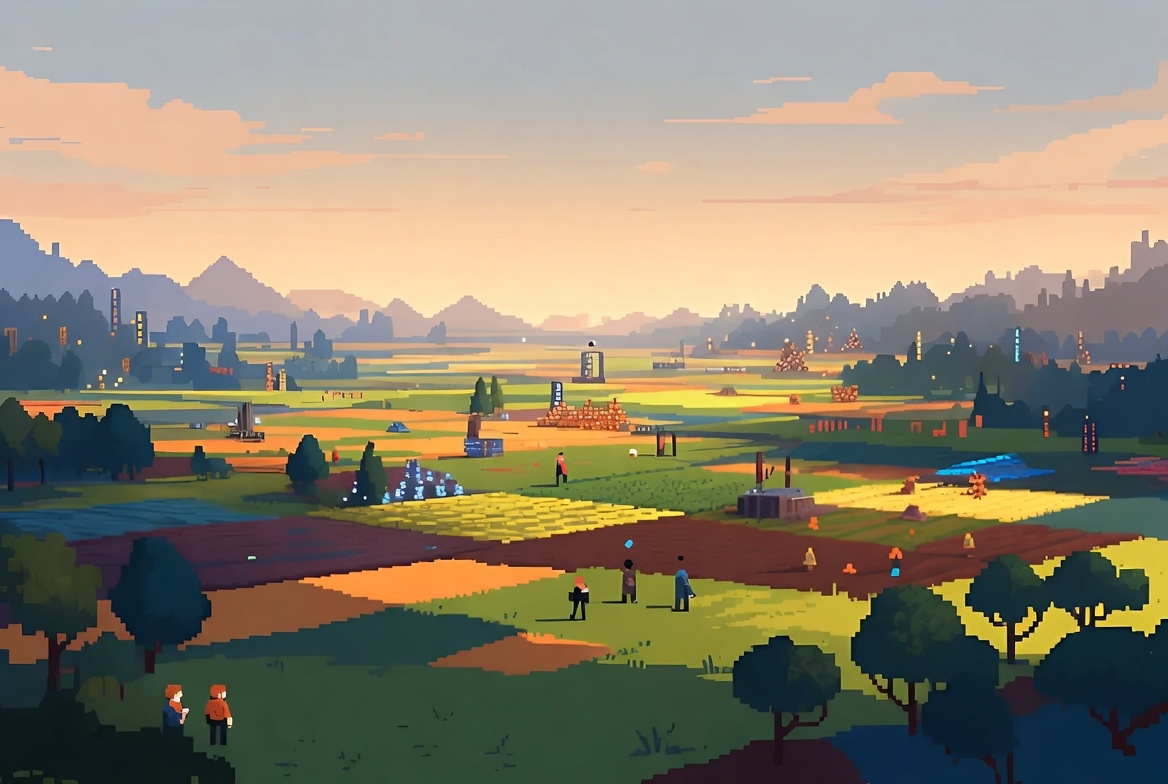
Maybe that’s unavoidable.
The Ronin connection adds another layer to this. Not just technically, but culturally. There’s already a history there — of economies forming, breaking, reforming. Of players who are not just players, but participants in something more fragile. That context doesn’t disappear just because the art style is softer or the loop is more relaxed.
If anything, it makes the calmness feel a little… provisional.
I wonder how stable these kinds of worlds really are. Not day-to-day, but over time. What happens when the incentives shift? When new players arrive with different expectations? When the balance between “playing” and “extracting” tilts too far in one direction?
Because it always tilts eventually.
And then there’s the quieter question — the one that’s harder to measure. What does it mean for a game to feel social when so much of the interaction is mediated by value? Not explicitly, not always, but just enough that it lingers in the background. You’re not just sharing a space. You’re sharing a system of accumulation.
That changes things. Subtly, but persistently.
Still, I can’t dismiss it entirely. There’s something oddly compelling about watching these worlds take shape in real time. Messy, uneven, occasionally charming. People show up, routines form, small economies emerge. It feels alive in a way that more polished systems sometimes don’t.
But I don’t think I fully trust that feeling.
Not yet, anyway.@Pixels #pixel $PIXEL