

I’ve seen this movie before.
Cute art.
Big emissions.
Discord full of “community.”
Then three weeks later you’re bagholding a governance token nobody actually needs while the “player base” turns out to be mercs with better timing than you.

I remember torching almost 2 ETH in 2021 hopping between random farm games because I thought high APR meant demand. It didn’t. It meant I was volunteering to be exit liquidity with extra steps. So when people started talking about Pixels like it was some new revelation, I rolled my eyes a little. Probably another liquidity bug dressed up as gameplay. But here’s the thing: the more I watched it, the less it looked like the usual farm-and-dump loop.
That’s the shift to me. Not the art. Not the token. The economic shape of it.
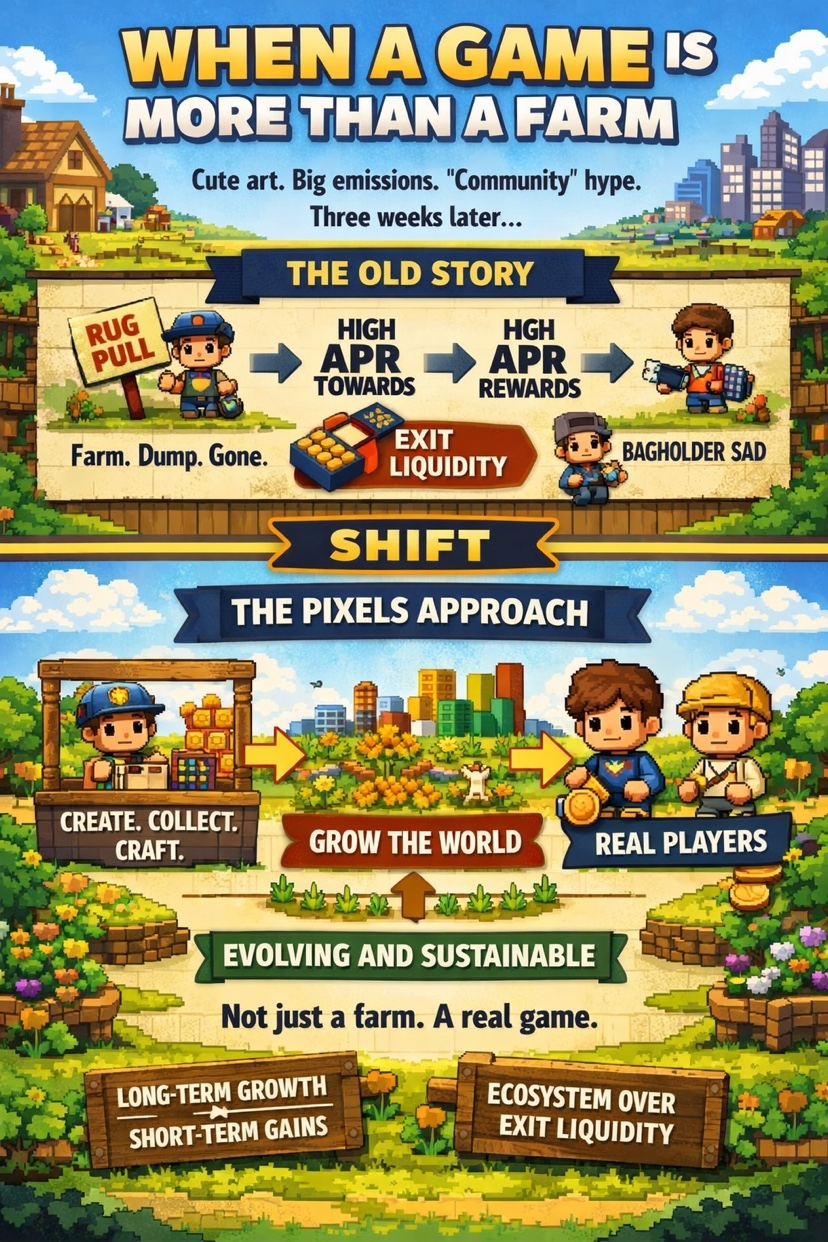
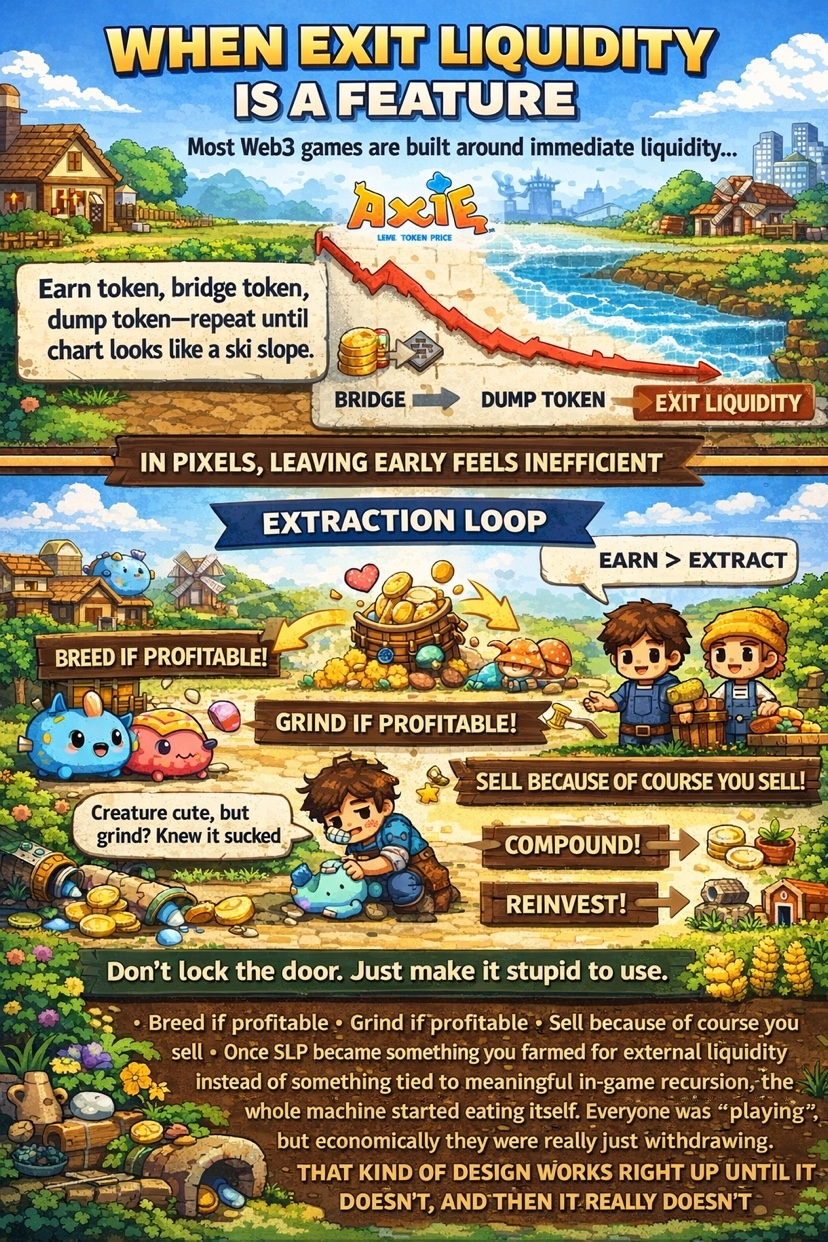
Most Web3 games were built around immediate liquidity like that was some kind of feature. Earn token, bridge token, dump token, repeat until chart looks like a ski slope. Axie did this at scale. Decentraland did it in a slower, more respectable-looking way, but the disease was similar: too much value formation happening outside the actual moment-to-moment loop of being in the game. People weren’t really participating. They were positioning.
Pixels feels different because it treats leaving the system early as inefficient, not impossible. That’s a very important distinction. It’s not locking the door. It’s just making the door kind of stupid to use if you care about maximizing upside.
Look, that changes behavior.
In Axie, the loop eventually got flattened into pure extraction. Breed if profitable. Grind if profitable. Sell because of course you sell. Once SLP became something you farmed for external liquidity instead of something tied to meaningful in-game recursion, the whole machine started eating itself. Everyone was “playing,” but economically they were really just withdrawing. That kind of design works right up until it doesn’t, and then it really doesn’t
Decentraland had the opposite problem. Less emissions-driven, more asset-narrative-driven. Land, identity, prestige, digital location, whatever. But for the average user there was never a thick enough daily economic loop to justify all that surface-level value. A lot of capital sat there like a museum piece. Very financialized. Not especially alive. You could own a thing, sure. The question was: what actually happens around that ownership on a Tuesday?
Pixels, for all its simplicity, keeps dragging value back into use.
You earn.
You spend to progress.
That spend helps somebody else.
They reinvest.
The loop continues.
That sounds basic, but basic is underrated in crypto because most teams skip straight to tokenomics theater. Pixels is closer to a functioning village economy than a yield machine. And I don’t mean that in a cute way. I mean it in the brutal, mechanical sense: value circulates through repeated low-friction actions between participants, instead of teleporting straight from rewards tab to exchange orderbook.
Anyway, that’s why “pick the right game, not the right token” actually means something here.
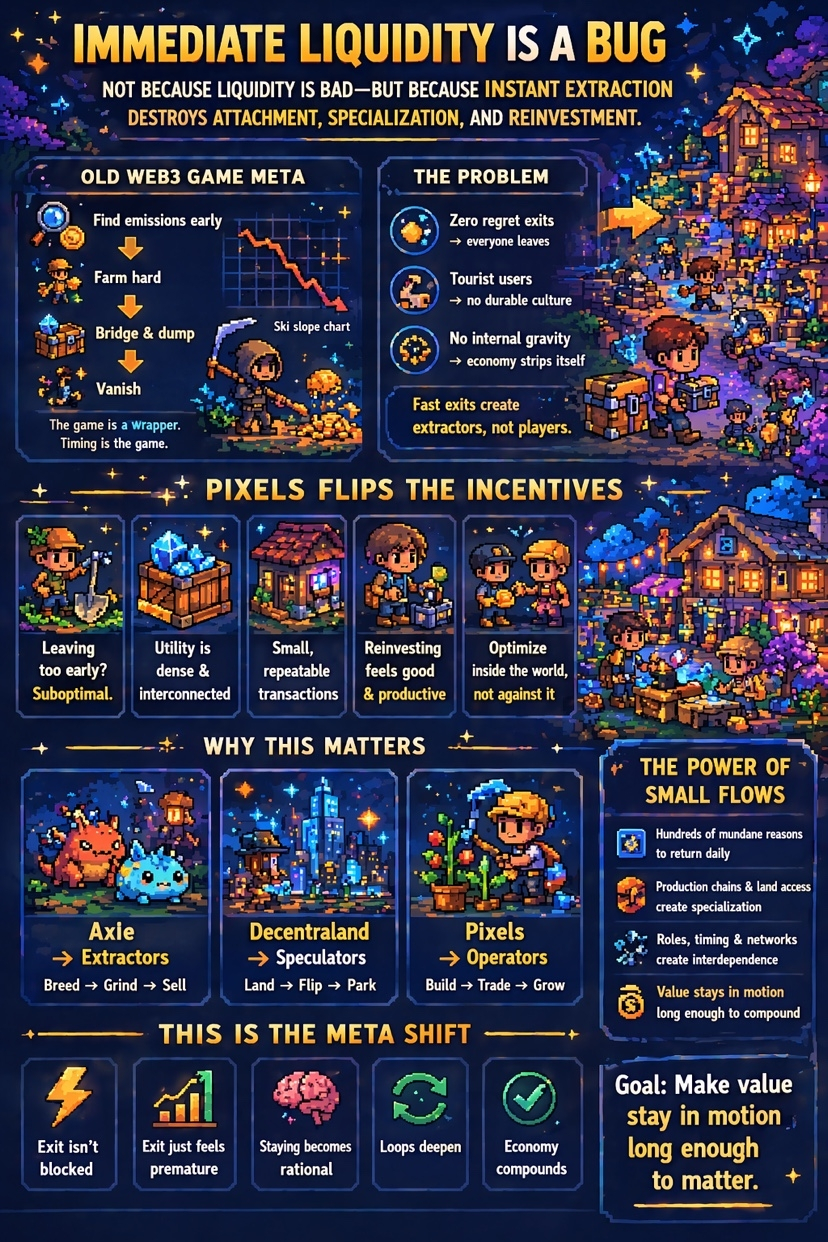
Old meta was obvious. Find emissions early. Farm hard. Don’t get sentimental. Be less dumb than the next guy. The “game” was mostly a wrapper around timing. So people optimized for liquidity above all else. Immediate exits were treated like a sign of healthy design, when really they were usually proof the system had no internal gravity. If capital can leave with zero regret and zero loss of opportunity, it usually will. Fast.
Immediate liquidity is a bug.
That’s the thesis.
Not because liquidity is bad.
Because instant extraction nukes attachment, specialization, and reinvestment.
If I can pull value out of a game instantly with no real tradeoff, then the smartest move is usually to become a tourist. Show up, farm, dump, vanish. That creates a culture of temporary users and temporary users do not build durable economies. They strip-mine them. Pixels seems to understand this on a gut level. It keeps utility dense enough that cashing out too aggressively feels suboptimal. Not illegal. Not blocked. Just kind of self-sabotaging.
And that matters more than people think.
Because once leaving becomes inefficient, staying starts to look rational. You begin optimizing inside the world instead of against it. You care more about your production chain, your land access, your role, your timing, your network. You stop acting like a mercenary and start acting like an operator. That’s a meta shift all by itself.
Axie made players think like extractors.
Decentraland made users think like speculators.
Pixels nudges people into thinking like small business owners with a game client open.
That’s a way healthier instinct.
Also, the scale of transactions matters. Web3 games love giant narratives about “ownership,” but most real economies are built on constant small exchanges. Tiny flows. Repeated behavior. A hundred mundane reasons to come back tomorrow. Pixels has more of that texture than most of its peers. It doesn’t rely only on the dream that your asset will moon someday. It gives you reasons to keep cycling resources, upgrading position, and participating in the loop now. That’s stronger than hype, honestly, because hype has the half-life of a fruit fly in this sector.
Is Pixels perfect? Obviously not. No onchain game has solved the problem forever. Every loop gets stress-tested eventually. People need liquidity. Attention fades. Speculators arrive, overoptimize, and start poking holes in whatever looked sustainable two months earlier. That part never changes. Crypto will always attract the liquidity bugs. We are the liquidity bugs.
But Pixels feels like a real shot at correcting the genre’s original sin.
Not “how do we reward users more?”
More like: “how do we make value stay in motion long enough to matter?”
That is the part Axie couldn’t hold.
That is the part Decentraland never really activated at the player layer.
And that is why Pixels feels like a meta shift instead of just another cycle prop.
It’s not trying to make exit impossible. That usually backfires anyway.
It’s making exit feel premature.
Uneconomic.
A little dumb.
And in Web3 gaming, that’s honestly a huge upgrade.