
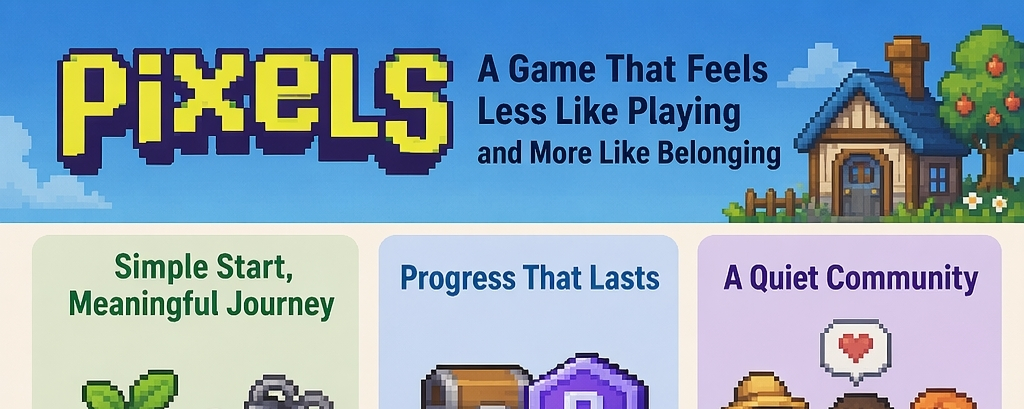
Most games today fight hard for your attention. They move fast, reward quickly, and constantly push you forward. Pixels takes a quieter approach. It doesn’t rush you or overwhelm you. Instead, it welcomes you in gently, almost like a place you can visit whenever you feel like slowing down.
In the beginning, everything feels simple. You plant crops, walk around, and explore at your own pace. There’s no pressure to be perfect or efficient. But as time passes, that simplicity starts to feel meaningful. The small things—watching your crops grow, improving your tools, discovering new areas—begin to create a sense of connection. It stops feeling like a task and starts feeling like something personal.
What makes Pixels different is not just what you do, but what stays with you. In most games, progress can feel temporary, like it only matters while you’re actively playing. Here, there’s a deeper sense of ownership. The time and effort you put into the world don’t just disappear. They remain part of something ongoing, something that continues even when you’re not there.
This idea is supported by the Ronin Network, which allows the game to give players more control over what they earn and create. But you don’t need to fully understand the technology to feel its presence. It works quietly in the background, making your progress feel more lasting and real without interrupting the experience.
The world of Pixels also feels shared in a natural way. You’ll often see other players going about their routines—farming, exploring, trading. There’s no constant competition or pressure to outperform others. Instead, it feels like you’re part of a larger space where everyone is doing their own thing, yet still connected. That sense of quiet community adds warmth to the experience.
Progression in Pixels is steady rather than fast. You don’t suddenly unlock everything or jump ahead overnight. Growth happens slowly, through consistent effort. And that’s what makes it satisfying. Each improvement, no matter how small, feels earned. It mirrors real-life growth in a way that feels grounded and believable.
Another comforting aspect is how the game treats time. It doesn’t punish you for stepping away. When you return, your world is still there, just as you left it. Your farm continues to feel like yours, not something you have to constantly defend or maintain under pressure. This creates a relaxed rhythm that’s rare in modern games.
At its core, Pixels isn’t trying to impress you with noise or speed. It builds its impact quietly, through feeling rather than force. The longer you stay, the more it starts to feel familiar—like a place you recognize, not just a system you’re using.
In the end, Pixels isn’t about finishing something or reaching a final goal. It’s about being part of a world that grows with you. And somewhere in that slow, steady process, it becomes more than just a game—it becomes something you return to because it feels like it belongs to you.
