
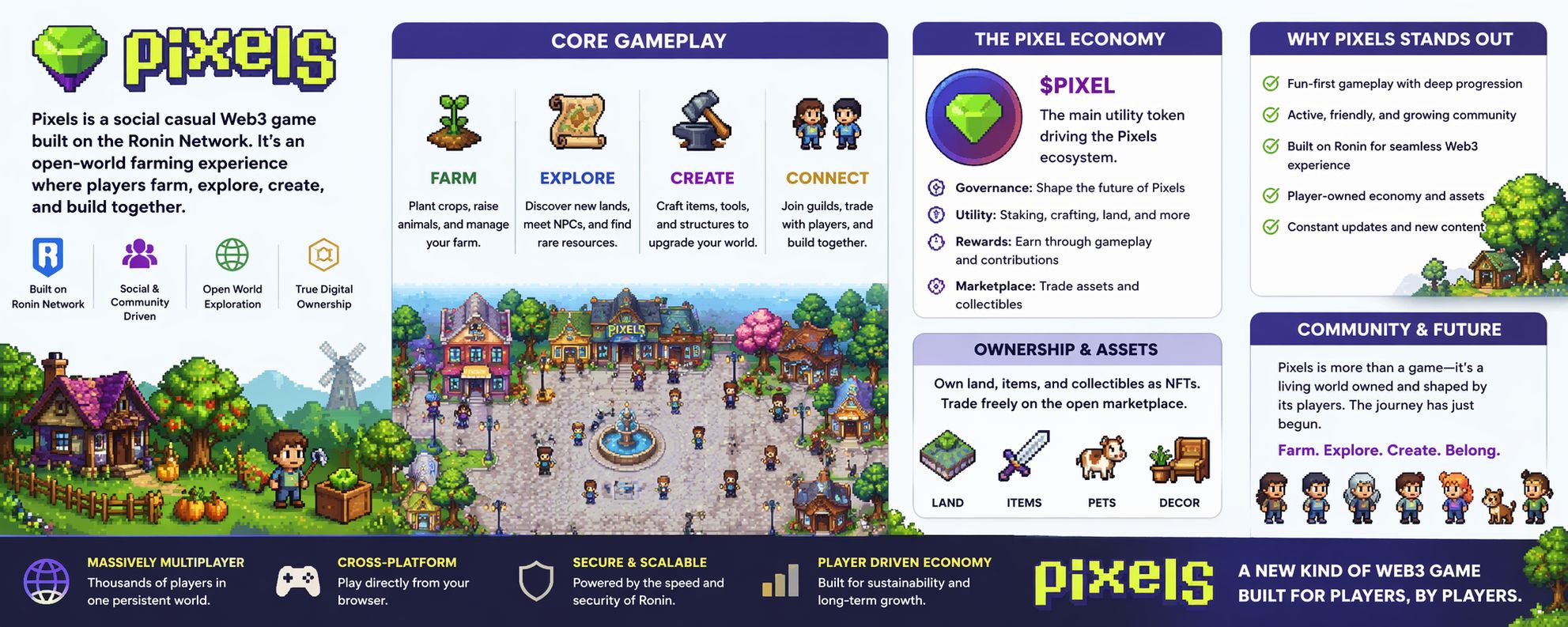

What keeps pulling me back to Pixels is that I still cannot decide whether it is one of the few Web3 games that actually understands its own category, or just one of the better-disguised versions of the same old loop.
Maybe that is why it is worth writing about at all.
After reading enough crypto gaming material, everything starts to blur. You see the same architecture over and over again. A token dressed up as an economy. A grind loop dressed up as gameplay. A land sale dressed up as community formation. Then somewhere in the middle of the deck, there is usually a sentence about “player ownership” or “interoperable identity,” and everyone is expected to nod like this still means what it used to mean in 2021.
Pixels does not completely escape that history, but it does feel slightly more self-aware than most of the projects orbiting the same space.
At first glance, it sounds familiar to the point of boredom. Social casual Web3 game. Farming, exploration, creation. Open world. Ronin. Tokenized economy. Land. Guilds. Progression. That whole stack. If you have been around long enough, you can almost predict the rest before opening a single document. And to be fair, some of it does unfold exactly the way you would expect. There is an economy layer. There are token sinks and reward loops and different tiers of access. There is an attempt to turn routine activity into something financially legible. None of that is new.
But Pixels is a little harder to dismiss immediately, and I think the reason is simple. Underneath all the Web3 framing, it actually seems to understand that a game needs texture before it needs tokenomics.
That should not be a radical insight, but in this sector it still is.
A lot of crypto games were built as if “on-chain” was enough to substitute for atmosphere, pacing, or attachment. They were designed from the wallet outward. You could feel it. The game existed mainly to justify an economic machine. Players were not really being invited into a world. They were being routed through a system. The result was almost always the same: short bursts of speculation, very loud communities, a temporary illusion of traction, and then the slow realization that no one actually cared what the game felt like once the numbers stopped moving.
Pixels seems at least partly shaped by the opposite instinct. When you strip away the network layer and the token layer, what is left is basically a farming game with social persistence. And I do not mean that dismissively. That is probably the most sensible place to start if the goal is to build something durable. Farming games work because they produce low-voltage attachment. Not excitement exactly. Something stickier than that. Routine. Return. Personal space. A sense that time spent in the world settles into the world somehow.
That is a real design foundation. Much more real than most of the things GameFi spent years pretending were foundations.
You can feel that in the structure of Pixels. The appeal is not hidden behind abstraction. You farm, gather, craft, wander, improve your land, unlock more capability, and gradually start participating in a world that remembers your effort. None of this is revolutionary. In some ways that is the point. It is legible. It borrows from genres that people already know how to enjoy without needing to be sold on ownership as a philosophical breakthrough.
That matters, because one of the quiet failures of Web3 gaming has been its tendency to confuse financial novelty with emotional durability. Those are not the same thing. A token can create a spike in attention. It cannot manufacture fondness. It cannot create the strange, almost embarrassing attachment people develop to virtual spaces they have spent enough time shaping. That comes from repetition, familiarity, and a feeling of presence. Pixels, at its best, seems interested in that older logic.
I keep coming back to that because it makes the project feel less naive than a lot of its peers. Not wiser exactly. Just less intoxicated by its own infrastructure.
The move to Ronin fits into this too. There is a version of this story where chain choice is treated as a purely technical detail, but that is not really how these ecosystems work. Chains have culture now, whether people like admitting it or not. Ronin already had a gaming-native identity. It had the residue of earlier successes and failures in that specific vertical. Putting Pixels there made intuitive sense. It moved the game into an environment where users were already primed to accept gaming as the center of the experience rather than some side effect of financial tooling.
That said, no game escapes the economic question, and Pixels definitely does not. If anything, the economic layer is where the project becomes most familiar again.
Like many Web3 games, it experimented with multi-token logic. On paper, this kind of architecture always sounds reasonable. One token for softer in-game circulation, another for premium utility, governance, access, or whatever else needs to look more scarce and strategically important. You can already hear the whitepaper language forming in the background. Separate use cases. Sustainable emissions. Balanced sinks. Reduced sell pressure. Incentivized engagement. It is the usual vocabulary of systems trying to describe themselves as stable before reality has had a chance to test them.
Pixels ran that script too, at least for a while. And then, like many projects before it, it ran into the obvious problem: game economies do not stay neat once players, markets, and time start interacting with them. Inflation accumulates. Behavior adapts. Rewards become expectations. What looked elegant in the abstract starts producing pressure in the wrong places. That is not unique to Pixels. It is almost a rite of passage.
What I find mildly encouraging is that the team seems willing to revise rather than endlessly rationalize. The project’s shift toward emphasizing PIXEL more heavily while moving away from BERRY as a central value layer reads less like a grand innovation and more like a team discovering, in public, that its earlier setup was not as sustainable as it hoped. That is not a flaw in itself. Honestly, it is one of the few normal things I have seen in this sector. Economies should be revised. They are not sacred. The problem is that crypto teams usually treat revision as weakness until circumstances force them to rename it strategy.
Pixels, for whatever reason, feels a little less performative about that process.
Still, skepticism is necessary here. It is easy to read changes in token structure as maturity when sometimes they are simply a more refined way of prolonging the same dependence on speculative alignment. Web3 games love talking about sustainability, but sustainability in these systems usually means one of two things. Either there is enough new demand entering to offset the exits, or the project has become sufficiently enjoyable that players stop relating to it purely through extraction. The first version is fragile. The second is rare. Pixels appears to be aiming for the second, which is good. The question is whether the actual play experience can carry enough weight to make that true over time.
I am not fully convinced, but I think it has a better chance than most.
The land system is a good example of why. Land in crypto games is usually where the ideological mask slips. It gets described as community infrastructure or user-owned space, but a lot of the time it is really just a way to front-load monetization and stratify future access. Players who buy in early gain leverage. Everyone else arrives later and is told this hierarchy is actually empowerment. We have seen that movie enough times already.
Pixels does not completely avoid that dynamic, but it seems to soften it. Ownership matters, clearly. Better utility, more production options, more flexibility, more room to shape how your piece of the world works. But participation is not entirely sealed off from non-owners. That is a crucial difference. It means the world can still function as a game for people who are not entering through capital first. In a healthier reading, that creates layered participation instead of pure exclusion. In a more cynical reading, it is just a cleaner onboarding funnel into the same structure. The truth is probably somewhere in between.
What makes it interesting is that the project seems aware of the tension. It is trying to make ownership meaningful without making everyone else feel like unpaid labor in someone else’s asset framework. That balance is difficult. Most teams fail at it. Pixels has not solved it either, but at least it appears to be wrestling with the actual problem instead of hiding it behind rhetoric.
The social layer is where things get more complicated, and maybe more real. Guilds in Pixels are not just decorative labels for player clustering. They carry actual structure. Reputation thresholds, treasury logic, role management, fee routing, group identity. Once you start building systems like that, you are no longer making a casual game with optional social features. You are building organizational machinery. That can be powerful. It can also create exactly the kind of micro-hierarchies that Web3 tends to reproduce whenever it tries to decentralize anything.
I do not say that as an accusation. It is just an observable pattern. As soon as assets, access, and coordination start overlapping, status forms. Some players become operators. Others become contributors. Others become spectators orbiting the system without really influencing it. The optimistic reading is that this creates durable communities and a real sense of belonging. The pessimistic reading is that every supposedly open digital world eventually reinvents class structure with better branding.
Again, Pixels is not uniquely guilty of this. If anything, it is one of the more legible examples. At least you can see the structure forming rather than being asked to pretend it is all frictionless community magic.
There is also the interoperability angle, which I admit I usually approach with immediate suspicion because the word has been stretched so far in crypto that it barely means anything anymore. Still, Pixels seems to frame it in a slightly more grounded way. Not as one universal metaverse fantasy, thankfully, but as a networked identity layer where collections, communities, and adjacent experiences can connect into the same broader world. That is more believable. The internet never wanted to become one room. It behaves more like overlapping neighborhoods with shared signals. Pixels seems closer to that model than to the old maximalist vision of one platform swallowing everything else.
Whether that becomes meaningful in practice is another matter. Interoperability is easy to celebrate in theory because theory never has to deal with mismatched incentives, uneven standards, or the fact that most users do not actually care about portability unless it improves their experience in immediate, tangible ways. Still, as a design instinct, it is preferable to the closed-world delusions that dominated so much earlier metaverse thinking.
What I keep circling back to, though, is the mood of the project. Not the branding, but the actual underlying mood. Pixels feels like a team trying to make Web3 mechanics inhabit a game format that people already know how to love. That sounds simple, but it is surprisingly uncommon. Too many projects tried to invent entirely new emotional logic around ownership and earning, as if decades of game design could just be skipped because wallets existed. Pixels seems less interested in replacing older game pleasures than in wrapping new infrastructure around them.
That gives it a better shot than most.
Not a guaranteed shot. Just a better one.
Because the core question has not changed. It never changes. If you remove the narrative premium around the token, if you mute the social media cycle, if you stop talking about the chain for a minute, what is left? Is there still enough there for a player to care? Enough texture, enough friction, enough satisfaction, enough social gravity?
With Pixels, I think the answer might be yes, but with an asterisk large enough to matter.
Yes, because the underlying genre logic is sound. Routine-based progression, place-making, shared-world presence, gradual improvement, light social coordination. These are durable ingredients. They have worked for years because they align with how people actually form attachment in games. Not through abstract promises, but through accumulated familiarity.
The asterisk is that once an open economy attaches itself to those loops, everything gets harder. Every design choice becomes legible not just as game balance, but as incentive engineering. Reward pacing becomes market signaling. Progression becomes monetization architecture. Community becomes distribution. This is the curse of GameFi generally. It forces systems that should feel playful to also carry economic meaning, and once that happens, players begin interpreting them differently. Some will optimize. Some will speculate. Some will leave the moment the numbers stop justifying the time.
Can Pixels outgrow that trap? Maybe. I would not say probably. But maybe, which is already more than I can say for most projects I have read this month.
That, in the end, is why it lingers in my mind. Not because it has solved Web3 gaming. It absolutely has not. Not because its token design is beyond criticism. It is not. Not because every social and ownership layer it introduces will produce healthy outcomes. Some of them almost certainly will not. It stays interesting because it feels like one of the few projects in the category that understands what the real challenge is.
The challenge is not putting a game on-chain. That part is easy enough now.
The challenge is building something where the chain does not become the only thing anyone remembers.
Pixels might not fully get there. But compared to the usual parade of token-first worlds pretending to be games, it at least seems to be walking in the right direction, a little tired, a little cautious, and maybe more aware than most of what usually goes wrong.