

Pixels ($PIXEL) — and why it doesn’t feel like the usual GameFi loop
I didn’t clock Pixels as anything special at first. Just another farming game with a token slapped on top. We’ve all seen that movie… it usually ends the same way—early players win, late ones become exit liquidity, and the whole thing slowly fades out.
But then I kept digging. And yeah… it’s not just a game.
It feels more like they’re trying to build a system. Not in the buzzword sense—but an actual loop where money, players, and games feed into each other. Messy in theory. Interesting in practice.
Where this whole thing actually starts
Most GameFi projects start with a token and work backwards.
Pixels didn’t. At least, that’s how it looks from the outside.
They started with a problem that’s almost boring at this point:
Play-to-earn games don’t last.
People come in, farm rewards, dump them, leave. Repeat until nothing’s left. You don’t need a whitepaper to see that—it’s just how incentives behave when they’re badly designed.
And to their credit, the Pixels team didn’t pretend otherwise. They straight up acknowledged inflation issues, weak reward systems, short-term users… the usual cracks.
So instead of pushing harder on growth (which most teams do), they slowed down and reworked the core loop.
That’s the part most people miss.
The loop — or the “engine,” if you want to sound dramatic
Here’s how I think about it, stripped down:
You stake $PIXEL into a game.
That game uses it to pull in players.
Players spend inside the game (hopefully).
Some value flows back.
Stakers get rewarded.
Data gets collected.
System adjusts.
And then… it runs again.
Simple on paper. But the twist is where it gets weird—in a good way.
Games here aren’t just content. They’re more like… competitors.
They fight for your stake.
Your capital decides which games grow. Not hype, not Twitter threads, not exchange listings. If a game actually keeps players around and makes them spend, it attracts more stake. If not… it fades.
It’s kind of brutal, honestly.
The token setup (this part’s easy to ignore—but you shouldn’t)
There are two layers to it:
$PIXEL is the main token. Governance, staking, the usual stuff. Limited supply—nothing shocking there.
Then there’s $vPIXEL.
And this is where it gets a bit clever.
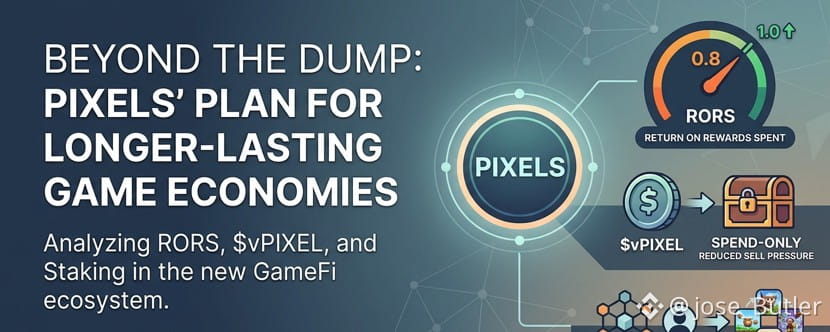
It’s backed 1:1 by $PIXEL, but you can’t trade it. You can’t just dump it on the market either. You spend it in-game or restake it.
At first glance, that sounds restrictive. And yeah, it is.
But think about what it does—it slows down the constant sell pressure that kills most GameFi economies.
Instead of rewards instantly becoming liquidity events, they stay inside the system a bit longer. They circulate.
Small tweak. Big implications.
Who actually benefits here?
Let’s not overcomplicate it.
Players get rewards, sure—but also a say in where value flows if they stake. And if the system improves over time (big “if”), rewards should get smarter, not just bigger.
Stakers are basically allocating capital. You’re betting on games, not just holding a token. That’s a different mindset—more like portfolio management than passive farming.
And devs… this is probably the most underrated angle.
Instead of dumping money into ads, they tap into staked capital to bring users in. They’re paying for engagement, not impressions.
Which—if you’ve ever run ads—you know how big that shift is.
What actually stands out (and what might not work)
A lot of projects claim they’re “different.” Most aren’t.
This one… at least tries.
Games competing for capital? That’s real pressure. No hiding behind marketing.
Rewards tied to data? Makes sense—though it depends how well they execute it.
And then there’s this RORS thing (Return on Reward Spend). Basically asking:
“Are these rewards doing anything useful, or are we just lighting money on fire?”
Last I saw, it’s hovering around 0.8. Not amazing. Not terrible. The real test is whether it can push past 1 and stay there. That’s where things start to click.
If it doesn’t… well, we’ve seen how that story goes.
The flywheel idea (sounds overused, but hear me out)
Stake → reward → spend → data → better rewards → repeat.
That loop.
The whole bet is that it improves over time instead of draining value out like most systems do.
It’s a nice theory. The execution is everything.
So… is it actually good?
I wouldn’t go that far. Not yet.
There are still some obvious pressure points:
Are the games fun enough to keep people around?
Will players actually spend, or just extract?
Can the system really sustain itself, or does it just slow the bleed?
Those aren’t small questions.
But compared to the usual GameFi noise, this feels more… intentional. Less rushed. Like someone actually sat down and tried to fix the core problem instead of decorating it.
If I had to sum it up
Pixels isn’t trying to be the biggest game.
It’s trying to be the system that games plug into.
That’s a harder bet. And honestly, a riskier one.
But if it works—even partially—it shifts how Web3 games think about value.
And yeah… that’s worth paying attention to.