
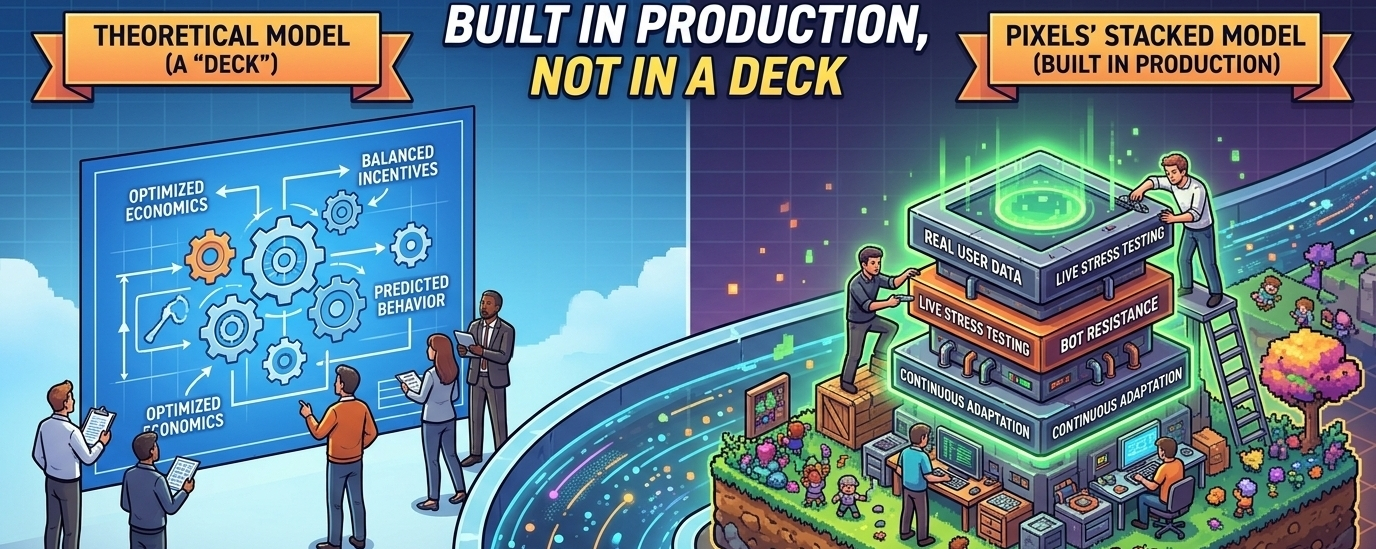


One thing I’ve noticed after spending time in crypto is how many projects look impressive on paper but feel very different once you actually use them. The ideas are strong, the decks are polished, and everything sounds convincing until real users show up and the system starts behaving in ways no one expected.
That gap between theory and reality is where most things fall apart.
What stands out to me with PIXELS, especially with the Stacked model, is that it doesn’t feel like something that exists only as a concept. It’s already being used, adjusted, and tested in a live environment with real players. And from my experience, that changes everything.
When a system is live, it has to deal with actual behavior not ideal scenarios. Players optimize, some try to exploit, others push the system in ways that weren’t originally planned. You can’t fully simulate that in advance. It only shows up once people start interacting with it at scale.
That’s where something like Stacked feels different.
Instead of being a fixed structure, it seems to respond to what’s happening inside the game. I’ve noticed that it doesn’t feel easy to lock into one dominant strategy and just repeat it endlessly. There’s a sense that the system is watching activity and adjusting in the background to keep things from getting too one-sided.
That kind of responsiveness is hard to replicate quickly.
Another important part is how it handles behavior that usually breaks GameFi systems things like botting or pure extraction. In most projects I’ve tried, once bots or highly optimized farming strategies take over, the experience for regular players starts to degrade fast. Rewards lose meaning, and the gap between different types of players becomes obvious.
Here, it feels like there’s more resistance to that.
I wouldn’t say it eliminates those issues completely, but the system doesn’t seem as easy to exploit in a predictable way. And because it’s already been running with real users, it’s learning from those patterns instead of reacting too late.
That’s where the idea of a “moat” starts to make sense.
It’s not just about having a better idea it’s about having something that has already gone through real usage, real stress, and continuous adjustment. Anyone can describe a dynamic reward system in theory, but building one that actually works under pressure is a different challenge entirely.
From what I’ve seen, @Pixels isn’t just trying to design a system it’s actively refining one in production. That gives it a kind of head start that isn’t easy to catch up to, because it’s based on lived data, not assumptions.
Of course, it’s still early, and long-term durability will depend on how well it continues to adapt as the player base grows. But compared to projects that are still at the idea stage, this feels more grounded.
And in this space, something that already works even imperfectly often has a much stronger foundation than something that only exists in a deck.
