
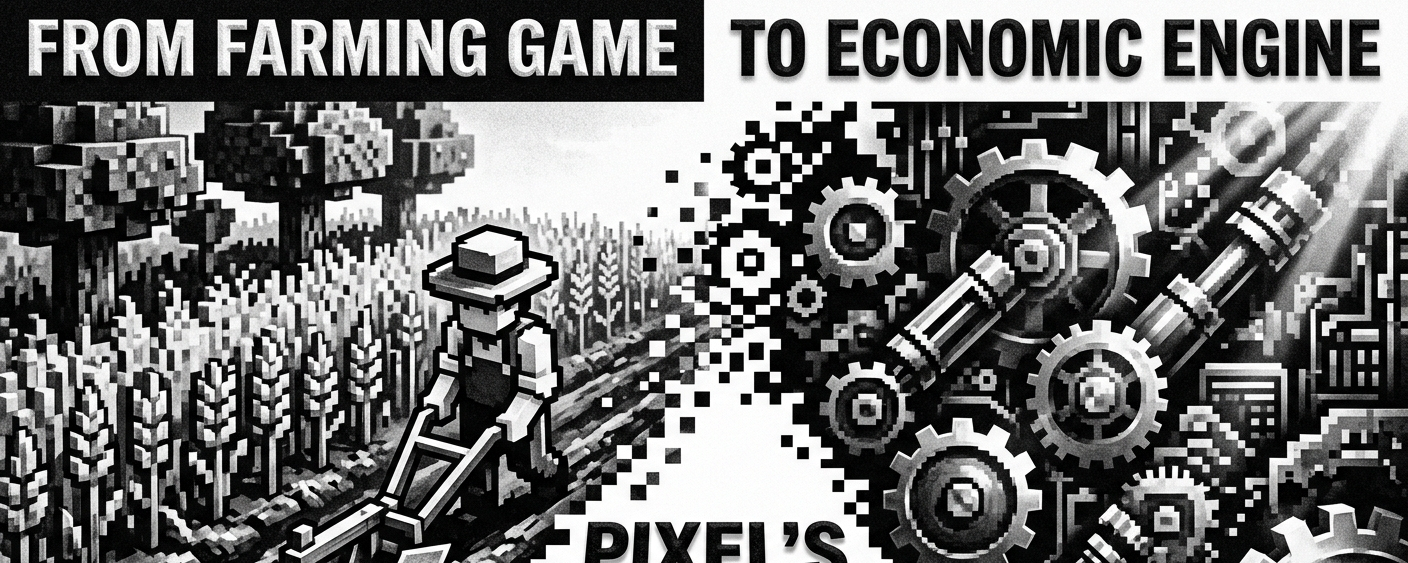
I think most people who haven't played pixel assume they know what it is?. Farming game. Cute graphics... Blockchain wrapper. The kind of thing that gets dismissed in a sentence by people who've never actually spent time inside it.
I believe that assumption is worth examining. Because what pixel has quietly built underneath the pastoral surface is something the broader web3 gaming space has been trying to crack for years without muCh success — a functioning player-driven economy with real interdependencies, real scarcity, and real incentive architecture.
The farming is almost a misdirection.
Yes.. you plant crops. Yes...you harvest. Yes...the visual language is soft and approachable in a way that doesn't immediately signal economic complexity. But the farming is just the entRy point. It's the on-ramp into a production system that, once you're inside it, starts to look less like a game loop and more like a supply chain.
Because raw materials need processing. Processed goods need distribution. Distribution requires coordination between players who don't necessarily know each other, operating on different schedules, with different specializations and different land allocations. That's nOt a game mechanic. That's a market structure.
When they're designed well, don't need to be maNaged. They self-organize. Pixel seems to understand this at a foundational level. Rather than scripting player interactions, it creates conditions where interaction becomes rational. You trade because trading is more efficient than doing everyThing yourself. You specialize because specialization compounds. You build relationships because relationships reduce friction.
That's economic thinking applied to game design. It produces something most games neVer achieve. Theemergent complexity that the developers didn't explicitly program.
I think the land system is whEre this becomes most visible. Land in pixel isn't decorative... It's productive infrastructure. The size, type, and location of your plots determines what you can produce. At what scale. At what cost. Two players with identical effort inputs can have wildly different output curves depending on their land configuration... That asymmetry creates the conditions for trade, for specialization, for the kind of player-to-player dependency that makes an economy breathe.
Actually scarcity does the rest... When land is finite and productive capacity is unevenly distributed, players can't simply grind their way to self-sufficiency. They have to engage with the market... They have to price their labor, negotiate their inputs, decide what's worth producing and what's worth buying. Those decisions, made by thousands of players simultaneously, generate the price signals that make the economy legible.
Why pixel seems to me real? Because this is what separates pixel from the dozens of blockchain games that bolt a token onto a simple gameplay loop and call it an economy. A token is not an economy... A token with nothing to do is just speculation dressed up in game aesthetics. Pixel's token exists inside a web of productive relationships... It moves because things are being made, exchanged, and consumed. The underlying activity gives it context.
The guild layer adds another dimension. Guilds in pixel function as economic entities. The pooling resources, dividing labor, coordinating production across members... A well-run guild isn't just a social club. It's a small firm. It has input costs, output targets, internal allocation problems, and competitive positioning relative to other guilds. The players who figure this out early tend to accumulate advantages that compound over time. That's not luck. That's organizational design.
A big question?... What pixel is building, then, is not a farming game with economic features. It's an economic system with farming as its most visible surface. The distinction matters because it changes how you evaluate the project's ceiling. A farming game scales until players get bored of farming. An economic engine scales with the complexity and density of its participant base — and that kind of growth has a very different trajectory.
The players who treat it like a game will extract some enjoyment and move on... The players who treat it like an economy will still be there years from now, running operations that look nothing like what they started with.
That gap in understanding, between what pixel looks like from the outside and what it actually is from the inside, might be the most interesting thing about it.