
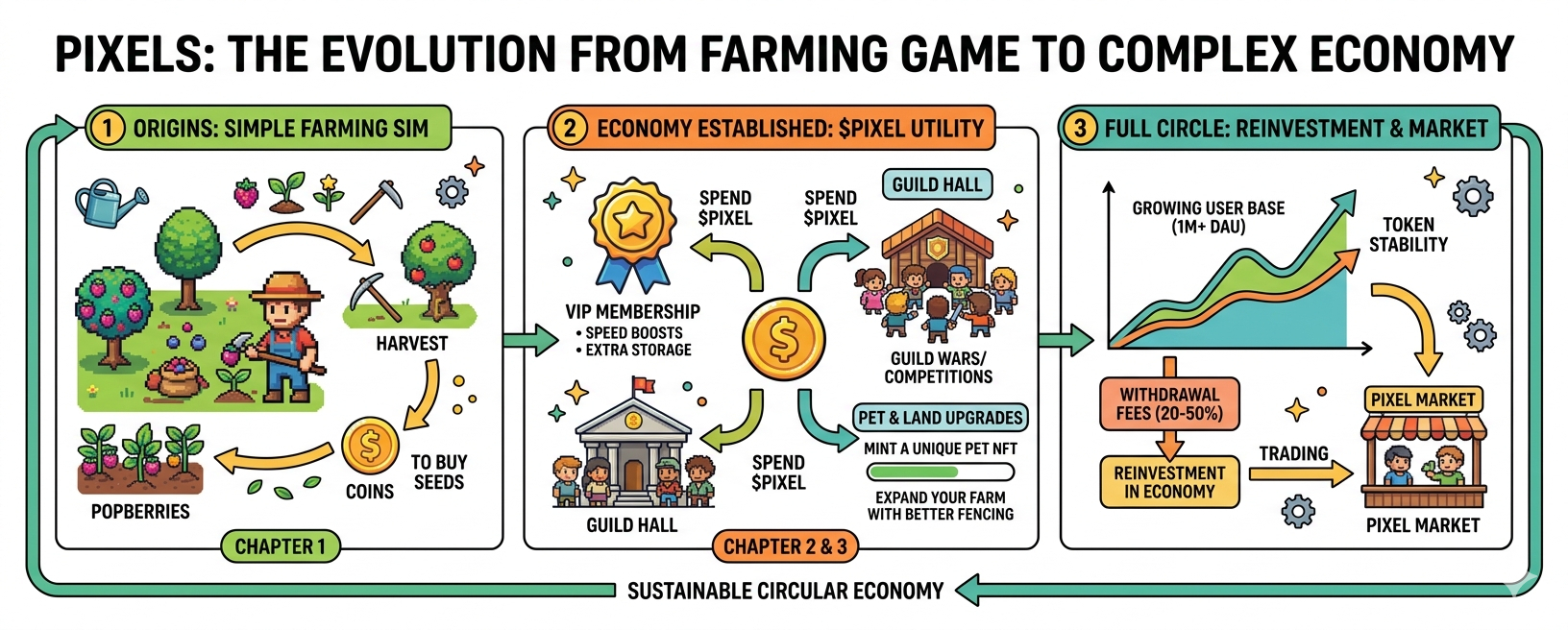
At first, Pixels feels almost too simple. You plant crops, walk around, maybe trade a few items—it has that calm, low-pressure vibe you’d expect from a casual farming game. Nothing about it screams “complex system” or “financial experiment.” But if you spend enough time in it, you start to notice something underneath the surface. The game isn’t just about playing—it’s about participating in something that slowly starts to feel like a real, working economy.
What makes Pixels interesting is not what it shows you right away, but what it’s trying to become.
Most blockchain games before it followed a predictable path. They rewarded players heavily at the start, attracted a crowd, and then struggled to keep things stable once those rewards lost value. Pixels seems to have learned from that. Instead of focusing on giving players more, it’s focusing on making players matter to each other. What you grow isn’t just for you—it feeds into crafting, trading, and upgrades that other players rely on too. Over time, you stop thinking of it as “my progress” and start seeing it as part of a shared system.
The way the tokens are designed adds to this feeling. $BERRY is what you earn regularly—it’s everywhere, flowing through the game like everyday cash. You don’t think too much about it because it’s constantly coming in and going out. Then there’s $PIXEL, which feels different. It’s tied to bigger decisions—owning land, unlocking features, getting deeper into the game. If $BERRY is what keeps things moving, $PIXEL is what gives things weight.
That split is important, even if it doesn’t seem like it at first. A lot of games tried to do everything with one token and ended up with systems that couldn’t hold themselves together. Pixels separates the roles. One part of the system can be flexible and active, while the other stays more controlled and meaningful.
Recently, the game has been quietly changing how rewards and spending work. It’s no longer as easy to jump in, farm quickly, and walk away with value. There are more reasons to spend what you earn—on upgrades, items, or access to certain features. At first, that might feel like a limitation, but over time it starts to make sense. The game is trying to keep things balanced, so that value isn’t just flowing out without anything coming back in.
You can see this shift reflected in how players behave. The number of active users has grown significantly, moving from a relatively small base to hundreds of thousands, even approaching a million during peak periods. That kind of growth usually comes with shallow engagement, but here, players are also spending inside the game—millions over time. That suggests they’re not just chasing rewards. They’re sticking around.
Still, it’s not a perfect system. There are moments when the token activity feels driven more by speculation than actual gameplay. Trading volumes spike in ways that don’t always match what’s happening inside the game. And there’s still a large portion of the token supply that hasn’t entered circulation yet, which raises questions about how things might look in the future. Like any evolving system, it’s stable until it isn’t—and that risk is always there.
The choice of Ronin as the underlying network helped a lot with growth. It removed friction. Transactions are cheap, fast, and barely noticeable, which makes the whole experience feel smoother. More importantly, it already had a community of players who understood blockchain games. Pixels didn’t have to start from zero—it stepped into an environment that was ready for it.
What’s starting to emerge now is a bigger ambition. Pixels doesn’t seem interested in staying just one game forever. There are hints that it could expand into something broader, where multiple experiences connect through the same economy. If that happens, $PIXEL stops being just a game token and starts becoming something closer to a shared layer across different worlds.
But right now, it’s still in between stages. It’s not just a game anymore, but it’s not fully a platform either. It’s still figuring out how to balance growth, rewards, and sustainability without tipping too far in any direction.
The most interesting thing about Pixels is that it’s not trying to impress you right away. It doesn’t rely on flashy mechanics or aggressive promises. Instead, it’s slowly building something that only becomes clear over time—a system where players aren’t just earning from the game, but shaping it.
And that’s what makes it worth watching. Not because it’s finished, but because it’s trying to solve a problem most others avoided: how to make a digital world that people don’t just visit—but actually help keep alive.
