
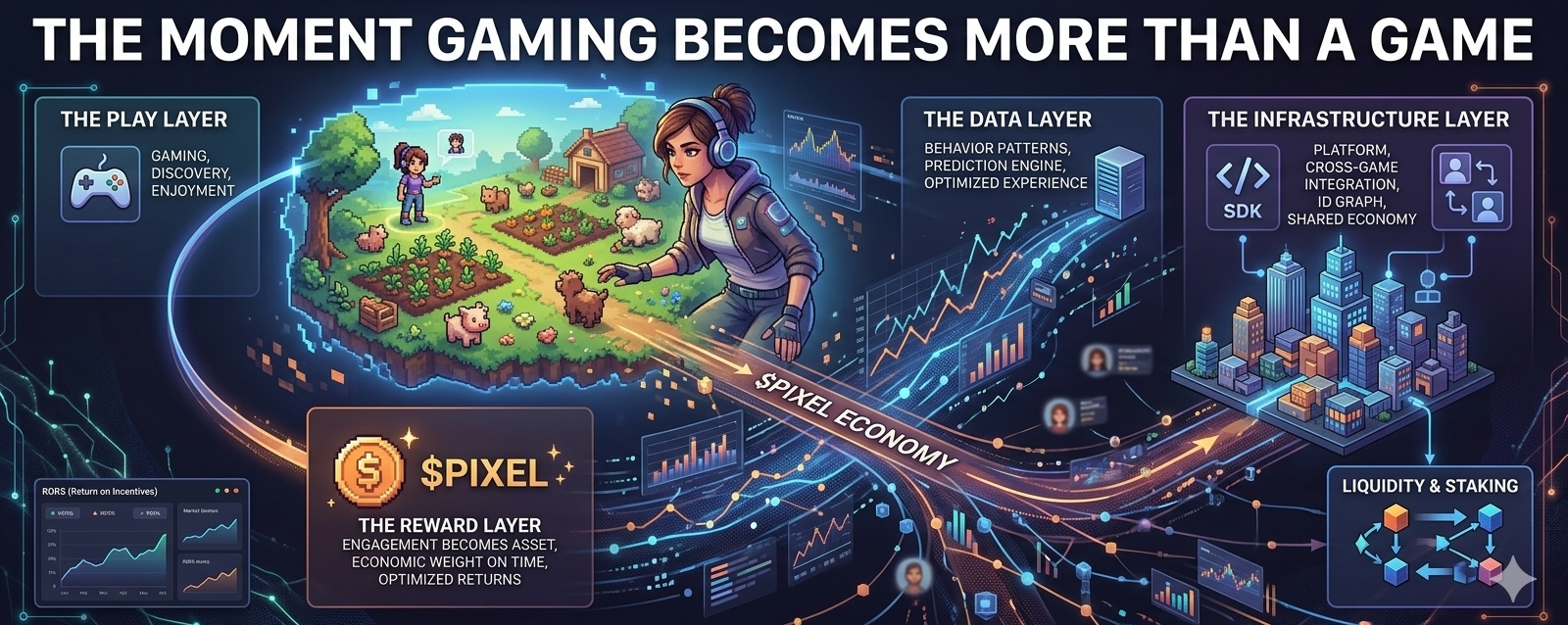
@Pixels There’s a thought that keeps circling back in my mind every time I sit with the idea behind Pixel and the Pixels ecosystem, and it’s not a simple one. At what point does a game stop being just a game? Because when you look closely, what’s being built here doesn’t feel like a traditional game anymore. It feels like something wider, something layered, almost like a living system where play, value, and behavior are all tied together in ways we haven’t fully experienced before. At first, it all looks familiar — rewards, tokens, data tracking, SDKs — things we’ve already seen across Web3 gaming. But the deeper you go, the more it starts to feel less like a single experience and more like an entire environment designed to function beyond entertainment.
The reward layer is where this shift becomes most visible. On the surface, it’s easy to understand: you play, you participate, and you earn something in return. It feels fair, even refreshing, especially when compared to the traditional internet where your time and attention are quietly monetized through ads while you receive little direct value. Here, the promise is different — your engagement itself becomes the asset. But that’s also where something subtle begins to change. When time inside a game starts carrying economic weight, the nature of that time shifts. It’s no longer just about enjoyment or curiosity. It slowly becomes measurable, valuable, and in some cases, optimized. What begins as a reward can quietly turn into a system where participation is driven by returns, and the experience transforms into a loop that needs to sustain itself.
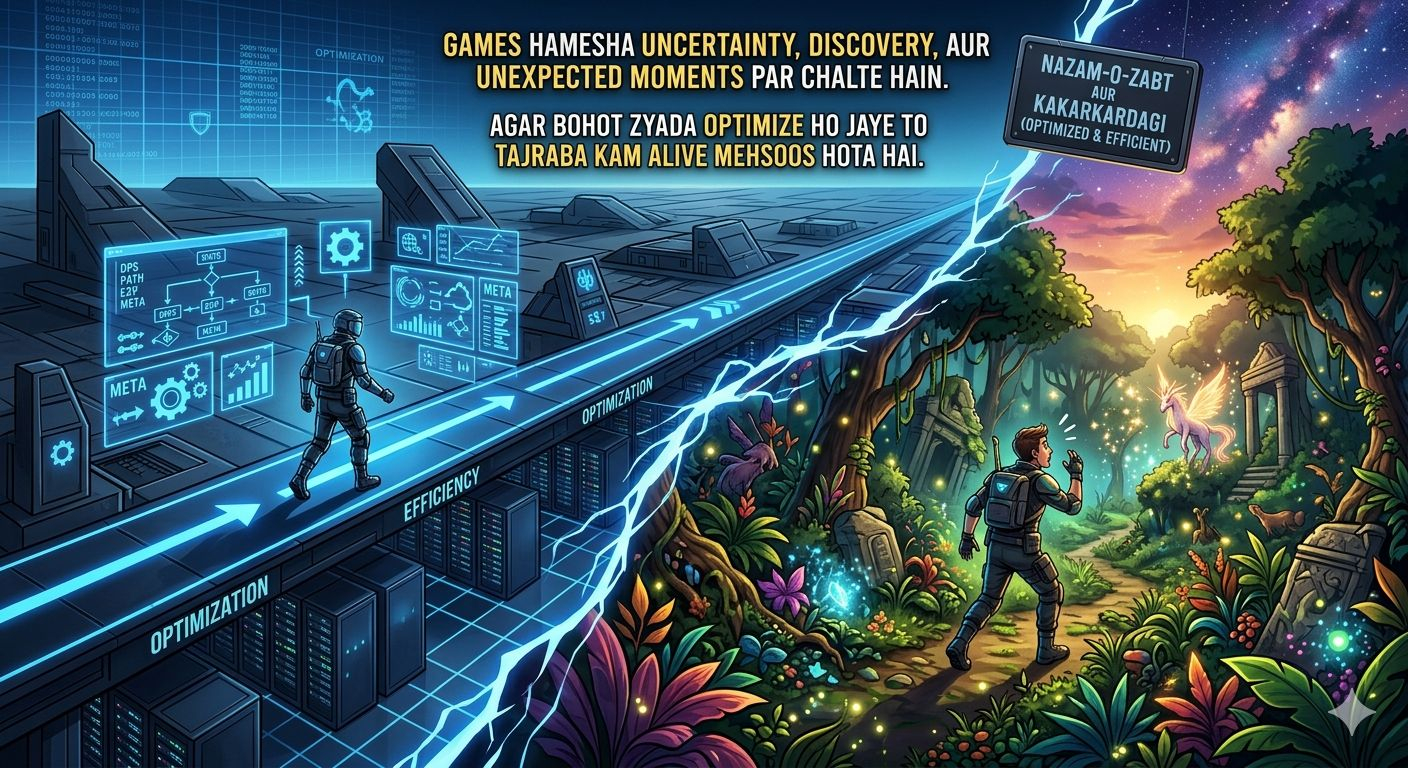
Then there’s the data layer, which feels like the quiet engine behind everything. Systems like the Events API don’t just observe what players are doing — they start to understand patterns, anticipate behavior, and shape future interactions. From the outside, it looks like analytics, something every modern platform uses. But internally, it begins to resemble prediction. The system learns how players move, what keeps them engaged, and what might bring them back. For developers, this is incredibly powerful because it reduces guesswork and turns design into something more precise. But there’s also a delicate balance here. When everything becomes predictable, something essential can fade. Games have always thrived on uncertainty, discovery, and unexpected moments. If too much becomes optimized, there’s a risk that the experience starts to feel less alive, even if it becomes more efficient.
The infrastructure layer adds another dimension entirely. The idea that multiple games can plug into the same ecosystem through an SDK changes the role of Pixels from a standalone product into something closer to a platform. It’s like building a city instead of a single building, where other creators can step in and build their own spaces on top of an existing foundation. The ID graph strengthens this even further by connecting identity across wallet, device, and behavior. A player is no longer just someone logging into a game for a session — they become part of a network that remembers, tracks, and evolves with them. This creates huge advantages in terms of growth and retention, but it also introduces a kind of gravity. The deeper you are inside the system, the harder it becomes to step outside of it.
Looking at how things have evolved over time, especially with features like the RORS dashboard and the shift from $BERRY to $PIXEL, it becomes clear that this isn’t just experimentation anymore — it’s gradual structuring. The RORS concept, for example, brings clarity to something that has always been uncertain in Web3: return on incentives. It turns rewards into something measurable and visible in real time, which helps developers understand whether their systems are actually sustainable. The staking and emission models go even further by introducing control over liquidity, turning rewards into a managed economic flow instead of an uncontrolled expense. And when you consider the cross-game integration, the biggest shift becomes obvious — individual games are no longer isolated experiences. They become parts of a shared economy.
At that point, the comparison to something like an ad network doesn’t feel far-fetched, except here the “ads” are replaced by gameplay, and the value comes directly from user participation rather than external advertisers. It’s a different kind of loop, one where players, developers, and even traders are all interacting with the same underlying system from different angles. For the player, it’s about playing and earning. For developers, it’s about building within an ecosystem that already understands users. For traders, it becomes a signal of activity and engagement. But all of this still rests on a question that hasn’t been answered yet — trust.

Because when behavior, identity, and value all exist in the same space, people start to look at the system differently. It’s no longer just a place to relax or explore. It becomes something that feels closer to an economy, and economies bring expectations, risks, and uncertainties. Token volatility alone can shift how people feel about participating. If rewards fluctuate too much, the motivation behind engagement can weaken. And if the system becomes too focused on optimization, it risks losing the emotional core that makes games meaningful in the first place.
So maybe the real question isn’t whether gaming will remain just a game. Maybe it’s whether something new is forming right in front of us — a hybrid space where entertainment and economics blend into one continuous experience. Pixels feels like a live experiment in that direction, not a finished answer. And the outcome doesn’t depend only on technology or design. It depends on people, on how they choose to engage, and on whether they’re comfortable living inside a system where play and value are deeply connected. No one really knows where this leads yet, and maybe that uncertainty is exactly what makes it so compelling to watch unfold.