
I keep watching how Pixels sits in that strange part of Web3 where nothing feels fully alive or fully dead. It’s active, yes, but activity in this space doesn’t always mean substance. I’ve been around long enough to know that motion can be misleading. A lot of projects move constantly just to avoid the appearance of stillness.
I don’t approach it with excitement anymore. That part of me burned out slowly over time, not in one moment. Now I mostly observe how people interact with these systems when they believe they’re building something lasting, even when the structure underneath is still shifting. Pixels feels like one of those places where belief arrives before clarity.
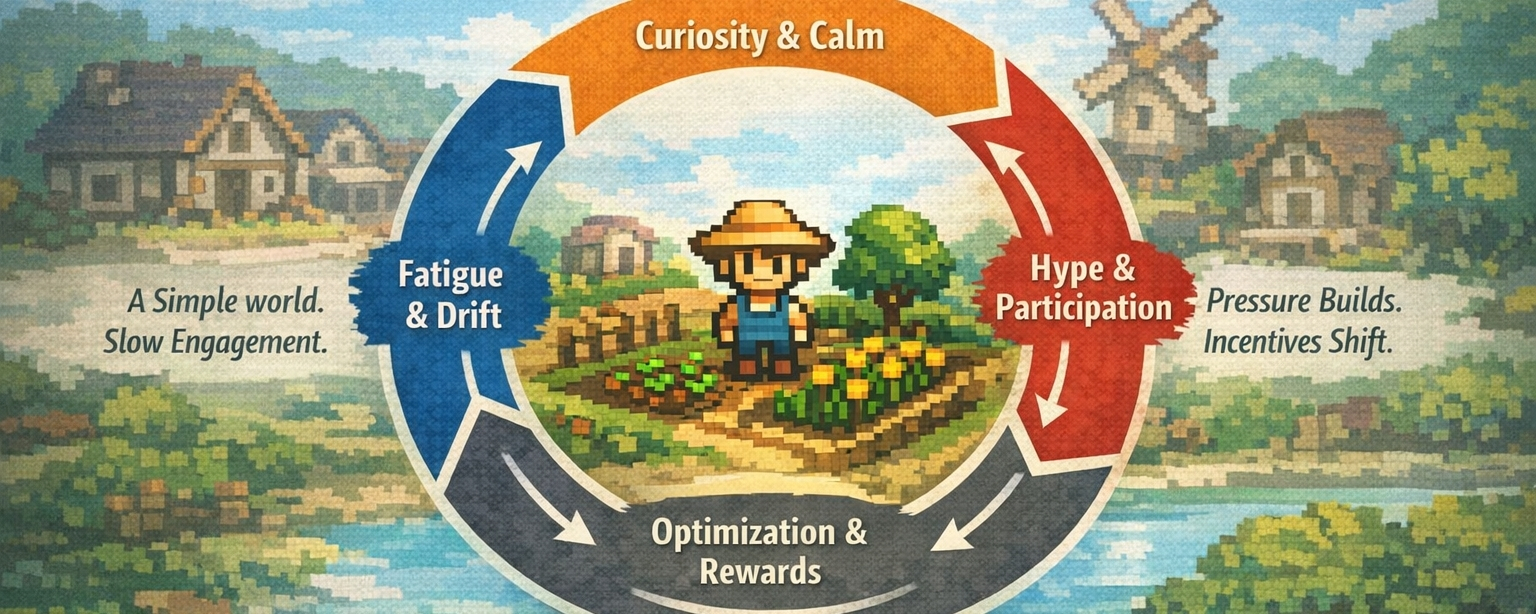
On the surface, it looks soft, almost harmless. Farming, social interaction, simple loops that don’t demand much at first. That’s usually the part that interests me the most—not the mechanics themselves, but how quickly people start assigning meaning to them. It never stays “just a game” for long in Web3. It becomes routine, then value, then expectation. That transition always happens quietly.
I’ve noticed how behavior changes once repetition settles in. What starts as casual login activity slowly turns into obligation dressed as engagement. People don’t always notice it happening. They just start showing up differently. Less curiosity, more structure. Less play, more maintenance. And I’ve seen enough cycles to recognize that shift even when no one says it out loud.
Pixels exists in that early-to-mid space where everything still feels undecided. That’s why people project so much onto it. Some see longevity, some see another loop in the cycle of attention. I don’t fully align with either view. I’ve learned not to lock into narratives too early, because narratives tend to outpace reality in this market.
What stands out more than the game itself is the rhythm of participation. There’s a steady pull to return, but it’s not loud or aggressive. It’s subtle, almost quiet enough that you could miss it if you weren’t paying attention. And I think that’s where its real test is happening—not in growth charts or announcements, but in whether that quiet pull can survive without constant external reinforcement.
I’ve seen similar systems before. Some held people longer than expected, not because they were deeper, but because they were consistent enough to become habit. Others faded slowly even while still technically “alive.” Pixels hasn’t decided which direction it belongs to yet, or maybe it has and I just haven’t seen it clearly.
The Ronin connection gives it context, but context isn’t the same as stability. It just means it exists in a familiar environment. Familiarity can make things feel safer than they are. I’ve learned to separate those two things more carefully over time.
What I keep returning to is the question of retention without momentum. When nothing is accelerating, when incentives aren’t pushing people forward, do they still stay? That’s usually where Web3 games reveal what they actually are. Not in their peak moments, but in their quiet ones.
Pixels still feels like it’s in that test phase. Not fully proven, not fully dismissed. Just existing in a state where attention hasn’t decided what it wants to become yet.
I don’t feel certainty when I look at it. I don’t think certainty is available here anyway. Just patterns repeating themselves in slightly different forms, and people trying to decide whether this time the pattern means something new.
So I stay in observation mode. Not waiting for validation, not expecting collapse. Just noticing how long something can remain interesting without fully explaining itself.
And even that feeling doesn’t stay fixed. It shifts slightly every time I come back to it, which might be the only honest signal I can trust right now.