
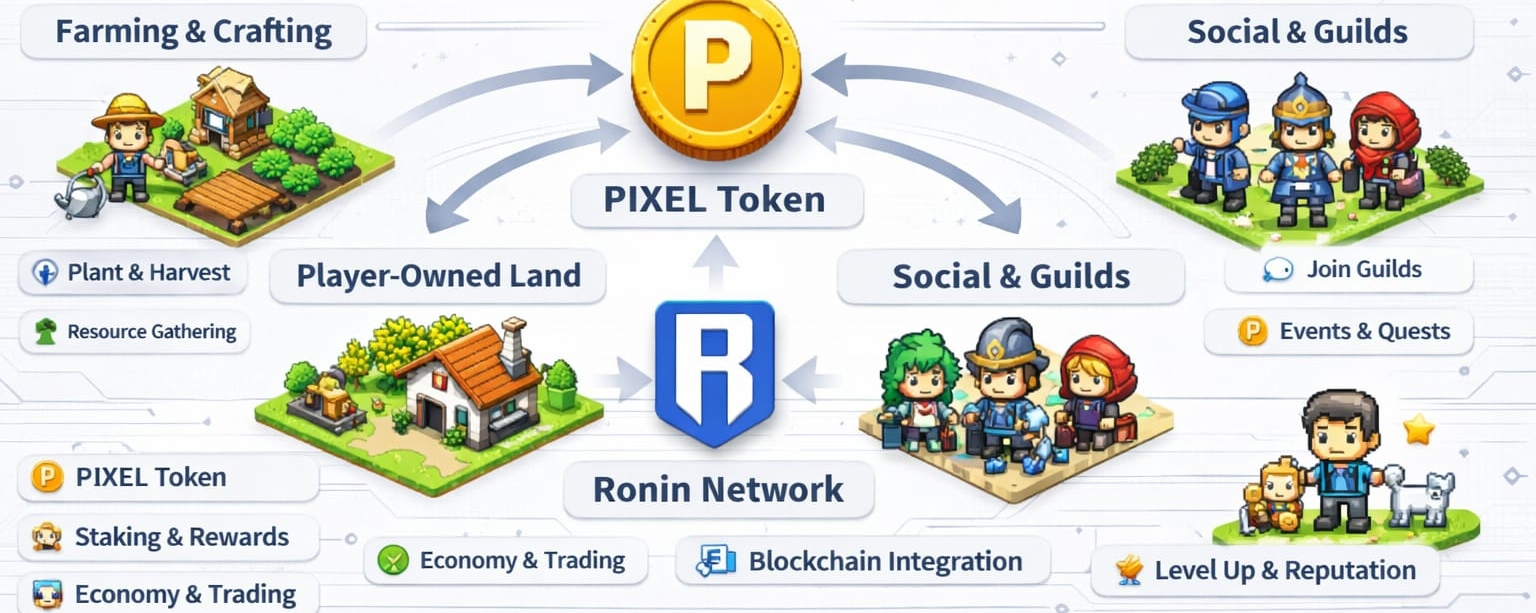

Pixels is the kind of project I probably would have dismissed too quickly a year or two ago.
Not because it looks bad. More because I have seen this exact setup too many times already. A light game, a token, some land mechanics, social hooks, ownership language, a chain partnership, and then the usual claim that this one is building the future of digital worlds. After a while, the pattern becomes easy to spot. You read enough whitepapers, token models, ecosystem maps, and “player-owned economy” decks, and your brain starts compressing everything into the same familiar shape. Most of it ends the same way too: decent marketing, temporary activity, mercenary users, then a slow fade once the emissions stop doing the heavy lifting.
So when I look at Pixels, that is the baggage I bring with me.
At first glance, it fits the template a little too neatly. Pixel art. Farming loop. social economy. on-chain assets. token utility. land. guild structure. identity layer. It almost sounds generated from a checklist of everything crypto gaming learned to say after the first big play-to-earn wave burned itself out. And that is exactly why I think Pixels is worth looking at a little more carefully. Not because it is obviously revolutionary. Honestly, I do not think it is. But because it feels like one of the few projects in this category that may have actually learned something from the wreckage that came before it.
That is a low bar, I know. Maybe an embarrassingly low bar. But in crypto, especially in GameFi, low bars are sometimes where the real signal starts.
The first thing that stands out is that Pixels does not feel overly obsessed with sounding important. That may seem like a strange compliment, but after years of reading projects that describe themselves like they are rebuilding civilization through tokenized middleware, restraint starts to look like intelligence. Pixels presents itself as a game first. Not in the empty “fun-first” way every deck now claims after the market punished obvious extraction loops, but in the more practical sense that the actual structure of the world seems built around repeat behavior people might do even if they were slightly less financially incentivized to do it.
That distinction matters more than most teams admit.
A lot of the earlier GameFi wave was based on a pretty fragile assumption: if you attach enough economic upside to shallow mechanics, players will treat the system as a game. What actually happened is that many players treated those systems exactly as they were designed — as economic surfaces to optimize, drain, and abandon. It was never really “play-to-earn.” It was closer to “perform repetitive actions until the yield degrades.” That model was not just unsustainable financially. It was unsustainable psychologically. People can feel when they are playing a world and when they are servicing a machine.
Pixels, to its credit, seems more aware of that distinction.
It starts with farming, which sounds almost comically safe at this point. Farming is basically the universal fallback genre for systems that need routine, retention, and a low-friction sense of progress. But maybe that is the point. Farming works because it creates a believable loop. You plant, wait, harvest, convert, improve, repeat. It gives structure without demanding constant adrenaline. And if you are trying to build a persistent social world, that kind of rhythm is probably more useful than spectacle. Spectacle gets attention. Routine gets retention. Crypto has historically overvalued the first and underestimated the second.
That may be one reason Pixels has held attention better than some louder projects.
The game begins in a way that feels almost modest. You move around. You gather. You plant. You notice other players. You start to see how production ties into tasks, how land matters, how reputation matters, how groups matter, and slowly the whole thing starts looking less like a toy economy and more like a deliberately layered environment. I am careful with praise here because crypto people, myself included, have a bad habit of overstating competence the moment a project clears the minimum threshold of functionality. But there is something structurally more grounded about Pixels than the usual GameFi launch cycle.
Part of that comes from how it handles pace.
Most weak tokenized games either feel dead on arrival or manic by design. Dead because the loop is too thin to support interest. Manic because the reward system pressures every action into urgency. Pixels sits somewhere else. It feels slower. More domestic, almost. Not in the sense that it is small, but in the sense that it is organized around return behavior rather than constant climax. That sounds simple, but it is one of the hardest things to design well. A lot of online worlds fail because they do not know how to survive ordinary time. They can create event spikes, promotional bursts, and short-lived speculation. But they cannot create a Tuesday afternoon reason to log in. Pixels seems more interested in solving for Tuesday afternoon.
And honestly, that may be one of the most mature design instincts in the entire project.
The Ronin move also makes more sense the longer I sit with it. At a surface level, it was easy to read as a distribution decision. Find a chain with gaming identity, existing wallet habits, decent user familiarity, and better alignment than a generic infrastructure environment. Fine. Standard logic. But I think it did something slightly more important than that. It placed Pixels inside a context where the game no longer had to explain why it was on-chain every five minutes. That alone reduces friction, not just technical friction, but conceptual friction. In the wrong environment, blockchain games always feel like they are apologizing for themselves or overcompensating for themselves. On Ronin, Pixels feels less like a thesis statement and more like a product.
That is healthier.
Because the problem with too much crypto-native design is that it tends to foreground the machinery. Wallets, assets, token sinks, staking hooks, liquidity assumptions, ownership language — all of it becomes hyper-visible. The player ends up staring at the economic scaffolding instead of the world. Pixels is still very much a crypto game, obviously. The on-chain layer is not cosmetic. Ownership matters. Token utility matters. Land matters. But the better versions of these systems are the ones you can inhabit without constantly feeling the architecture pressing against your forehead.
Pixels gets closer to that than most.
Its economy is probably the part I look at with the most suspicion, but also the part that makes it more interesting. Suspicion, because GameFi economies have trained anyone moderately awake to ask the same boring but necessary questions. Who is the real buyer? What behavior is actually being rewarded? What happens when new user inflow slows? How dependent is the system on social belief versus mechanical utility? Does the token support the world, or does the world exist to support the token? These questions are not glamorous, but they are the only ones that matter after the narrative dust settles.
With Pixels, I do not think the answers are magically clean. I do not think any live tokenized game has solved that permanently. But the project does seem to be making a more serious attempt to separate gameplay usefulness from pure speculative pressure. That is an important difference. A game economy should not force every meaningful action to become a market event. If everything is priced too visibly, players stop behaving like inhabitants and start behaving like operators. Pixels appears to understand that a world needs softer layers between action and extraction.
That may sound like a small design point, but it is actually central.
The earlier generation of crypto games often collapsed because they confused measurable activity with meaningful activity. It was easy to count transactions, emissions, participation spikes, NFT volume, and wallet growth. It was much harder to build attachment. Pixels seems more focused on the second problem, even while still having to manage the first. That is why systems like land, guilds, reputation, and identity matter here. They are not just features. They are attempts to create forms of embeddedness.
Land, for example, is usually where I roll my eyes first in these projects. “Own a piece of the metaverse” has probably done more long-term damage to credibility than almost any phrase in this sector. Most digital land has felt either decorative or speculative, and often both. But in Pixels, land appears to function more like an active node in the player’s daily life. It is tied to routine, productivity, access, customization, and visible investment in the world. That does not make it immune to speculation, obviously. Nothing tokenized is immune to speculation. But it does make ownership feel more operational and less ceremonial.
And that distinction is huge.
The same goes for guilds. Normally when crypto projects talk about community, I expect the usual emptiness. Maybe a Discord role, maybe a vague governance pretense, maybe a few ceremonial group structures that mostly exist for optics. In Pixels, guilds seem more concrete than that. They carry permissions, roles, internal status, economic coordination, and real social shape. That can cut both ways, to be clear. A more formalized social system can create stronger commitment, but it can also create hierarchy, gatekeeping, and the kind of semi-financialized belonging that makes crypto communities occasionally feel like country clubs with token wrappers. Still, I would rather see a project acknowledge that social worlds have structure than keep pretending “community” just means engagement metrics and mascot loyalty.
Pixels at least seems willing to build the structure.
The reputation layer is another signal that the team is thinking about something beyond raw wallet movement. In these ecosystems, the big hidden problem is always the same: how do you distinguish a resident from a tourist? How do you tell the difference between someone who is extracting and someone who is actually inhabiting the world? Most systems fail at that. They reward whatever is easiest to count. Pixels appears to be trying to measure deeper involvement, or at least approximate it through a wider set of behaviors. That is not perfect, and it can absolutely create weird incentives of its own, but it is still a more intelligent direction than pretending a transaction history alone tells you who matters to the health of a game.
And I think that is what keeps pulling me back to the project intellectually. Not excitement exactly. More like reluctant interest.
Because Pixels is not doing something radically new in the abstract sense. Farming games exist. Social MMOs exist. tokenized economies exist. identity layers exist. interoperable assets exist. None of these components are novel on their own. What matters is the assembly. What matters is whether the combination creates a world that feels stable enough, human enough, and useful enough to survive after the narrative premium fades. Most projects never get there. They either drown in their own financialization or flatten into irrelevance once the market moves on to the next beautiful theory.
Pixels might still fail in one of those ways. I would not rule that out at all.
In fact, the risks here are exactly the familiar ones. The more a game rewards players economically, the more it risks turning leisure into labor. The more it ties social structure to ownership and status, the more it risks making the world feel pre-sorted for insiders. The more it succeeds as a token ecosystem, the more pressure there is to preserve the economy even when game design would benefit from disruption. These are not side concerns. They are the central contradictions of the whole category. Pixels is not above them. It is sitting right inside them like everyone else.
But maybe the meaningful question is not whether it escapes the contradiction. Maybe the question is whether it manages it better than most.
Right now, I think the answer might be yes.
Not because the project is clean. It is not. Not because it feels post-speculative. It definitely is not. And not because it has transcended the usual crypto cycle dynamics. Nothing has. But because it gives the impression of a team that understands, at least to some extent, that a tokenized world cannot survive on financial logic alone. It needs ritual. It needs texture. It needs identity. It needs reasons to return that are smaller and quieter than number-go-up expectations.
That is a much harder thing to build than a reward loop. And also much less marketable.
Maybe that is why Pixels feels more real than a lot of competitors. It is not trying to convince me it is reinventing civilization. It is trying to become part of a player’s habits. That is a very different ambition, and in some ways a more credible one. Real products do not always arrive as grand theories. Sometimes they arrive as routines people keep choosing.
After too many years of reading crypto projects explain why they are inevitable, I find that strangely refreshing.
So no, I do not look at Pixels and think this is the definitive future of Web3 gaming. I am not that far gone. I still think the category carries structural problems that no single project has solved. But I do look at it and think this may be one of the clearer examples of a team trying to move beyond the dumbest version of GameFi without abandoning the experiment entirely. And at this stage, that counts for something.
Maybe not enough to call it a breakthrough. But enough to keep watching.
And honestly, in crypto, careful attention is sometimes the highest compliment a project can earn.