
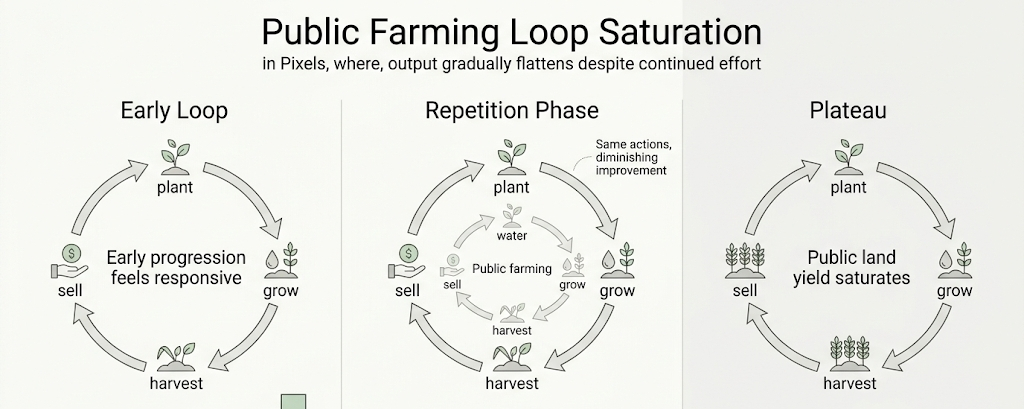
I did not really understand what land was doing to the economy in Pixels at first.
I understood the obvious version. Land looked important because it was scarce, because it was on Ronin, because people talk about ownership in Web3 games like the sentence is already finished once the NFT is in your wallet. That is the normal play-to-earn reflex. You see land and you assume prestige, maybe convenience, maybe some gated upside later. I thought of it like a place. A stronger place, sure, but still mostly a place.
Then I stayed inside the game long enough for that idea to stop holding.
Because once I started looking at staking instead of just movement, farming, and inventory, land stopped feeling like scenery with status attached to it. It started feeling like weight. Not dramatic, not loud, not the kind of thing the screen screams at you every minute. More like the system had a second way of listening, and land changed how loudly your wallet spoke when rewards were being sorted out. Pixels’ own staking FAQ makes that pretty explicit: for in-game staking, Farm Land NFT holders get additional staking power based on a formula where each land adds a 10% boost on the amount staked, capped at 100,000 extra staking power per land. The same FAQ also says this landowner benefit applies only to in-game staking, not on-chain dashboard staking.
That distinction is where it got interesting for me.
Because Pixels already has this split personality all over the place. One part feels like a game world you move through casually. Another part is constantly sorting behavior, rewards, access, and retention underneath that casual surface. So when I realized that in-game staking is passive as long as you stay active and hold enough $PIXEL, while on-chain staking is active and asks you to deliberately choose which game to support, land started looking less like decorative ownership and more like a built-in amplifier inside one side of that system. Pixels says in-game staking requires activity within the past 30 days and at least 100 $PIXEL, and rewards are distributed on a regular cadence through in-game mail. That means the land bonus is not just attached to having assets. It is attached to staying inside the live loop.
And that changes the social feeling of land too.
In a lot of play-to-earn systems, land can end up being one of two lazy things. Either it is mostly cosmetic prestige wrapped in financial language, or it is a rent-extraction device so blunt that everyone can see the hierarchy immediately. Pixels feels more slippery than that. The hierarchy is there, but it is woven into participation logic. The same help material that explains the landowner staking bonus also notes that if land is rented out, the benefit goes to the wallet currently holding the land, and if land is connected to your game account, even rented land can count toward the stake holding calculation. So the system is not treating land as a passive trophy. It is treating control over land placement and wallet relation as something that can modify economic influence.
Once I saw that, staking itself stopped looking passive too.
On the surface, staking PIXEL looks like the usual familiar thing: lock token, wait, collect rewards, maybe restake, maybe unstake later. And yes, there is a dashboard, there is a claim flow, and there is even a 72-hour lock after unstaking before funds become withdrawable. But the official staking docs keep phrasing it in a way that pushes past simple yield. They say you stake into different game projects, not just into a generic pool, and that staking is meant to support development and expansion tied to each project. The whitepaper goes further and says players choose games to stake into, effectively influencing which games deserve ecosystem resources and how rewards are allocated.
That is the moment where the whole thing stopped feeling like finance and started feeling like allocation.
Because if I put PIXEL behind one game instead of another, I am not only seeking return. I am participating in a sorting process. Pixels’ whitepaper says games compete for stakers by improving retention, increasing net in-game spend, and using ecosystem tools well, while rewards are distributed according to game-specific performance. Another section of the whitepaper describes the staking pool as converting into a user-acquisition budget for the game, which the studio can use for targeted in-game rewards instead of traditional ad spend. So my “stake” is not sitting there as a quiet vote in theory. It is being turned into fuel for one game’s ability to attract, retain, and reward users.
That is a very different feeling from the older play-to-earn pattern where staking mostly exists to absorb supply and flatter long-term holders with the language of loyalty.
On Pixels, the token is trying to behave like belief, budget, and routing at the same time. Pixels literally frames staking as part of a decentralized publishing model where games become the primary validators of the ecosystem rather than nodes. It also says the loop is circular: staking leads to UA credits, those bring players, player spend creates revenue, revenue funds rewards, the resulting behavior produces richer data, and that data sharpens future targeting. The more I read that, the less I could pretend staking was passive support. It is closer to saying: tell us where the ecosystem should concentrate attention, and we will operationalize that choice.
And then land comes back into the picture and makes that even less neutral.
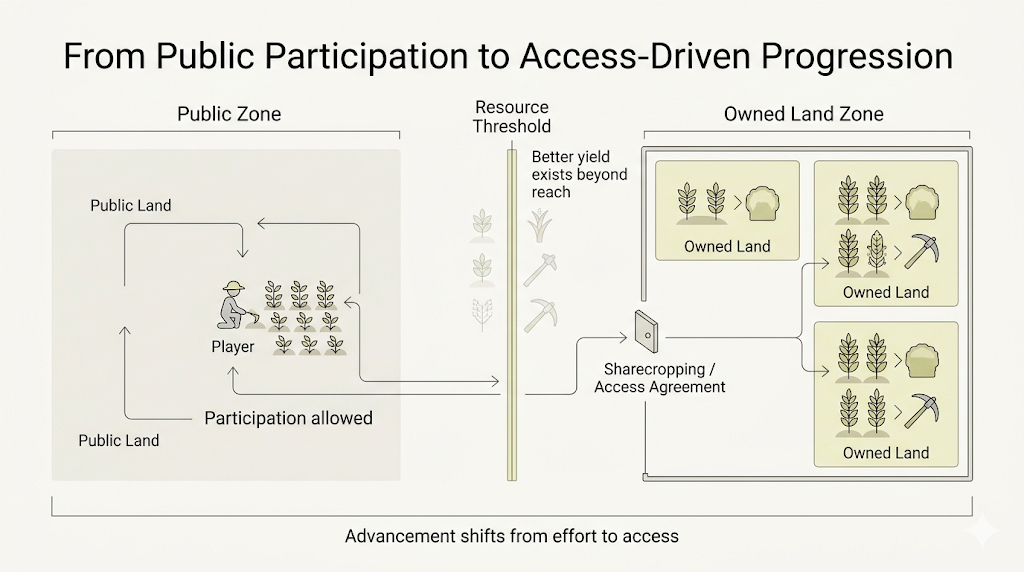
Because if land increases staking power on the in-game side, then landholders are not just participants in the economy. They have a better angle inside one of the channels through which the economy redistributes attention and reward. Not absolute control, obviously. Pixels does not say landowners directly receive Farmer Fees. In fact, the FAQ says they do not receive those payments directly, though stakers can still benefit indirectly because 100% of Farmer Fee revenue goes back to stakers. But that still means the person already holding land can stand in a stronger position when that reward pool flows back through staking logic, especially since Farmer Fees themselves vary by Reputation Score, with better reputation reducing the cut.
That is why the system feels more layered than a normal “own land, get perks” setup.
Land is a place, yes. It is also a modifier on economic audibility. Staking is a reward path, yes. It is also a distribution signal about which games should thicken and which ones should stay thin. Put those together and Pixels starts looking less like a game where assets merely decorate your status and more like a game where some assets change how hard the ecosystem leans toward you when resources, rewards, and future momentum get sorted.
That is the part I keep getting stuck on.
Pixels can still be more playable than the old play-to-earn worlds where every action felt like accounting homework. It can still be more alive than the token-first systems that burned everyone out by making staking feel detached from actual play. But that does not make this neutral. It just makes the hierarchy softer to look at. When land multiplies staking power in-game and staking itself behaves like ecosystem allocation, the question is no longer whether landowners are recognized.
The question is how much of the future map is already being weighted by the people who own the terrain and can make their support count harder than everybody else’s.