
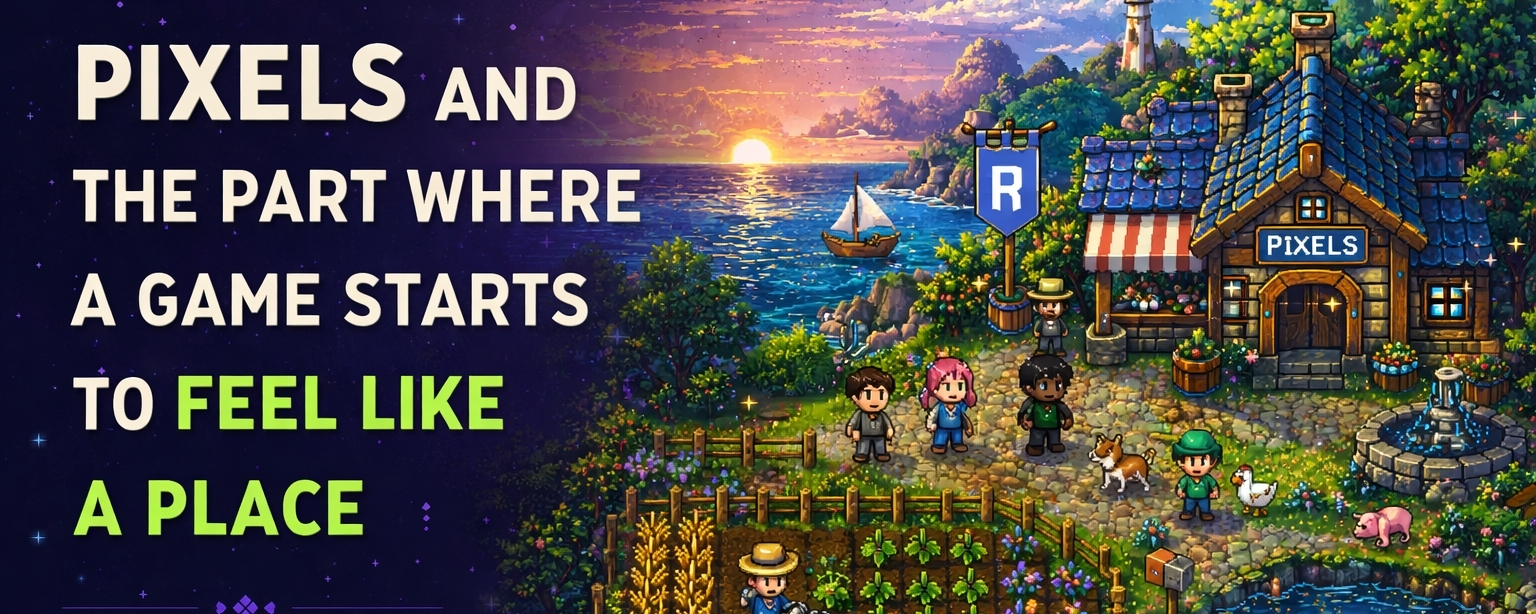
There’s a difference between something you use… and somewhere you return to.
At first, most Web3 games feel like tools. You log in with a purpose. Do a few actions. Check outcomes. Then leave. The interaction is clean, but also transactional. You’re there to do something specific, not to stay.
That’s how I approached Pixels in the beginning too.
Just another system to understand.
Just another loop to test.
But after a while, something subtle started to change.
I stopped logging in with a goal.
I started logging in out of habit.
Not a strong habit. Nothing forced. Just a quiet sense that I wanted to check in. See how things looked. Maybe adjust something small, maybe not. The intention wasn’t clear, but the action was consistent.
That’s when I realized it no longer felt like a system.
It started to feel like a place.
That shift is hard to explain, but easy to notice once it happens.
In a system, everything is structured around outcomes. You interact to achieve something. There’s always a reason behind what you’re doing, even if it’s small.
In a place, that pressure fades.
You can still do things.
But you don’t have to.
You can just exist there for a moment.
Walk around. Check your farm. See what changed. Then leave again.
Nothing is demanded.
Nothing is evaluated.
That’s not something most Web3 games manage to create.
Because the moment value is introduced, systems tend to tighten. They push players toward efficiency. They create subtle expectations around how time should be used.
And over time, that turns everything into a loop you manage, not a space you inhabit.
Pixels feels different because it leaves room for that second mode.
You can treat it like a system if you want.
But you can also treat it like a place.
That duality is what makes it interesting.
The world doesn’t feel static. It changes slowly, but it changes. Crops grow. Spaces evolve. Your presence has continuity, even if you’re not actively optimizing anything.
That continuity matters.
Because it creates a sense of return.
Not return as in “I need to do this again.”
But return as in “this is still here.”
That’s closer to how real environments feel.
You don’t visit them to complete tasks.
You visit them because they exist in a way that feels stable.
That stability is something crypto hasn’t fully mastered yet.
Most systems feel temporary.
Not unreliable, but unfinished. Always shifting, always evolving, always one update away from feeling different again.
That makes it hard to form attachment.
Because attachment depends on consistency.
Pixels, at least for now, holds onto that consistency better than most.
The loop doesn’t change drastically.
The world doesn’t reset.
Your progress doesn’t feel fragile.
That allows something else to form.
Familiarity.
And familiarity is what turns interaction into habit.
You don’t think about why you’re opening it.
You just do.
That’s where things start to feel less like a product and more like an environment.
Of course, the system underneath still exists.
There are mechanics.
There are economies.
There are ways to optimize and improve.
That layer doesn’t disappear.
But it doesn’t dominate either.
And that balance is important.
Because if the system takes over completely, the sense of place disappears. Everything becomes about doing, not being.
Pixels hasn’t fully solved that tension.
No Web3 game has.
But it leans enough toward the “place” side that you can feel the difference.
You can log in without a plan.
You can leave without finishing anything.
You can return without needing a reason.
That’s not something people usually talk about.
Because it doesn’t show up in metrics.
It doesn’t look impressive on paper.
But it changes how the experience feels.
At this point, I find myself less interested in how advanced a game is and more interested in whether it gives me a reason to return that isn’t tied to outcomes.
Something that exists even when I’m not trying to optimize it.
Pixels gets closer to that than most.
Not by adding more.
But by leaving enough space for the experience to breathe.
And sometimes, that’s what makes something feel real.
Not how much it offers…
But how comfortable it is to come back to.