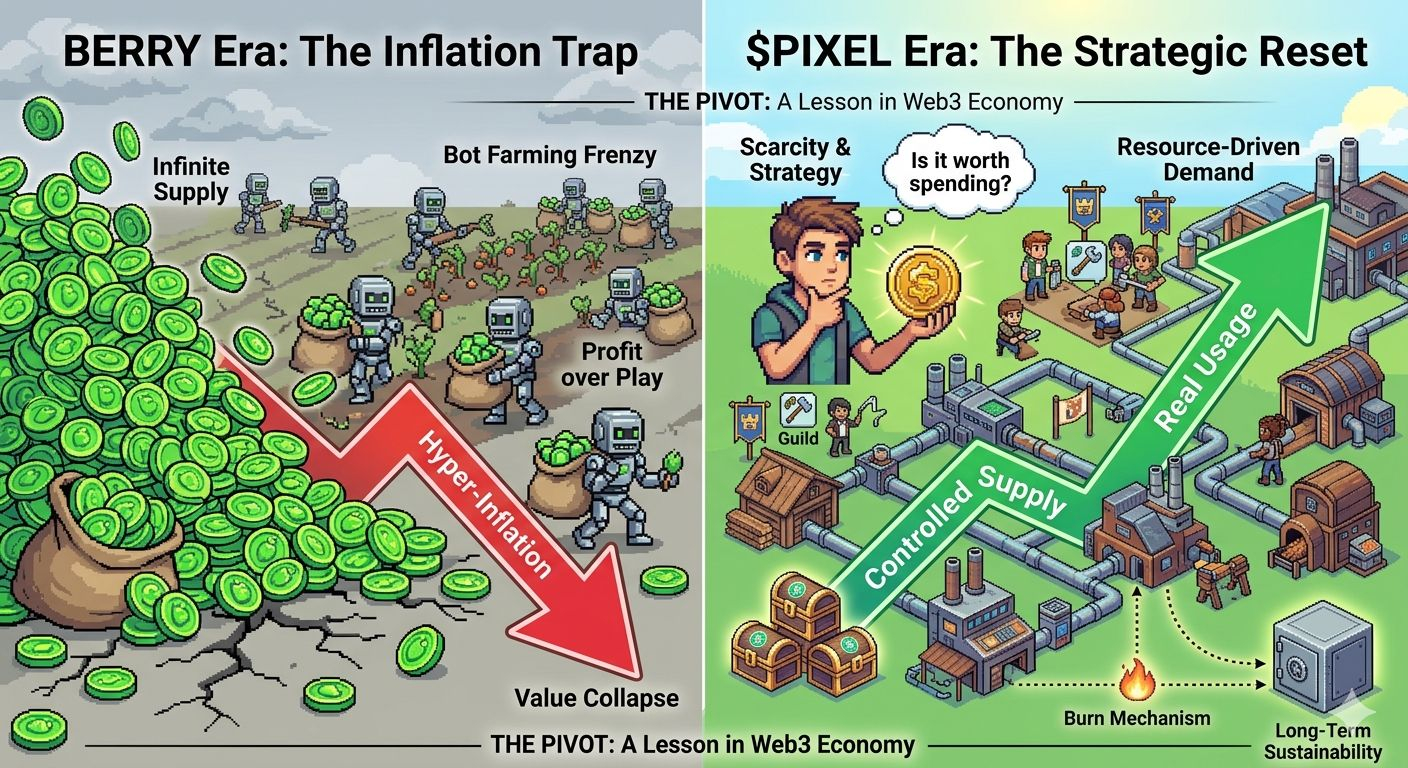
The shift of Pixels from BERRY to $PIXEL wasn’t just a simple game update—it felt more like a major lesson in blockchain gaming. When you look back at it, you realize how difficult it is to save an economy that’s heading toward collapse. In many ways, it was a battle between easy, short-term growth and long-term sustainability. At the beginning, BERRY was designed to be simple: you farm, you earn, and you spend. But the real problem started when it became on-chain and easily tradable. Once players could convert in-game currency into real value, the focus shifted. People stopped playing for enjoyment and started playing for profit. That’s when bots and heavy grinders took over, flooding the system with supply. Over time, inflation got out of control, and BERRY lost its value completely. When players have more currency than they can realistically spend, it stops feeling rewarding. It turns into just a number, and the motivation to play fades away.
That’s where $PIXEL comes in, and its introduction felt like a complete reset. Instead of trying to patch a broken system, the team essentially rebuilt the economy from scratch. But more than just a technical change, it created a psychological shift in how players think. Earlier, the main question was always about how much time it would take to grind for something. Now, it’s about whether spending that currency is actually worth it. This subtle change makes a huge difference. Every upgrade, every resource, and every decision now carries weight because it connects to real-world value. The game no longer feels purely casual—it feels strategic.
At the same time, this shift brings a deeper question into focus: is Pixels still a game, or has it become an economy disguised as a game? During the BERRY era, it clearly felt like a game-first experience—simple, relaxed, and focused on progression. But with $PIXEL, it leans more toward being economy-first. One of the biggest trade-offs here is volatility. Now, even basic in-game decisions can be influenced by external market conditions. For players who enjoy Web3 and financial strategy, this adds excitement and depth. But for more casual players, it can feel overwhelming or even stressful. Pixels is no longer just about farming—it feels closer to a digital marketplace where every action has financial implications.
What’s even more interesting now is the direction the game is heading in. The industrial expansion, with its resource chains, production systems, and guild-based interactions, is pushing the experience far beyond simple farming. The focus is slowly shifting from “farm and sell” to actually using resources within the ecosystem to build something larger. This could be the key to making the economy sustainable, because real usage creates real demand.
In my view, Pixels is evolving into a platform that supports an entire digital economy rather than just a game with a market attached to it. The big question now is whether these new systems are strong enough to control supply in the long run, or if more burn mechanisms will be needed to keep the balance intact and prevent the same kind of collapse that happened during the BERRY era. 🤔 $PIXEL