
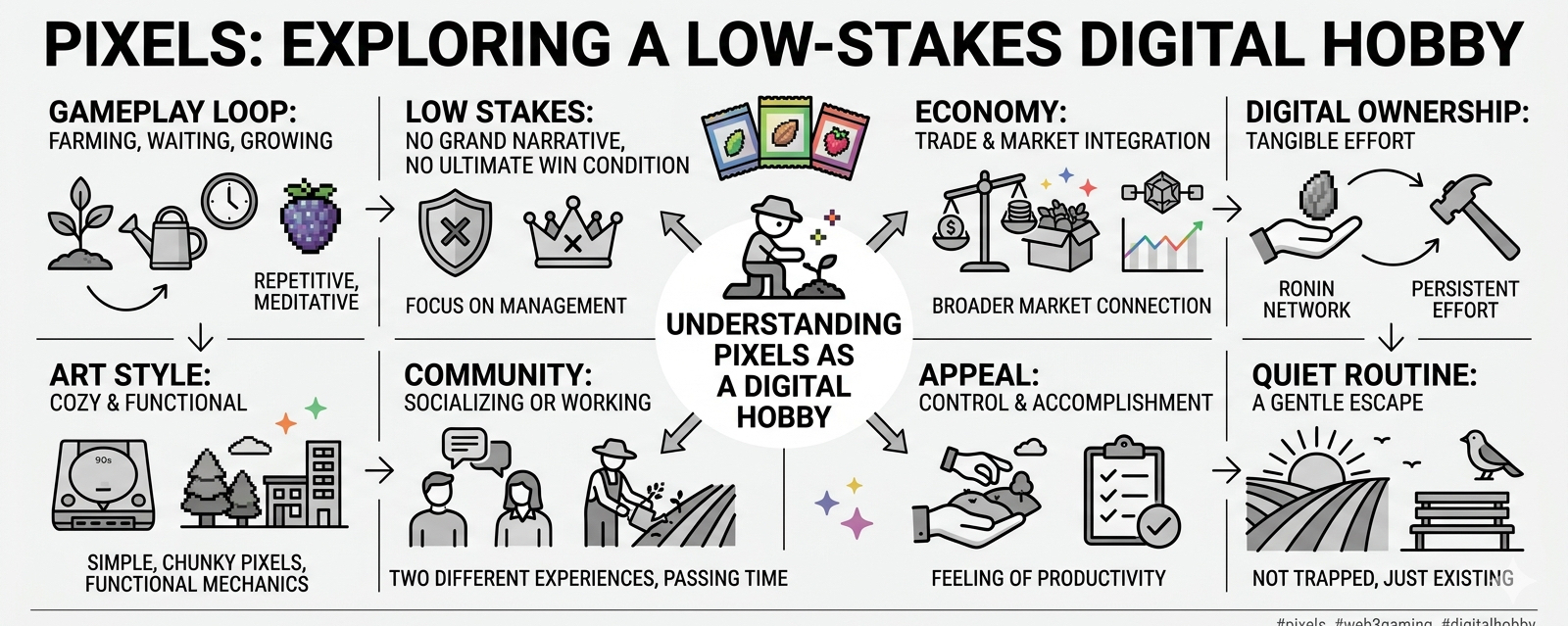
I’ve been spending some time looking at @Pixels lately. It’s one of those games that doesn’t really demand your attention in the way a fast-paced shooter or a deep strategy game might. It’s built on the Ronin network, which means there’s a whole layer of digital ownership underneath the surface, but when you’re actually inside the game, it mostly just feels like farming.
You start out with a small plot of land. You plant seeds, you water them, you wait. It’s repetitive, almost meditative in a way. There isn’t a grand narrative pulling you forward, no princess to save or dark lord to defeat. You’re just… managing a space. You can usually tell within the first few minutes if this is going to be your kind of thing or not. If you like the idea of watching a bar fill up while a crop grows, you’ll probably find a rhythm here. If you’re looking for high stakes, you’ll likely feel a bit underwhelmed.
It’s interesting, how these kinds of spaces shift our expectations. We’re so used to games being about winning. You play, you get better, you conquer something. But here, the goal is a bit looser. You’re building resources, maybe trading them, maybe using them to build other things. It’s more like a digital hobby than a traditional game. I found myself thinking about how much of our digital time is spent in these "productive" loops. We like to feel like we’re accomplishing something, even if the "something" is just growing a virtual pixelated berry.
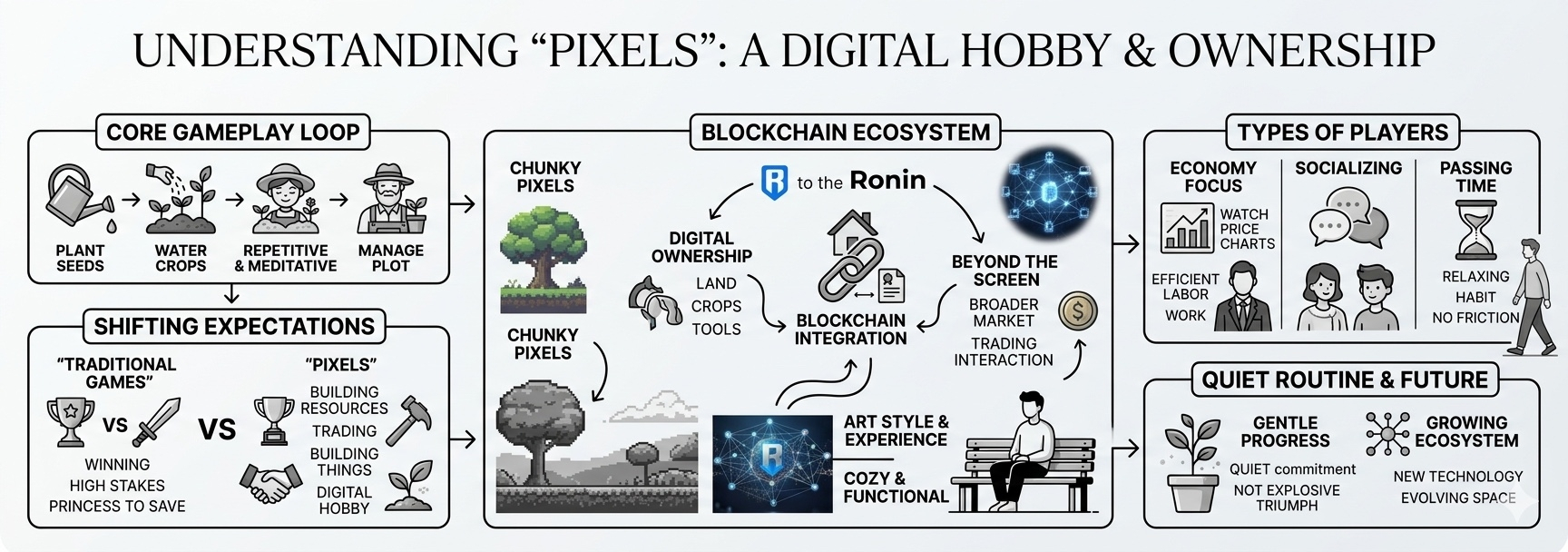
That’s where things get interesting, I think. Because it’s all tied to a blockchain, those berries or seeds or whatever you’re farming have a place in a broader market. It’s not just a closed loop inside the game’s own memory. You can take what you’ve grown, or the tools you’ve crafted, and interact with a world outside of just your own screen. Most games, when they shut down or you stop playing, everything just evaporates. Everything you built is gone. Here, there’s this lingering sense that the effort might have a different kind of footprint.
But honestly, most of the time, I’m just walking around the map. The art style is intentionally simple—lots of bright, chunky pixels. It feels like a throwback to games from the early 90s, the ones that ran on hardware that could barely handle colors. It’s cozy. It doesn’t try to be hyper-realistic or cinematic. It’s just functional. And maybe that’s the point. It doesn’t distract you with fluff. It just gives you the mechanics and lets you decide what to do with them.
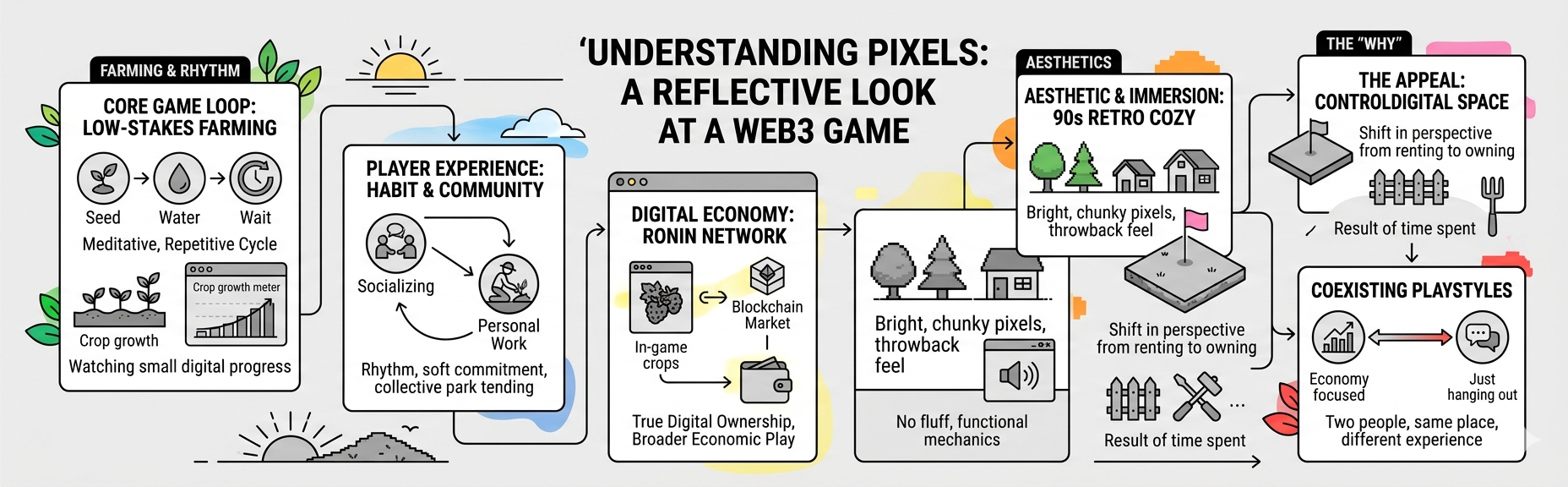
I’ve noticed that the way people talk about the game changes, too. Some people are there purely for the economy, watching price charts and trying to figure out how to be more efficient with their labor. Others are just hanging out, chatting with whoever happens to be near their plot. It becomes obvious after a while that two people can be in the same game, standing in the same field, and be having two completely different experiences. One is working. One is socializing. One is just passing time.
It makes me wonder about the nature of play. When we remove the "win condition," what’s left? Usually, it’s community or habit. You come back because your crops are ready, or because you told someone you’d meet them there. It’s a soft sort of commitment. You don’t feel like you’re failing if you miss a day, but you do feel a little pull to see how things have changed while you were gone.
The movement through the world feels a bit like walking through a park that everyone is collectively tending to. You see other players wandering by, doing their own tasks. There isn’t a lot of friction. Everything is pretty much as it appears. You plant, you gather, you move on. There’s a certain honesty in that. You aren’t being tricked into a complex story or a manipulative reward system that tries to keep you logged in for twelve hours a day. It’s just… chores, in a way. But they’re chores that belong to you.
I think that’s the underlying appeal for a lot of people. In a world where so much of what we do online feels like we’re just renting space on someone else’s platform, there’s a slight shift in feeling when you have even a small amount of control over your digital environment. Even if it’s just a patch of soil that you’ve claimed for a little while. It changes how you relate to the digital objects you encounter. You stop seeing them as just assets and start seeing them as the result of the time you’ve spent.
Still, it’s not for everyone. If you need constant stimulation, this is going to feel like watching paint dry. It’s slow. It’s quiet. It requires a level of patience that a lot of modern games have trained us to lose. You have to be okay with not having a big, explosive moment of triumph. You have to find your own satisfaction in the small, incremental progress of a digital garden.
Sometimes I think we overcomplicate these things. We look for deep meaning in every line of code, or we look for reasons why something is failing or succeeding. But sometimes, people just want a place to exist for a little bit. A place where the rules are clear, the stakes are low, and the work—even if it’s virtual—has a beginning and an end.
I’ve spent a few hours just moving between zones, watching the trees sway, hearing the simple sound effects. It’s not mind-blowing. It’s not trying to reinvent the medium. It just… is. And maybe that’s enough. There’s something refreshing about a game that doesn’t try to be your whole life, but instead just slots into the quiet edges of it, like a book you keep on your nightstand.
I’m curious how these things evolve, though. As more people join, and the world gets busier, does that sense of quiet calm stick around? Or does the market pressure eventually wash away the charm, turning the fields into something more rigid? It’s hard to say. The technology is still so new, and we’re still figuring out how these digital spaces want to behave. For now, it’s just a patch of land. A few seeds. Some time set aside in the afternoon.
The sun sets in the game, the colors shift, and the loop starts over again. You get up, you check the garden, you see what the day holds. It’s a quiet sort of routine. Not entirely unlike the things we do in the physical world, just translated into a different language of pixels and code. You put in the time, and you wait to see what grows. It’s a gentle way to spend an hour, provided you’re willing to let the pace be what it is. I keep thinking about how the tools we have, the ones that let us own our digital spaces, are still very much in their infancy. This, whatever this is, feels like the beginning of something, but it’s still very quiet, very small, and very much in the process of becoming whatever it’s meant to be…$PIXEL

