
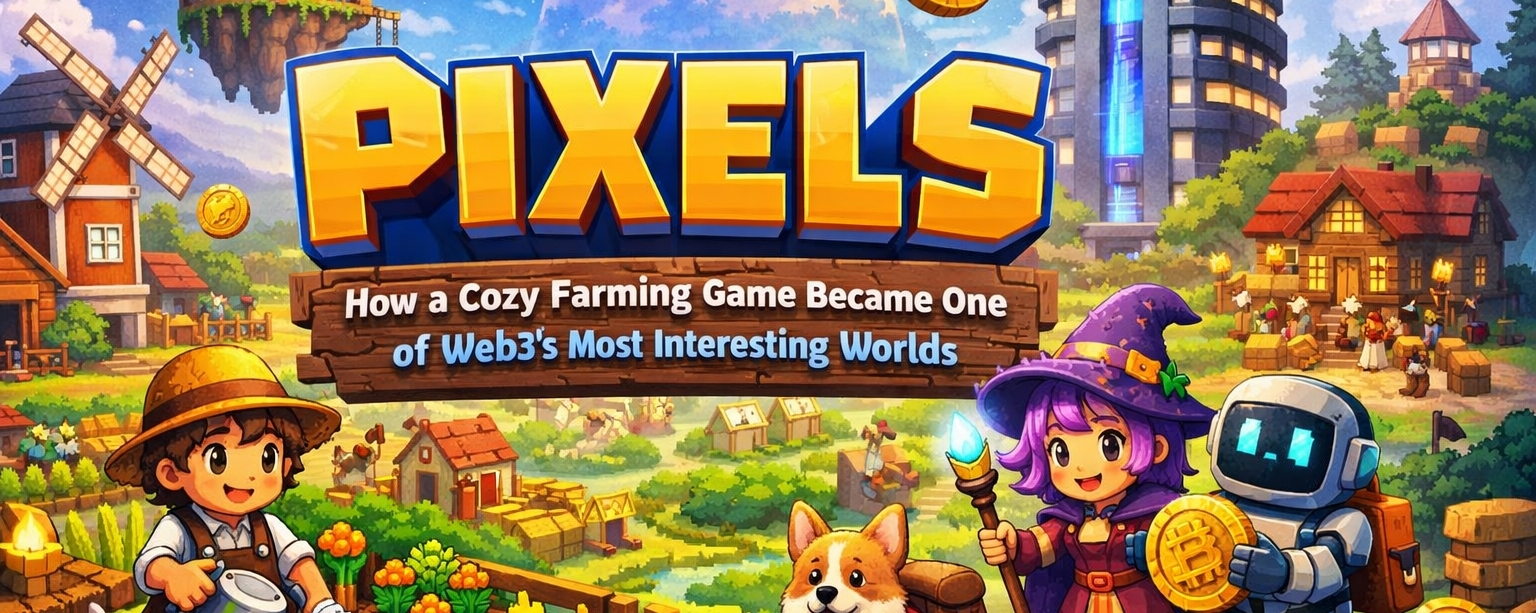
Pixels is easy to misunderstand if you only look at it through the usual lens of crypto gaming. On the surface, it is a free-to-play social game built around farming and exploration, but the official description makes it clear that it is trying to be more than a pastime. Pixels presents itself as an open-ended world where players gather resources, advance skills, build relationships, complete quests, and create things inside a universe tied to blockchain ownership and progression. That combination matters, because it places the game somewhere between a traditional life-sim and a digital economy, where time spent in the world can become part of the world’s value system.
What makes Pixels stand out is the tone of its design. It does not present itself like a noisy, high-pressure competitive title. Instead, its official site emphasizes play with friends, managing crops, raising animals, building communities, and using the energy generated by harvests to expand the universe. In other words, the game’s appeal comes from repetition, familiarity, and slow accumulation rather than constant escalation. That is an important distinction in Web3, where many projects have historically leaned too hard on speculation and too little on actual play. Pixels’ own whitepaper says the project was founded to solve the weaknesses of play-to-earn by using better economic structures, targeted rewards, and more careful incentive design.
The project’s evolution also tells a broader story about where Web3 gaming has been headed. Ronin announced Pixels’ migration in 2023, describing it as a rare Web3 game that already had serious traction, with reported figures at the time including 100K monthly active wallets, 5K daily active users, and 1.5M monthly transactions. Ronin also noted that the game remained fully playable during the transition and that Pixels already included mini-games, peer-to-peer resource trading, and no-code tools that let players create their own in-game items. That is significant because it shows Pixels was not built as a single isolated app, but as a living game world with systems that could keep expanding.
The move to Ronin was not just a branding choice; it was an infrastructure decision. Ronin later said its upgraded bridge was being prepared to support new on-chain assets including Pixels Farm Land and $PIXEL itself, which shows how closely the game’s economy became tied to the network around it. Pixels’ own homepage now highlights “Explore land on Ronin,” which reinforces the idea that ownership, land, and movement through the ecosystem are core parts of the experience rather than side features. In a game like this, infrastructure is not invisible plumbing; it is part of the design language.
The token design is where Pixels becomes especially interesting. Before $PIXEL, the ecosystem used $BERRY as an in-game utility token, and Ronin described it as uncapped, with players earning it by completing challenges or selling resources they generated. Ronin’s launch post for Pixels on Ronin also explained that $BERRY could be earned through gameplay, spent in the game, and used to buy things such as land or pets. The point here is not simply that the game has a token, but that the token is embedded in ordinary play loops: farming, crafting, trading, and progression. That is a much stronger model than a token that exists only to be traded.
Pixels’ newer $PIXEL economy pushes that idea further. The official site says players can earn rewards, boost gameplay, and shape the Pixels universe by staking $PIXEL, while the whitepaper frames the token as part of a larger attempt to redesign game growth and user acquisition. The FAQ also explains that the game was shifting toward Chapter 2, introducing Coins as an off-chain in-game currency that can be purchased using $PIXEL, while $BERRY holders were being guided into an exchange path toward Even without getting lost in the mechanics, the broader pattern is clear: Pixels is trying to make the token an actual lever inside the game rather than a detached financial object sitting beside it.
What gives Pixels more texture than many blockchain games is how many overlapping systems it has built into the world. The FAQ describes a game focused on farming, resource gathering, skill growth, relationships, quests, and ownership. The Ronin announcement adds player-owned land plots, integrated avatars, and tokenized pets with utility such as storage and interaction bonuses. Other help-center material shows that land ownership, VIP status, pets, quests, guilds, and live events all contribute to reputation and progression, which means the game’s social and economic layers feed into one another. That kind of design makes Pixels feel less like a single mechanic and more like a small society with its own rules, rewards, and status signals.
Recent cross-game activity suggests Pixels is also trying to become more interoperable. In 2025, Ronin announced a Pixels and Forgotten Runiverse event where players could earn, spend, and claim Pixels’ ecosystem token across another Ronin game, with a 5M $PIXEL prize pool involved. That is a meaningful development because it hints at a future where the token is not only useful inside Pixels itself, but across a wider network of connected game worlds. If that model keeps growing, Pixels could become less like a standalone game and more like an economic layer shared by multiple experiences.
That future is the real reason Pixels deserves attention. Many Web3 games have tried to put ownership and earnings on top of weak gameplay. Pixels appears to be attempting the reverse: build a comfortable, repeatable game first, then let ownership, reputation, staking, land, and token utility deepen the experience over time. The project’s own materials repeatedly point in that direction, from “Chapter 2” on the homepage to the whitepaper’s focus on incentive alignment and long-term engagement. Whether Pixels ultimately becomes a lasting game, a broader platform, or a template for other worlds, its most important contribution may be that it treats Web3 not as the point of the game, but as the structure underneath a world people actually want to spend time in.
