
I keep coming back to the same question.
Not what Pixels is, but how it survives.
On the Pixels, it doesn’t look like something that should even raise that question. It’s a social, open-world farming game. You plant crops, run around a pixel map, complete quests, trade resources. The loops are simple by design. That simplicity is the appeal.
But simplicity at the surface doesn’t explain what’s happening underneath.
Pixels Systems like this, reward-heavy, open economies with real value, don’t usually last. Not because they’re badly designed at the start, but because they don’t hold over time. Rewards get farmed, tokens get sold, incentives drift. The system keeps running, but something underneath gives way.
Why does that happen so consistently?
Most game economies are static. Designed once, deployed, then left to run. Maybe adjusted when things break. But they don’t react fast enough, or precisely enough, to what players actually do.
And players don’t behave the way designers expect.
Pixels takes a different route. Not by predicting behavior better, but by reacting to it continuously. If behavior can’t be predicted reliably, the system has to adapt in real time.
The architecture reflects that.
The game on Pixels itself, farming, movement, interactions, runs off-chain on traditional servers. That’s what allows it to scale. Millions of players can act simultaneously without every action touching a blockchain. But ownership doesn’t live there. Land, high-value items, and the core token settle on the Ronin Network, which acts as the permanent layer.
The split is deliberate.
Fast, flexible gameplay on one side. Slow, verifiable ownership on the other.
There’s also a third pixels layer in between—and that’s where control sits.
Moving value from an off-chain environment into an on-chain one is where systems usually break. That’s where extraction happens. That’s where bots scale. That’s where economies leak.
Pixels doesn’t leave that boundary open, it gates it.
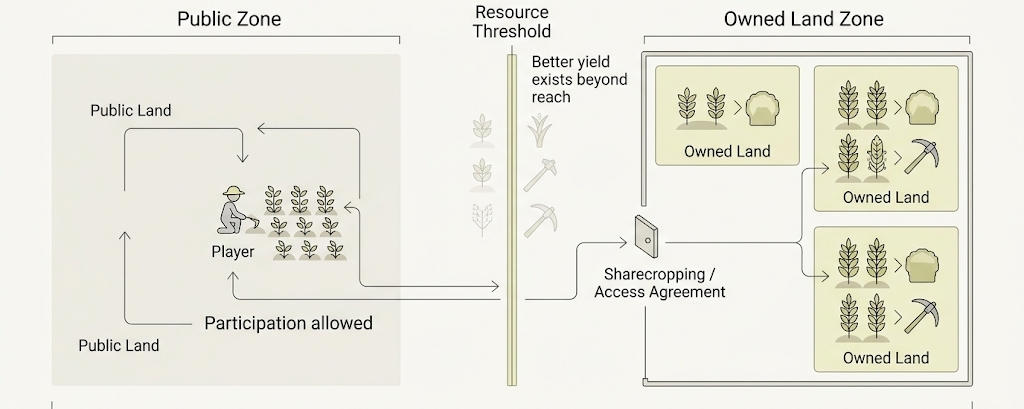
The Pixels Trust Score system sits at that bridge. You don’t just earn and withdraw freely. You build a reputation through activity, quests, engagement, assets—and that determines how easily you can extract value.
It shifts the system from earning to qualifying for extraction.
Underneath that, the economy isn’t a single loop. It’s a set of coordinated pixels systems. Contracts manage how new modules enter, how staking directs capital, and how rewards are distributed. The task board, what looks like a quest system is actually deciding which player actions deserve incentives based on observed behavior.
Which actions matter? Which ones don’t?
That decision moves.
on some point, calling it just an “economy” doesn’t hold. It behaves as a control system, a loop adjusting itself based on what’s happening inside it.
on Pixels is Return on Reward Spend, or RORS. It reads like a metric, but it acts as a condition. If $1 of rewards goes out, the system expects more than $1 in value to come back. If that doesn’t happen, something shifts, rewards recalibrate, flows tighten, distribution adjusts.
It’s less about measuring performance and more about constraining it.
But that introduces another problem. What counts as “value”? Revenue? Retention? Activity? Some combination of all three? And how quickly can the system detect drift?
Those definitions shape how the system reacts.
Inside pixels, RORS only works if behavior can be read clearly. The AI layer handles that, not as a feature, but as interpretation. It processes activity at scale, surfaces patterns, identifies where incentives misalign.
Instead of waiting weeks to understand what’s happening, the system compresses that into a live signal.
Once the signal is visible, the system recalibrates.
Rewards shift. Incentives rebalance. Loops tighten or loosen.
Continuously.
But that assumes the signal itself is reliable. In open pixels systems, it rarely is. Bots, multi-accounting, extraction loops, they don’t just drain value, they distort the feedback the system depends on.
So the problem isn’t just reacting. It’s deciding what to react to.
This is where Trust Score matters again, differently. Not just as a withdrawal gate, but as a filter on signal quality. It determines whose behavior actually influences the system.
Not every action carries equal weight.
A feedback loop is only as good as the signals it listens to.
Then there’s pressure.
Most game economies collapse because everything sits in the same loop. One token, one flow, one surface carrying all activity. High-value and low-value actions compete in the same space, and over time the lower-value activity dominates.
Pixels splits that pressure.
Daily gameplay runs on soft currency, off-chain, infinite, disposable. The grind sits there. The noise sits there. The core token, PIXEL, operates separately, on-chain, capped, tied to ownership, governance, coordination.
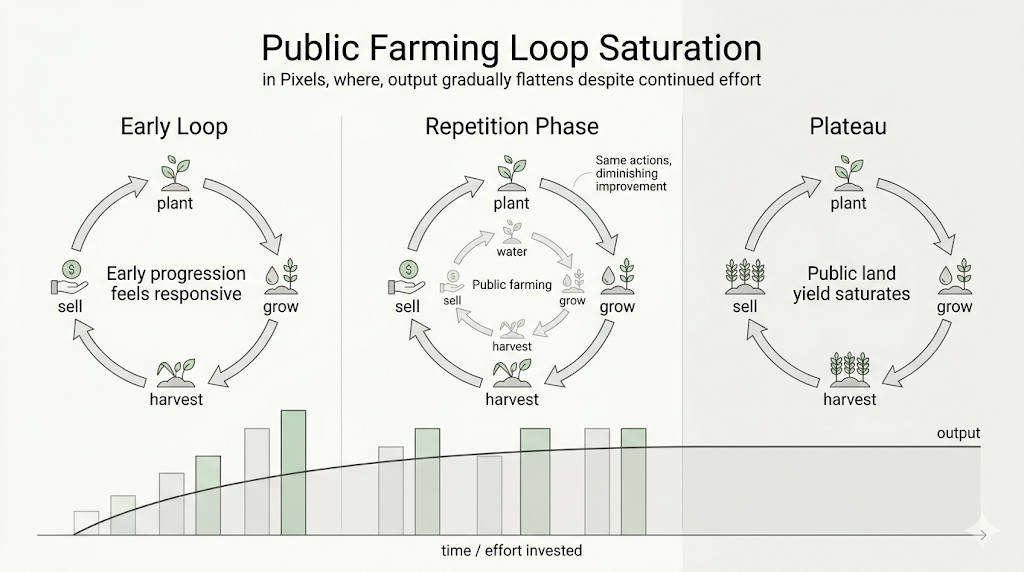
That separation isolates the layers.
Routine activity doesn’t dilute the higher layer. Not every action feeds back into the same system.
Even interoperability follows this logic. External NFT collections can be used directly inside the game as avatars, mapped into the engine without custom integrations. Assets move across experiences, but the same economic rules apply.
Instead of a single loop, the pixels system becomes layered. Rewards flow out, signals return, filters decide what matters, and adjustments follow.
Imperfect, but persistent enough to shape outcomes.
The real test is whether that holds as the system expands.
Because now it’s no longer just one game.
With Stacked, this architecture opens to other games. New loops plug into the same system. Different behaviors, different incentives, different failure modes, all feeding into the same feedback structure.
Can a single control system handle that?
Or does it fragment under conflicting signals?
That remains unresolved.
But the direction is hard to miss.
Game economies don’t fail because they lack rewards. They fail because they can’t adjust. They drift, and by the time they react, it’s too late.
Pixels is trying to remove that lag. Not by designing a perfect system upfront, but by building one that keeps correcting itself.
That changes the problem entirely.
You stop asking how to design a stable economy, and start asking how to design one that doesn’t stay static in the first place.
Whether that works long-term is uncertain. But the idea that an economy should regulate itself instead of relying on periodic fixes, holds weight.
Once you accept that player behavior is unpredictable, sometimes adversarial, and always evolving, the alternative doesn’t hold.
And the question shifts.
Not how to build the perfect system.
But how to build one that doesn’t break when it’s wrong.