
Why I’m actually watching Pixels 👀
I’ve been digging through “play-to-earn” for a while now, and yeah… most of it is still the same recycled loop.
Grind → farm → dump → repeat.
Liquidity comes in, gets extracted, and leaves a graveyard behind.
That’s the model.
And it’s broken.
Because “farming and dumping” isn’t a side effect… it’s the core mechanic in most of these games.
You’re not playing a game.
You’re speedrunning exit liquidity.
I looked at PIXEL thinking it was just another version of that.
At surface level, it kinda is.
Farming sim, token rewards, vibes we’ve all seen before.
But then you start pulling at the threads, and it doesn’t fully collapse into the usual pattern.
The first thing that made me pause was how they’re treating emissions.
Instead of just printing and praying, they’re trying to redirect value back into the ecosystem itself.
Not perfectly.
But intentionally.
And that’s rare.
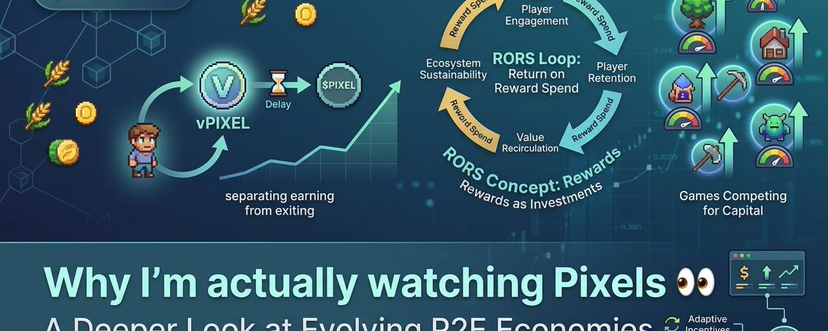
The real pivot, for me, is the introduction of vPIXEL.
At first glance, it looks like your standard soft-lock gimmick.
We’ve seen a hundred versions of this.
“Stake this, lock that, please don’t dump on us.”
But this one actually does something subtle and important.
It separates earning from exiting.
You can still play.
Still earn.
Still feel progression.
But you can’t instantly flip that into sell pressure.
That delay matters more than people think.
Because most P2E economies don’t die from lack of users.
They die from synchronized selling.
Everyone earning the same token, at the same time, with the same incentive… to dump.
It’s not a game loop.
It’s a coordinated bank run.
vPIXEL slows that down without killing motivation.
Not eliminating sell pressure.
Just stretching it.
And sometimes that’s enough to keep an economy from imploding overnight.
Then there’s this RORS concept — Return on Reward Spend.
Honestly, this is the part most people are sleeping on.
Because it sounds boring.
But it’s not.
It’s basically asking a brutally simple question:
“If we spend $1 in rewards… are we getting more than $1 back in value?”
That’s it.
And almost no one in crypto gaming actually answers that.
They just inflate user numbers, pump activity metrics, and call it growth.
Fake growth.
Subsidized engagement.
Temporary hype.
Pixels is at least trying to close that loop.
Rewards go out → players engage → players stick → value comes back → system sustains itself.
If that loop works, even partially, it changes everything.
Because now emissions aren’t just costs.
They’re investments.
And suddenly, games inside the ecosystem aren’t just “reward farms.”
They’re competing for capital.
For attention.
For stake.
You don’t just play anymore.
You choose where your capital goes.
That’s a different dynamic.
Closer to actual markets.
Bad games don’t get propped up forever.
They starve.
Good ones attract more stake.
Simple.
Brutal.
Needed.
There’s also a feedback layer here that most projects ignore.
Player behavior actually influences reward tuning.
Not static emissions.
Not fixed APYs.
Adaptive incentives.
Which sounds obvious… but in Web3, it’s basically unheard of.
Most systems are rigid.
And rigid systems get farmed.
Fast.
Now, I’m not saying this magically solves everything.
It doesn’t.
People will still try to game it.
They always do.
And if RORS assumptions are wrong, or vPIXEL gets bypassed in practice, the whole thing can still unwind like every other P2E graveyard.
That risk is real.
This isn’t “the future of gaming.”
It’s an experiment.
But at least it’s an experiment aimed at the actual problem.
Not just wrapping the same broken loop in better marketing.
And right now, in a space full of copy-paste economies…
That alone is enough to keep me watching.