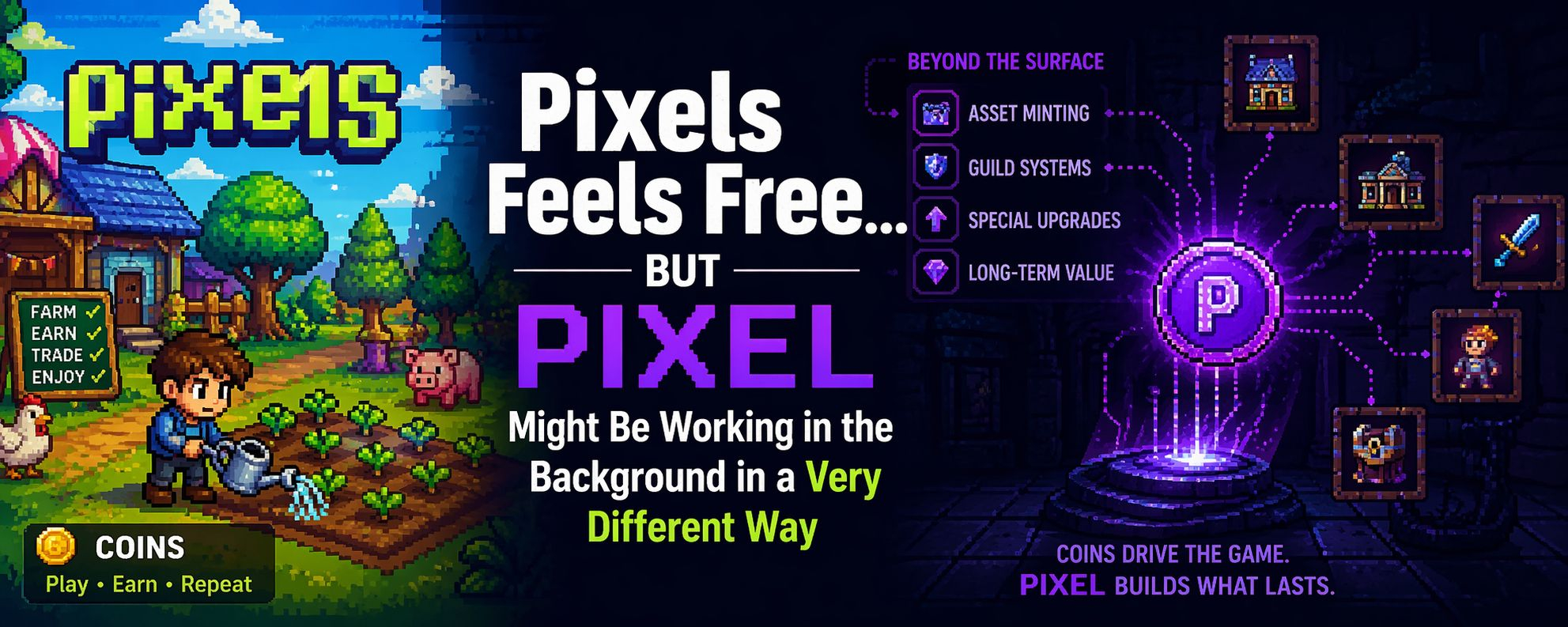

AT First, Pixels doesn’t really feel complicated.
You log in, you play, you farm, you earn Coins, and everything just kind of flows. Nothing feels forced. No constant pressure to spend. No obvious pay or lose wall sitting in your face. Honestly, it just feels like a pretty normal free-to-play game with a Web3 twist.
And that’s exactly why it’s easy to miss what’s actually going on underneath.
Because after spending a bit more time watching how things move inside the game, you start noticing something slightly off—not in a bad way, just… structured differently.
There are two layers happening at the same time.
Coins are everywhere. They’re what you see, what you earn, what you spend constantly. They keep the game running on a day-to-day level. You farm, you use them, and they come back again. It feels active and alive, but also very temporary. Like everything resets emotionally pretty fast.
Then there’s PIXEL.
And it doesn’t show up nearly as much.
It’s not in every action. You don’t feel it in every click. Instead, it appears in specific moments—things like upgrades, minting assets, guild systems, and features where what you do actually sticks longer than just one session.
That difference matters more than it looks at first.
Coins are about movement.
$PIXEL is more about permanence.
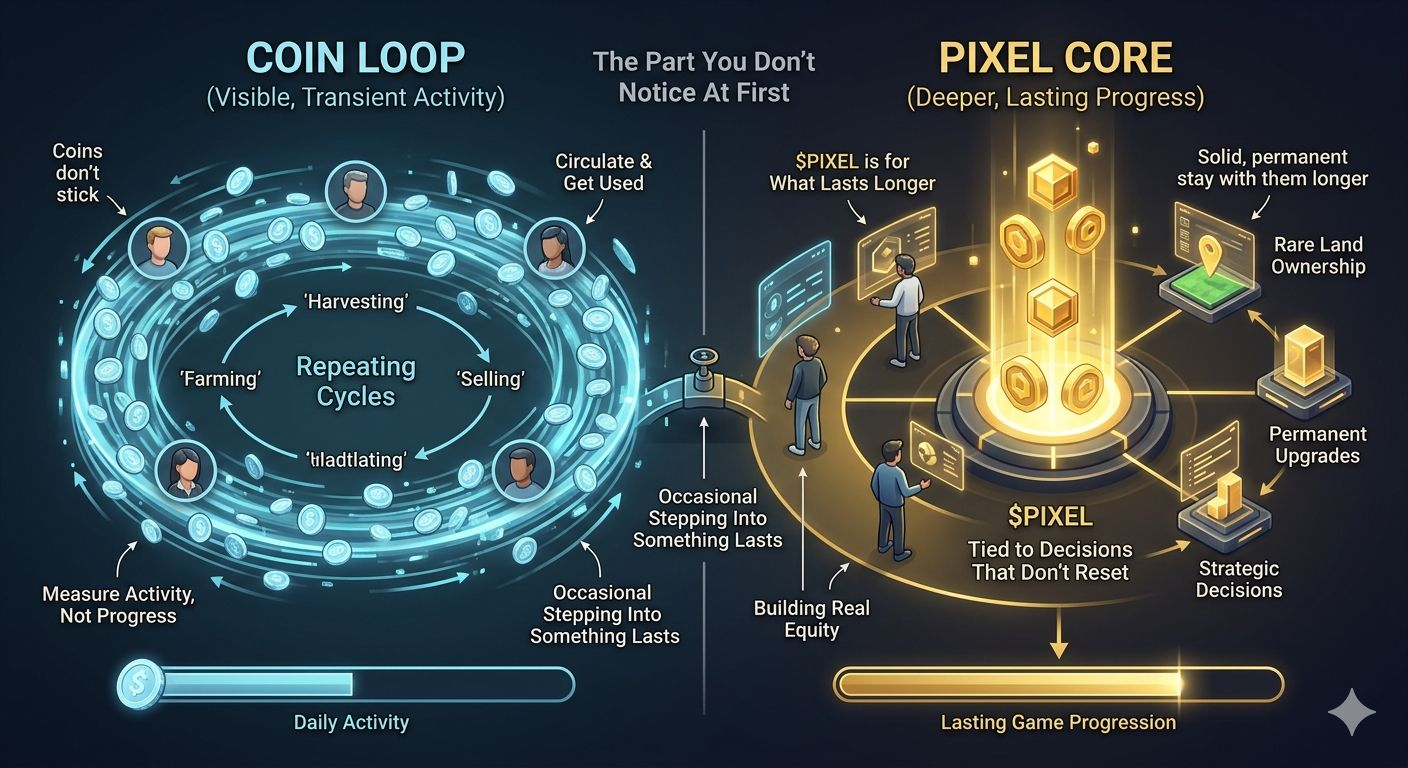
And most players naturally stay in the movement part because that’s where the game feels most active. The part you don’t notice at first
What’s interesting is that Pixels doesn’t push you to think about PIXEL early on.
You can play for a long time without really touching it. The game doesn’t interrupt you or force you into it. So most of your attention stays in the Coin loop, because that’s where everything visible is happening.
Farming, upgrading, repeating cycles that’s the main experience.
But over time, you start noticing that not everything carries the same weight.
Coins don’t really “stick.” They circulate, they get used, and then they’re gone. They measure activity, not lasting progress.
PIXEL, on the other hand, feels like it shows up when something is meant to last longer than a moment. Like it’s tied to decisions that don’t just reset tomorrow.
So even if two players spend the same amount of time in the game, they might not actually be building the same kind of progress. One is staying in the loop. The other is occasionally stepping into something that stays with them longer.
You don’t notice that gap immediately. It builds slowly.
It’s not really pay-to-win… but it’s not totally flat either This is where it gets a bit tricky.
Pixels doesn’t feel like a typical pay-to-win system. You’re not constantly blocked or forced to buy anything. You can play freely for a long time.
But that doesn’t mean everything inside the system carries equal long-term value.
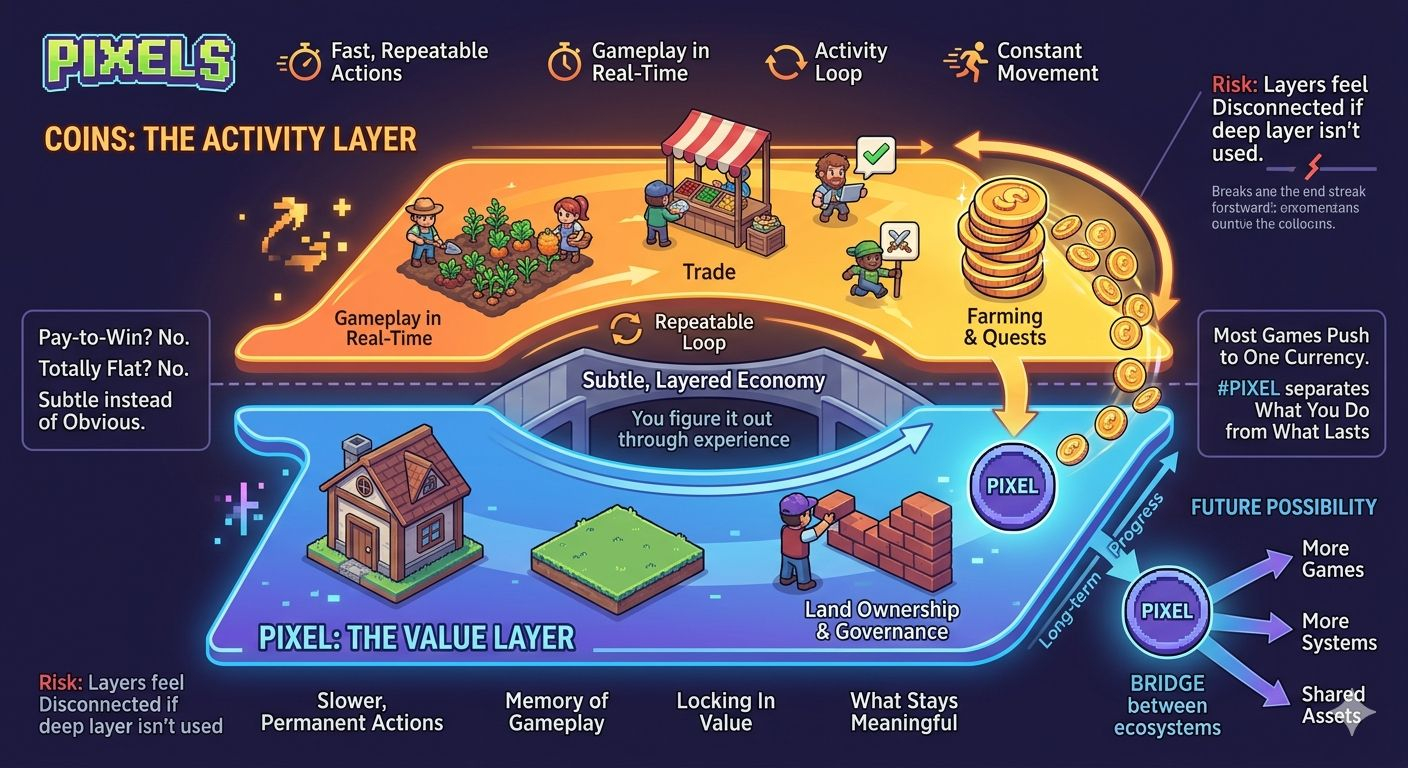
The economy feels split between:
fast, repeatable activity
slower, more permanent actions
And the game doesn’t loudly explain that difference. You kind of figure it out through experience, not tutorials.
That’s why it feels subtle instead of obvious.
Why this design is actually interesting
In most games, everything pushes you toward the same type of currency or reward loop.
#pixel doesn’t fully do that.
Instead, it separates what you do from what lasts.
Coins are for doing things.
PIXEL is for locking things in.
That’s a small difference on paper, but in practice it changes how value moves through the system.
One layer keeps you active.
The other decides what stays meaningful over time.
It almost feels like:
Coins = gameplay in real time
PIXEL = memory of gameplay
The risk no one really talks about
There’s also a catch here, though.
If most players stay in the Coin layer (which is likely), then a big part of the economy is constantly active but not deeply connected to PIXEL.
That creates a kind of split:
A lot of movement on one side
Less engagement on the other
And in systems like this, if the deeper layer doesn’t get enough natural usage, it can start feeling disconnected from the actual gameplay experience of most players.
Not broken—just slightly separate from where people spend most of their time.
That’s something you don’t really notice unless you zoom out. The bigger picture possibility
At the same time, there’s another angle where this structure actually makes sense.
If Pixels expands into more games, more systems, more shared assets… then PIXEL could become the thing that connects everything together.
Coins would stay local—inside each game loop.
PIXEL would travel across systems.
That’s when it stops being “just another token” and starts acting more like a bridge between different parts of the ecosystem.
Right now, it’s not fully there yet. But the structure feels like it’s designed with that direction in mind.
Pixels looks simple when you first play it.
That’s the interesting part.
But under the surface, it’s not actually one clean economy. It’s layered. One layer is all about activity and repetition. The other is about what actually stays after the activity ends.
And depending on which layer you spend most of your time in, your experience of value inside the game can be completely different even if you never really notice it happening.
That’s what makes it worth paying attention to.
Not because it feels complicated…
But because it doesn’t feel complicated at all when you’re inside it.